Quick answer
IUCN status: Least ConcernLesser short-nosed fruit bat at a glance
The Lesser short-nosed fruit bat (Cynopterus brachyotis) is a mammal in the family Pteropodidae. Its IUCN Red List category is Least Concern.
| Scientific name | Cynopterus brachyotis |
|---|---|
| Indonesian name | Codot krawar |
| Group | Mammals |
| Family | Pteropodidae |
| Range in Indonesia | Sumatra, Java, Bali, Kalimantan (Borneo) and Sulawesi |
| Linked habitats | Tropical Rainforests, Mangroves, Urban Habitats |
| Diet | Juice and pulp of soft fruit, nectar, pollen, leaves |
| Range in Indonesia | Sumatra, Java, Bali, Kalimantan and Sulawesi |
| Key feature | Dog-like face, large eyes, white-edged ears |
| Other names | Codot krawar (Indonesian) |
| IUCN status | Least Concern |
| IUCN status | Least Concern · IUCN Red List (via GBIF) · checked 25 September 2026 |
In this guide (10)
What is the lesser short-nosed fruit bat?
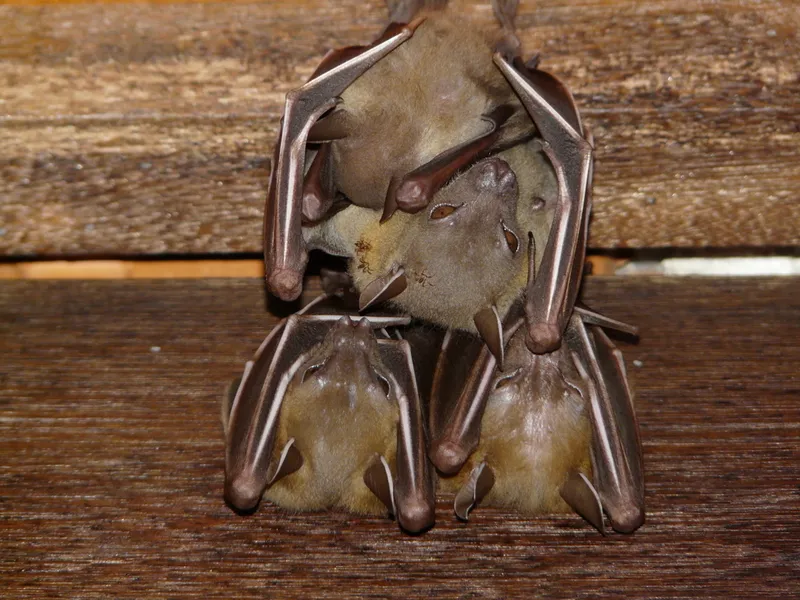
The lesser short-nosed fruit bat (Cynopterus brachyotis) is a small fruit-eating bat of the family Pteropodidae. It has a dog-like face with large dark eyes, brown to yellowish-brown fur, and usually white edges to the ears and wings. Malaysia's MyBIS gives a forearm length of 55–65 mm and an adult weight of about 21–32 g.
Adult males have a dark orange collar and females a yellowish one. Seven Cynopterus species occur in Indonesia, so it is easily confused with relatives such as C. sphinx, which has larger ears on average. Studies have also found two distinct forms, nicknamed 'Sunda' and 'Forest', so its taxonomy is still debated.
Evidence: Malaysia Biodiversity Information System (MyBIS) — Cynopterus brachyotis ↗ · Animal Diversity Web — Cynopterus brachyotis (lesser short-nosed fruit bat) ↗ · Biodiversitas — Mubarok et al. (2021), Karyotype variation in lesser short-nosed fruit bat Cynopterus brachyotis from Special Region Yogyakarta, Indonesia (PDF) ↗
Where does the lesser short-nosed fruit bat live?
In Indonesia the lesser short-nosed fruit bat is recorded on Sumatra, Java, Bali, Kalimantan and Sulawesi. Elsewhere it ranges across Sri Lanka, Southeast Asia and the Philippines. MyBIS calls it one of the commonest and most widespread fruit bats in the region.
It uses many habitats, but most often disturbed and fragmented areas. On Java, researchers caught it in towns, coffee and rubber plantations, pine forest, secondary forest, natural forest and mangroves. In Malaysia it also lives in more mature forest, from the lowlands to the hills.
Evidence: Biodiversitas — Mubarok et al. (2021), Karyotype variation in lesser short-nosed fruit bat Cynopterus brachyotis from Special Region Yogyakarta, Indonesia (PDF) ↗ · Journal of Genetic Engineering and Biotechnology (PMC) — Phylogenetic and genetic variation analysis of Cynopterus brachyotis on Java island, Indonesia (2023) ↗ · Malaysia Biodiversity Information System (MyBIS) — Cynopterus brachyotis ↗
What does the lesser short-nosed fruit bat eat?
The lesser short-nosed fruit bat feeds mainly on small fruits, sucking out the juice and soft pulp and spitting out the seeds and fibre as a flat pellet. A study in Peninsular Malaysia (Tan et al., 1998) recorded fruits of 54 plant species in its diet, including bananas, mango and rose apple (Eugenia jambos).
It also eats the leaves of 14 plant species, flower parts, nectar and pollen, and insect remains are sometimes found in its stomach. On Java, researchers set their nets near Jamaican cherry (Muntingia calabura) and fig (Ficus) trees to catch it.
Evidence: Malaysia Biodiversity Information System (MyBIS) — Cynopterus brachyotis ↗ · Biodiversitas — Mubarok et al. (2021), Karyotype variation in lesser short-nosed fruit bat Cynopterus brachyotis from Special Region Yogyakarta, Indonesia (PDF) ↗ · Journal of Genetic Engineering and Biotechnology (PMC) — Phylogenetic and genetic variation analysis of Cynopterus brachyotis on Java island, Indonesia (2023) ↗
How does the lesser short-nosed fruit bat live and breed?
The lesser short-nosed fruit bat is known as a tent-making bat. According to MyBIS and Animal Diversity Web, dominant males chew the ribs of leaves from eight broad-leaved palm species until they fold into umbrella-like tents, then attract females to them. A group is usually one male with about four females, sometimes up to 20. It also roosts in other trees or bright parts of caves.
Females give birth to a single young, which they carry for more than a month. In Peninsular Malaysia it appears to breed all year round, and pregnant females can be found at any time. Gestation is thought to last about 120 days.
Evidence: Malaysia Biodiversity Information System (MyBIS) — Cynopterus brachyotis ↗ · Animal Diversity Web — Cynopterus brachyotis (lesser short-nosed fruit bat) ↗
How does the lesser short-nosed fruit bat help pollinate plants and spread seeds?
The lesser short-nosed fruit bat disperses the seeds of more than ten plants and helps pollinate them, according to UGM and LIPI researchers. They belong to families such as Anacardiaceae (the mango family), Myrtaceae (the guava family), Fabaceae, Rubiaceae and Loranthaceae. Because it eats fruit from so many plants, Tan et al. (1998) considered it a very important seed disperser.
Fruit bats in general are thought to pollinate many fruit crops. In Gunungkidul, Yogyakarta, a UGM expert quoted by Mongabay Indonesia lists durian, guava, mango, jackfruit and petai as crops that need bat pollination. This species is among the fruit bats recorded in that karst area, at Kalisuci Cave.
Evidence: Biodiversitas — Mubarok et al. (2021), Karyotype variation in lesser short-nosed fruit bat Cynopterus brachyotis from Special Region Yogyakarta, Indonesia (PDF) ↗ · Malaysia Biodiversity Information System (MyBIS) — Cynopterus brachyotis ↗ · Mongabay Indonesia — Bagaimana Nasib Kelelawar, Sang Penyerbuk dan Pengendali Serangga Kala Karst Gunungsewu Terpangkas? (2023) ↗
What should you do if fruit bats visit your home or orchard?
If lesser short-nosed fruit bats visit your garden or home, do not kill them or handle them with bare hands. They can damage some fruit, but they also spread seeds and pollinate flowers. In Luwu, South Sulawesi, some villagers simply hang cans on a rope and pull it to scare bats away during the fruit season.
Researchers note that bats are natural hosts of various viruses, including lyssaviruses. A LIPI researcher advises against eating bats or destroying their habitat. If you are bitten or scratched by a bat, seek medical care at a health facility immediately.
Evidence: Animal Diversity Web — Cynopterus brachyotis (lesser short-nosed fruit bat) ↗ · Mongabay Indonesia — Mengenal Kelelawar, Satwa Penyerbuk Tanaman dan Pengendali Hama (2020) ↗
Explore related habitats
These habitat relationships are supported by species sources in this guide. This is not a complete range map.
Common questions about the Lesser short-nosed fruit bat
What is the scientific name of the Lesser short-nosed fruit bat?
The scientific name of the Lesser short-nosed fruit bat is Cynopterus brachyotis, in the family Pteropodidae. In Indonesian it is called Codot krawar.
Where can the Lesser short-nosed fruit bat be found in Indonesia?
In Indonesia, this guide records the Lesser short-nosed fruit bat in: Sumatra, Java, Bali, Kalimantan (Borneo) and Sulawesi.
Source-supported habitats: Tropical Rainforests, Mangroves, Urban Habitats.
What does the Lesser short-nosed fruit bat eat?
Diet of the Lesser short-nosed fruit bat: juice and pulp of soft fruit, nectar, pollen, leaves.
What is the conservation status of the Lesser short-nosed fruit bat?
On the IUCN Red List, the Lesser short-nosed fruit bat is listed as Least Concern: it does not currently qualify for a threatened category in the global assessment. Source: IUCN Red List (via GBIF), checked 25 September 2026.
This global category is separate from legal protection in Indonesia. To check whether the Lesser short-nosed fruit bat is a protected species, consult the current national list of protected species or contact the local BKSDA (natural resources conservation office).
Sources & references
- Animal Diversity Web — Cynopterus brachyotis (lesser short-nosed fruit bat) ↗
- Malaysia Biodiversity Information System (MyBIS) — Cynopterus brachyotis ↗
- Journal of Genetic Engineering and Biotechnology (PMC) — Phylogenetic and genetic variation analysis of Cynopterus brachyotis on Java island, Indonesia (2023) ↗
- Biodiversitas — Mubarok et al. (2021), Karyotype variation in lesser short-nosed fruit bat Cynopterus brachyotis from Special Region Yogyakarta, Indonesia (PDF) ↗
- Perpustakaan Universitas Indonesia — Studi populasi codot krawar (Cynopterus brachyotis) di Kampus Universitas Indonesia, Depok ↗
- Mongabay Indonesia — Bagaimana Nasib Kelelawar, Sang Penyerbuk dan Pengendali Serangga Kala Karst Gunungsewu Terpangkas? (2023) ↗
- Mongabay Indonesia — Mengenal Kelelawar, Satwa Penyerbuk Tanaman dan Pengendali Hama (2020) ↗
- IUCN Red List of Threatened Species, version 2026-1, via GBIF (CC BY 4.0) ↗
References can change. Check dates and context in the original source.
Cite this page
PanduanHewan. (2026, 25 September). Lesser short-nosed fruit bat (Cynopterus brachyotis). PanduanHewan.org. https://panduanhewan.org/en/species/lesser-short-nosed-fruit-bat/