Quick answer
IUCN status: EndangeredAgile gibbon at a glance
The agile gibbon (Hylobates agilis) is a mammal in the family Hylobatidae. Range in Indonesia: Sumatra, south of Lake Toba. Diet: mainly fruit, plus young leaves, flowers and insects. IUCN Red List status: Endangered. It is a legally protected species in Indonesia (Regulation P.106/2018).
| Scientific name | Hylobates agilis |
|---|---|
| Indonesian name | Owa ungko |
| Group | Mammals |
| Family | Hylobatidae |
| Range in Indonesia | Sumatra, south of Lake Toba |
| Linked habitats | Tropical Rainforests |
| Diet | Mainly fruit, plus young leaves, flowers and insects |
| Range in Indonesia | Sumatra, south of Lake Toba |
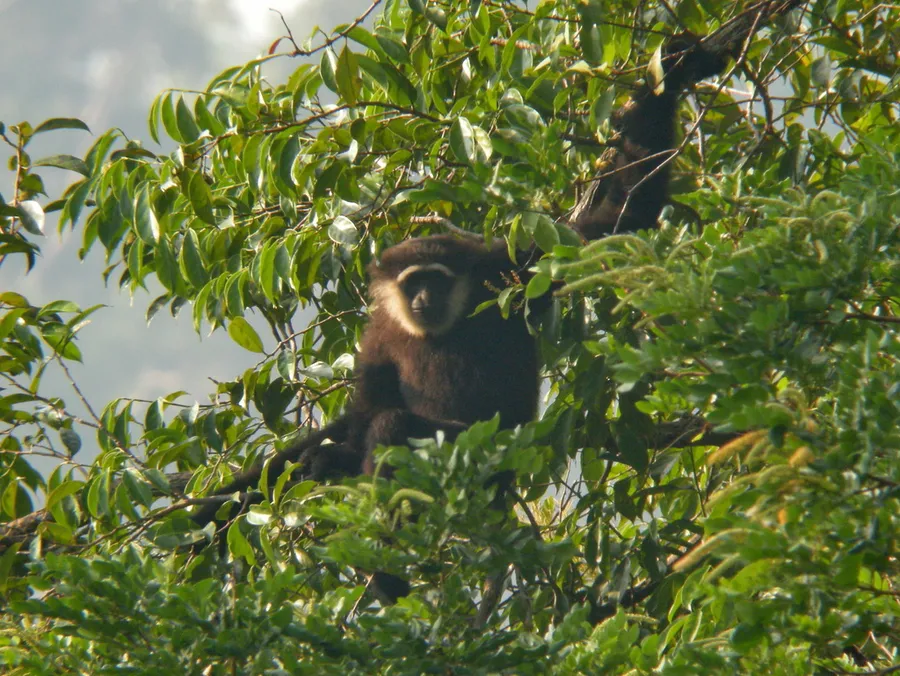
| Key feature | White brow band, dark hands, very long arms |
| Other names | Black-handed gibbon, dark-handed gibbon |
| IUCN status | Endangered · IUCN Red List (via GBIF) · checked 1 October 2026 |
| Legal protection in Indonesia | Protected · Regulation P.106/2018 · annex no. 64 |
| Body length | 44–63.5 cm (tailless) · New England Primate Conservancy — Agile gibbon |
| Oldest recorded age | 49 years (a captive female) · New England Primate Conservancy — Agile gibbon |
| Reproduction | Giving birth to live young (viviparous) · Animal Diversity Web |
| Observance days | Indonesian Primate Day (30 January) |
| Active | Diurnal (active by day) · EltonTraits 1.0 (Wilman et al. 2014, Ecology 95:2027), MamFuncDat.txt |
In this guide (12)
What is the agile gibbon?
The agile gibbon (Hylobates agilis) is a tailless small ape of the gibbon family (Hylobatidae) that lives in the forest canopy. Its arms are about 1.5 times longer than its legs. Fur ranges from pale buff to dark brown, with blond animals typical on Sumatra, but the hands are always dark. A white band across the brow is characteristic, and males also have pale cheeks. The New England Primate Conservancy gives weights of 4.4–7.4 kg for males and 4.5–6.8 kg for females. The Bornean white-bearded gibbon (Hylobates albibarbis) was once treated as a subspecies of the agile gibbon, but genetic analyses separated it as a distinct species.
Evidence: New England Primate Conservancy — Agile gibbon, Hylobates agilis ↗ · New England Primate Conservancy — Bornean white-bearded gibbon, Hylobates albibarbis ↗
Where does the agile gibbon live?
In Indonesia, the agile gibbon lives only on Sumatra, in forests south of Lake Toba; around Toba its range meets that of the lar gibbon (Hylobates lar). Outside Indonesia it also occurs in northern Peninsular Malaysia and southern Thailand. It uses evergreen and semi-deciduous forest, from lowland swamp forest up to montane forest at about 1,400 m. Bukit Barisan Selatan National Park is one of its important strongholds. Older references placing the agile gibbon on Borneo follow the taxonomy used before the white-bearded gibbon was recognised as a separate species.
Evidence: Mongabay — The singing apes of Sumatra need rescuing, too (commentary, 2021) ↗ · New England Primate Conservancy — Agile gibbon, Hylobates agilis ↗ · New England Primate Conservancy — Bornean white-bearded gibbon, Hylobates albibarbis ↗
What does the agile gibbon eat?
The agile gibbon feeds mainly on energy-rich fruit, plus young leaves, flowers and insects. The New England Primate Conservancy reports that about 60% of its nutrition comes from fruit and 39% from young leaves. In fruiting seasons, families stay longer around trees in fruit. In drier months they travel further and eat more leaves and insects. Because it swallows fruit and then moves long distances, the agile gibbon disperses seeds, helping new trees grow away from their parent tree.
Evidence: New England Primate Conservancy — Agile gibbon, Hylobates agilis ↗ · Animal Diversity Web (University of Michigan) — Hylobates agilis, agile gibbon ↗
How do agile gibbons live and sing?
Agile gibbons live in small families, usually a monogamous adult pair with one or two young, and defend their territory by singing. The female gives a “great call” that can be heard about 800 m away, and the male closes it with a coda. Males also sing solo before sunrise. A family's home range covers 16–43 ha, and they may travel up to 1.34 km a day. Females are pregnant for 7–8 months, bear a single infant and typically give birth about once every 3.2 years. Young gibbons reach sexual maturity at around 8 years.
Evidence: New England Primate Conservancy — Agile gibbon, Hylobates agilis ↗ · Ditjen KSDAE (BBKSDA Riau) — Mari mengenal satwa owa ungko ↗
Why is the agile gibbon threatened?
The agile gibbon is threatened mainly by the loss and fragmentation of Sumatra's forests, and by the capture of infants for the pet trade. IUCN lists it as Endangered. Andalas University primatologist Rizaldi told Mongabay Indonesia that gibbon numbers have fallen in lowlands converted to oil palm and rubber. Gibbons will not cross forest gaps wider than 20 m, so they are easily isolated. For each infant traded, usually two to four family members are killed. Slow breeding makes it hard for populations to recover.
Evidence: Mongabay Indonesia — Sebanyak 16 owa dikembalikan ke habitatnya, ancaman perburuan? (2023) ↗ · Mongabay — The singing apes of Sumatra need rescuing, too (commentary, 2021) ↗ · New England Primate Conservancy — Agile gibbon, Hylobates agilis ↗
How can the agile gibbon be protected?
The agile gibbon is protected in Indonesia: it is listed in the annex to Permen LHK P.106/MENLHK/SETJEN/KUM.1/12/2018. Do not buy, keep or accept an infant gibbon as a pet. Former pets are hard to return to the wild: they must be healthy, paired, and released into forest not already occupied by other groups. For example, 16 agile gibbons that had been confiscated or handed in by residents were released by BKSDA West Sumatra in November 2023, after 3–7 years of rehabilitation. If you know of a gibbon being kept or sold, report it to the local BKSDA.
Evidence: JDIH Kementerian Kehutanan — Permen LHK P.106/MENLHK/SETJEN/KUM.1/12/2018 tentang Jenis Tumbuhan dan Satwa yang Dilindungi (PDF, dengan lampiran) ↗ · Mongabay Indonesia — Sebanyak 16 owa dikembalikan ke habitatnya, ancaman perburuan? (2023) ↗ · Mongabay — The singing apes of Sumatra need rescuing, too (commentary, 2021) ↗
Explore related habitats
These habitat relationships are supported by species sources in this guide. This is not a complete range map.
Scientific classification of the Agile gibbon
| Kingdom | Animalia |
|---|---|
| Phylum | Chordata |
| Class | Mammalia |
| Order | Primates |
| Family | Hylobatidae |
| Genus | Hylobates |
| Species | Hylobates agilis |
Source: GBIF Backbone Taxonomy, adjusted to the ranks commonly used in school biology (for example class Reptilia).
Common questions about the agile gibbon
What is the scientific name of the agile gibbon?
The scientific name of the agile gibbon is Hylobates agilis, in the family Hylobatidae. In Indonesian it is called Owa ungko.
Where does the agile gibbon live in Indonesia?
In Indonesia, this guide records the agile gibbon in: Sumatra, south of Lake Toba.
Source-supported habitats: Tropical Rainforests.
What does the agile gibbon eat?
Diet of the agile gibbon: mainly fruit, plus young leaves, flowers and insects.
How does the agile gibbon reproduce?
The agile gibbon reproduces by giving birth to live young (viviparous). Source: Animal Diversity Web.
Is the agile gibbon nocturnal?
The cited source records the agile gibbon as diurnal (active by day). Source: EltonTraits 1.0 (Wilman et al. 2014, Ecology 95:2027), MamFuncDat.txt.
See also the list of nocturnal and diurnal animals in Indonesia.
What are the main features of the agile gibbon?
Key features of the agile gibbon, from this guide’s sources: Key feature: white brow band, dark hands, very long arms; Body length: 44–63.5 cm (tailless).
How big is the agile gibbon?
Body length: 44–63.5 cm (tailless). Source: New England Primate Conservancy — Agile gibbon.
What is the scientific classification of the agile gibbon?
Scientific classification of the agile gibbon: kingdom Animalia, phylum Chordata, class Mammalia, order Primates, family Hylobatidae, genus Hylobates, species Hylobates agilis.
Source: GBIF Backbone Taxonomy, adjusted to the ranks commonly used in school biology.
Is the agile gibbon endangered?
Yes. On the IUCN Red List, the agile gibbon is listed as Endangered: it is considered to face a very high risk of extinction in the wild. Source: IUCN Red List (via GBIF), checked 1 October 2026.
This global category is separate from national legal protection. Is the agile gibbon protected in Indonesia?
Is the agile gibbon protected in Indonesia?
Yes. The agile gibbon (Hylobates agilis) is a protected species in Indonesia under Environment and Forestry Ministerial Regulation No. P.106/MENLHK/SETJEN/KUM.1/12/2018 on protected plant and animal species (annex, entry 64).
Article 21(2) of Law No. 5 of 1990, as amended by Law No. 32 of 2024, prohibits anyone from hunting, catching, injuring, killing, storing, owning, keeping, transporting or trading a protected animal, alive or dead, including its body parts, eggs and nests.
If you see this animal being traded, kept or injured, contact the local BKSDA office.
Can the agile gibbon be kept as a pet?
No. Because the agile gibbon is a protected species, catching, owning, keeping, transporting or trading it without a permit is prohibited by law. Trading without a permit through electronic media is also prohibited.
If you see this animal for sale or being kept, report it to the local BKSDA office.
Sources & references
- New England Primate Conservancy — Agile gibbon, Hylobates agilis ↗
- New England Primate Conservancy — Bornean white-bearded gibbon, Hylobates albibarbis ↗
- Animal Diversity Web (University of Michigan) — Hylobates agilis, agile gibbon ↗
- Mongabay — The singing apes of Sumatra need rescuing, too (commentary, 2021) ↗
- Mongabay Indonesia — Sebanyak 16 owa dikembalikan ke habitatnya, ancaman perburuan? (2023) ↗
- Ditjen KSDAE (BBKSDA Riau) — Mari mengenal satwa owa ungko ↗
- JDIH Kementerian Kehutanan — Permen LHK P.106/MENLHK/SETJEN/KUM.1/12/2018 tentang Jenis Tumbuhan dan Satwa yang Dilindungi (PDF, dengan lampiran) ↗
- Animal Diversity Web ↗
- EltonTraits 1.0 (Wilman et al. 2014, Ecology 95:2027), MamFuncDat.txt ↗
- GBIF Backbone Taxonomy (GBIF) ↗
- IUCN Red List of Threatened Species, version 2026-1, via GBIF (CC BY 4.0) ↗
References can change. Check dates and context in the original source. How we use sources and data →
National parks where it is recorded
According to the official national park profiles from the KSDAE directorate. The animal may also live elsewhere.
Further reading
Gibbon: facts, threats and conservation ↗ — World Animal Rescue Network. A broader overview that covers this animal.
Related site: PanduanHewan’s founder is also a director of World Animal Rescue Network.
Cite this page
Credit PanduanHewan when referring to this page. Check the original evidence sources before reusing a claim.
PanduanHewan. Agile gibbon (Hylobates agilis). Last substantive update: 1 October 2026. https://panduanhewan.org/en/species/agile-gibbon/