Quick answer
IUCN status: Data DeficientJavan mouse-deer at a glance
The Javan mouse-deer (Tragulus javanicus) is a mammal in the family Tragulidae. Its IUCN Red List category is Data Deficient.
| Scientific name | Tragulus javanicus |
|---|---|
| Indonesian name | Kancil jawa |
| Group | Mammals |
| Family | Tragulidae |
| Range in Indonesia | Java and a few small nearby islands |
| Linked habitats | Tropical Rainforests |
| Diet | Mainly fruit, plus leaves and young shoots |
| Range in Indonesia | Java and a few small nearby islands |
| Key feature | No antlers; adult males have long upper canines |
| Other names | Javan chevrotain, pelanduk kancil, kancil |
| IUCN Red List status | Data Deficient (2015 assessment) |
| Legal protection in Indonesia | Protected (Ministerial Regulation P.106/2018) |
| IUCN status | Data Deficient · IUCN Red List (via GBIF) · checked 25 September 2026 |
In this guide (10)

What is the Javan mouse-deer?
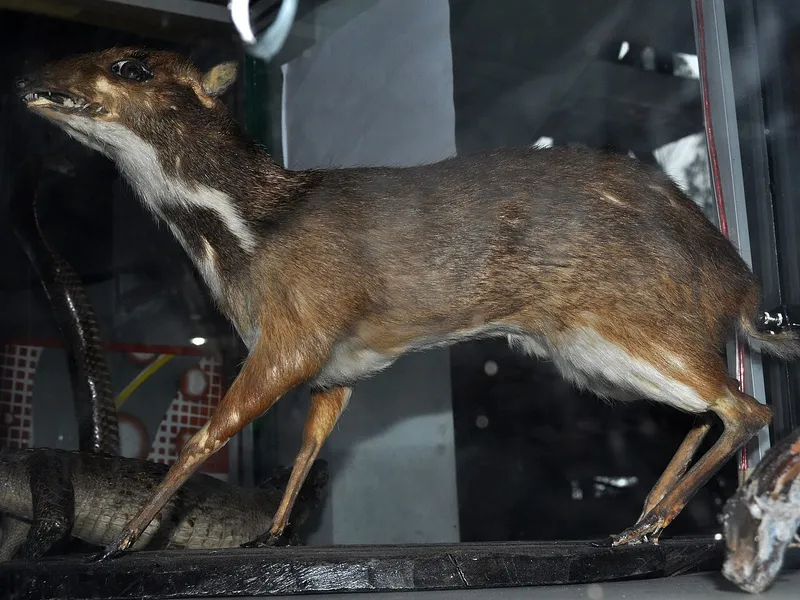
The Javan mouse-deer (Tragulus javanicus) is a tiny, antlerless chevrotain found only on Java. Ultimate Ungulate gives a head-and-body length of 40–45 cm, a shoulder height of 25–30 cm and a weight of about 2 kg. The coat is reddish-brown with white underparts, and three white stripes run from the chin down the throat. Adult males have long upper canines that can protrude past the lip. Since a 2004 taxonomic revision, the name T. javanicus has applied only to Java's lesser mouse-deer; those in Sumatra and Borneo are now Tragulus kanchil. Unlike the muntjac, it has no antlers at all.
Evidence: Ultimate Ungulate — Javan chevrotain (Tragulus javanicus) fact sheet ↗ · Mammal Diversity Database (ASM) — Tragulus kanchil, Lesser Indo-Malayan Chevrotain ↗ · Biodiversitas — Farida et al. (2003), Habitat dan keragaman tumbuhan pakan kancil (Tragulus javanicus) dan kijang (Muntiacus muntjak) di Cagar Alam Nusakambangan ↗
Where does the Javan mouse-deer live?
The Javan mouse-deer lives only in the forests of Java and a few small nearby islands; its presence on Bali is unconfirmed. Ultimate Ungulate notes that it favours forest with a dense, brushy understorey, often near rivers, from sea level to 1,150 m or even 1,600 m. In the Nusakambangan nature reserve near Cilacap, LIPI researchers found it in thick scrub with deep leaf litter and under salak palms, usually close to a river. In Gunung Halimun National Park, West Java, it was recorded up to 1,100 m, using dense bush, rock crevices, tree hollows and even overgrown tea plantations.
Evidence: Ultimate Ungulate — Javan chevrotain (Tragulus javanicus) fact sheet ↗ · Biodiversitas — Farida et al. (2003), Habitat dan keragaman tumbuhan pakan kancil (Tragulus javanicus) dan kijang (Muntiacus muntjak) di Cagar Alam Nusakambangan ↗ · Tropics (J-STAGE) — Farida et al. (2006), Habitat distribution and diversity of plants as feed resources for mouse deer and barking deer in Gunung Halimun National Park ↗
What does the Javan mouse-deer eat?
The Javan mouse-deer feeds mainly on fruit, along with leaves and young shoots. On Nusakambangan, Farida and colleagues (2003) recorded 14 food plants, mostly fruits, including several figs (Ficus), wild salak palm and the seeds of mresak (Amomum). Muntjacs in the same forest chose mainly leaves. In Gunung Halimun, a second study listed 50 food plants for mouse-deer and muntjac, 44 of them eaten by mouse-deer. Both studies found that the animals feed mostly at night and in the early morning. Their tiny hooves leave few tracks, so researchers more often find droppings.
Evidence: Ultimate Ungulate — Javan chevrotain (Tragulus javanicus) fact sheet ↗ · Biodiversitas — Farida et al. (2003), Habitat dan keragaman tumbuhan pakan kancil (Tragulus javanicus) dan kijang (Muntiacus muntjak) di Cagar Alam Nusakambangan ↗ · Tropics (J-STAGE) — Farida et al. (2006), Habitat distribution and diversity of plants as feed resources for mouse deer and barking deer in Gunung Halimun National Park ↗
How does the Javan mouse-deer behave and breed?
The Javan mouse-deer is shy and usually solitary, occasionally seen in pairs. According to Ultimate Ungulate, camera traps show it is active by day and by night. It rests in hollow tree trunks and often uses footpaths through dense brush. It normally moves slowly with a low, slinking gait, but if startled at close range it bounds away with its tail raised, flashing the white underside. Little is known about its breeding. Gestation lasts 132–134 days and usually produces one young, although twins are known. Captive births in Java have been recorded in several different months, suggesting year-round breeding.
Evidence: Ultimate Ungulate — Javan chevrotain (Tragulus javanicus) fact sheet ↗
How is the Javan mouse-deer linked to the Si Kancil folk tales?
Si Kancil, the clever hero of Indonesian animal fables, is a mouse-deer, and the stories have long been told in Java, the Javan mouse-deer's home island. According to the history magazine Historia, Kancil tales existed in Java before the island had a written tradition and were often used to teach children. The folklorist James Danandjaja classed Kancil as a trickster figure. The oldest known written version is the Serat Kancil Amongsastra by Kyai Rangga Amongsastra of Surakarta, composed in 1822 and printed in 1878. The tales do not name a species, but Java's small mouse-deer is now recognised as Tragulus javanicus.
Evidence: Historia.id — Di Balik Cerdik Licik Si Kancil ↗ · Ultimate Ungulate — Javan chevrotain (Tragulus javanicus) fact sheet ↗
How can the Javan mouse-deer be protected?
The Javan mouse-deer is protected in Indonesia, so the most important step is not to hunt, buy, sell or keep one. Tragulus javanicus is listed as ‘pelanduk kancil’ in the annex of Ministerial Regulation P.106/2018 on protected species. Its main threats are forest loss and fragmentation, and hunting. The IUCN Red List assessed it as Data Deficient in 2015, and no population estimate exists. In 2017, the Central Java conservation agency (BKSDA) arrested a Cilacap man for selling a mouse-deer, and officers still detect hunters seeking mouse-deer on Nusakambangan. Report any trade to the local BKSDA, and hand over captive animals to officers.
Evidence: JDIH Kemenko Infrastruktur — Permen LHK P.106/MENLHK/SETJEN/KUM.1/12/2018 tentang Jenis Tumbuhan dan Satwa yang Dilindungi (PDF) ↗ · Ultimate Ungulate — Javan chevrotain (Tragulus javanicus) fact sheet ↗ · Mongabay Indonesia — Kasus Perburuan dan Perdagangan Satwa Liar Masih Marak Terjadi (2017) ↗
Explore related habitats
These habitat relationships are supported by species sources in this guide. This is not a complete range map.
Common questions about the Javan mouse-deer
What is the scientific name of the Javan mouse-deer?
The scientific name of the Javan mouse-deer is Tragulus javanicus, in the family Tragulidae. In Indonesian it is called Kancil jawa.
Where can the Javan mouse-deer be found in Indonesia?
In Indonesia, this guide records the Javan mouse-deer in: Java and a few small nearby islands.
Source-supported habitats: Tropical Rainforests.
What does the Javan mouse-deer eat?
Diet of the Javan mouse-deer: mainly fruit, plus leaves and young shoots.
What is the conservation status of the Javan mouse-deer?
On the IUCN Red List, the Javan mouse-deer is listed as Data Deficient: there is not enough information to assess its extinction risk. Source: IUCN Red List (via GBIF), checked 25 September 2026.
This global category is separate from legal protection in Indonesia. To check whether the Javan mouse-deer is a protected species, consult the current national list of protected species or contact the local BKSDA (natural resources conservation office).
Sources & references
- Ultimate Ungulate — Javan chevrotain (Tragulus javanicus) fact sheet ↗
- Mammal Diversity Database (ASM) — Tragulus kanchil, Lesser Indo-Malayan Chevrotain ↗
- Biodiversitas — Farida et al. (2003), Habitat dan keragaman tumbuhan pakan kancil (Tragulus javanicus) dan kijang (Muntiacus muntjak) di Cagar Alam Nusakambangan ↗
- Tropics (J-STAGE) — Farida et al. (2006), Habitat distribution and diversity of plants as feed resources for mouse deer and barking deer in Gunung Halimun National Park ↗
- Historia.id — Di Balik Cerdik Licik Si Kancil ↗
- Mongabay Indonesia — Kasus Perburuan dan Perdagangan Satwa Liar Masih Marak Terjadi (2017) ↗
- JDIH Kemenko Infrastruktur — Permen LHK P.106/MENLHK/SETJEN/KUM.1/12/2018 tentang Jenis Tumbuhan dan Satwa yang Dilindungi (PDF) ↗
- IUCN Red List of Threatened Species, version 2026-1, via GBIF (CC BY 4.0) ↗
References can change. Check dates and context in the original source.
Further reading
Chevrotain: facts, threats and conservation ↗ — World Animal Rescue Network. A broader overview that covers this animal.
Cite this page
PanduanHewan. (2026, 25 September). Javan mouse-deer (Tragulus javanicus). PanduanHewan.org. https://panduanhewan.org/en/species/javan-mouse-deer/