Quick answer
IUCN status: VulnerableBearded pig at a glance
The Bearded pig (Sus barbatus) is a mammal in the family Suidae. Its IUCN Red List category is Vulnerable.
| Scientific name | Sus barbatus |
|---|---|
| Indonesian name | Babi berjenggot |
| Group | Mammals |
| Family | Suidae |
| Range in Indonesia | Borneo (Kalimantan) and Sumatra |
| Linked habitats | Tropical Rainforests, Mangroves |
| Diet | Omnivore: dipterocarp seeds, fruit, roots, earthworms, carrion |
| Range in Indonesia | Kalimantan, Sumatra and some smaller islands |
| Key feature | Bristly beard on jaw and snout, long head |
| Other names | Sunda bearded pig, Bornean bearded pig |
| IUCN status | Vulnerable, assessed before the African swine fever outbreak |
| IUCN status | Vulnerable · IUCN Red List (via GBIF) · checked 25 September 2026 |
In this guide (10)
What is the bearded pig?
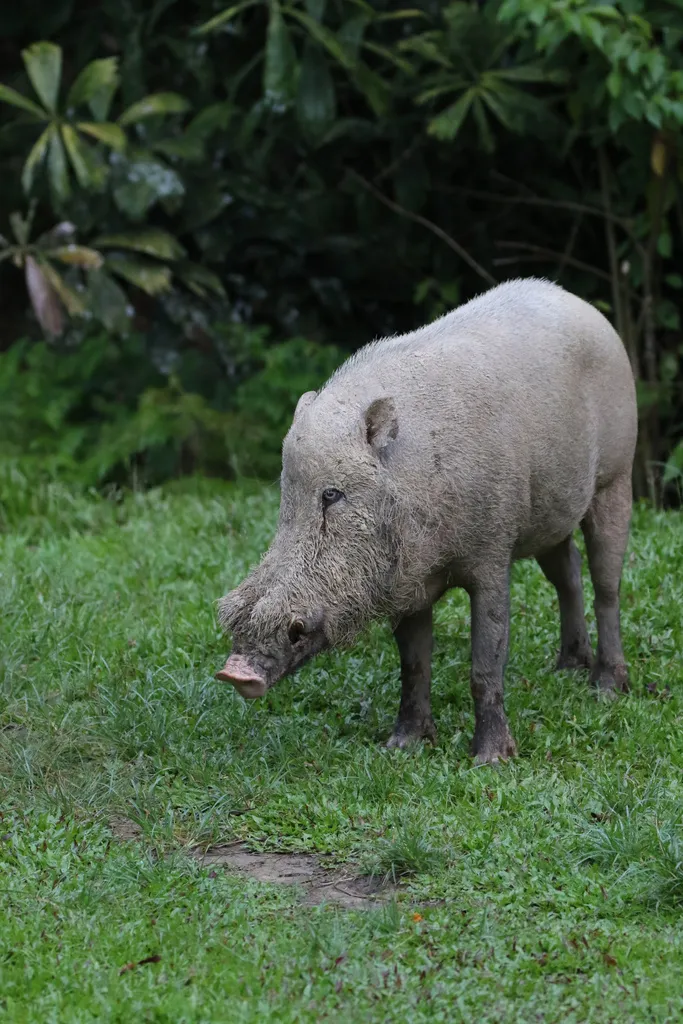
The bearded pig (Sus barbatus) is a long-legged wild pig with an elongated head and a “beard” of coarse bristles along the lower jaw and across the snout. Young animals are blackish, while adults range from reddish brown to yellow-grey or almost white. Piglets are striped lengthwise, and the stripes fade by about six months. The IUCN Wild Pig Specialist Group gives a usual weight of 58–83 kg, rising to 200 kg when food is plentiful. It recognises two subspecies: S. b. barbatus on Borneo and nearby islands, and S. b. oi on Sumatra and the Malay Peninsula.
Evidence: IUCN SSC Wild Pig Specialist Group — Sunda bearded pig (detailed profile) ↗ · ASM Mammal Diversity Database — Sus barbatus, bearded pig ↗
Where does the bearded pig live?
In Indonesia, bearded pigs live on Borneo (Kalimantan) and Sumatra, and have been recorded on smaller islands such as Karimata and Laut. On Borneo the species is still widespread but declining; on Sumatra it now occupies only a small part of its former range. Its core habitat is lowland and hill dipterocarp forest, but it also uses riverbanks, estuarine swamps, beaches, secondary forest and plantations. It is the only wild pig on Borneo. On Sumatra it shares its range with the Eurasian wild boar (Sus scrofa), which is now more widespread.
Evidence: IUCN SSC Wild Pig Specialist Group — Sunda bearded pig (detailed profile) ↗ · Animals (Daniel et al. 2025, via PubMed Central) — Rapid spread of African swine fever across Borneo ↗
What does the bearded pig eat?
The bearded pig is a true omnivore that eats almost anything, with forest seeds and fruit as its most important foods. Oil-rich seeds of dipterocarps and of the oak family (Fagaceae, such as Castanopsis, Lithocarpus and Quercus) matter most, especially in mast-fruiting years. It also roots for earthworms and roots along riverbanks, and eats fungi, invertebrates in rotting wood, small vertebrates, turtle eggs and carrion. ADW notes that bearded pigs often follow macaques to pick up dropped fruit. By eating and spreading seeds, they shape how forests regenerate.
Evidence: IUCN SSC Wild Pig Specialist Group — Sunda bearded pig (detailed profile) ↗ · Animal Diversity Web (University of Michigan) — Sus barbatus, bearded pig ↗
Why do bearded pigs migrate?
Bearded pigs are known for mass migrations linked to the mast fruiting of dipterocarp trees. When fruit is abundant, herds move from mountains and swamps to drier lowland forest, and they cross rivers in groups of more than 100. They are strong swimmers and have even been reported crossing sea channels. Mating appears to coincide with synchronised flowering in the forest, and females build nests of vegetation to give birth. The Wild Pig Specialist Group notes that litter size varies widely: 3–4 piglets for small mothers and 10–12 for large ones.
Evidence: IUCN SSC Wild Pig Specialist Group — Sunda bearded pig (detailed profile) ↗ · Animal Diversity Web (University of Michigan) — Sus barbatus, bearded pig ↗
How has African swine fever affected the bearded pig?
African swine fever (ASF) has caused mass deaths of bearded pigs on Borneo since late 2020. A 2025 study by Daniel and colleagues in the journal Animals records the first deaths in bearded pigs in Sabah in December 2020. The virus then spread across almost the whole island within about a year. In Kalimantan, the first pig deaths were reported in May 2021 in North and East Kalimantan. An estimate cited in the study suggests about 90% of Sabah's bearded pigs disappeared. ASF does not infect people, but there is no vaccine or cure.
How can the bearded pig be protected?
Protecting the bearded pig depends on large areas of dipterocarp forest, controlled hunting and preventing the spread of disease. Before the ASF outbreak, IUCN already listed it as Vulnerable because of forest loss and heavy hunting. The authors of the ASF study recommend keeping existing hunting bans, tightening biosecurity where outbreaks reach backyard pig farms, and urgently reassessing its IUCN status. ASF spreads through contact with sick pigs and contaminated meat. If you find a dead wild pig, do not touch it or take its meat, and report it to local animal health officers.
Evidence: Animals (Daniel et al. 2025, via PubMed Central) — Rapid spread of African swine fever across Borneo ↗ · IUCN SSC Wild Pig Specialist Group — Sunda bearded pig (detailed profile) ↗ · Mongabay — Southeast Asian wild pigs confront deadly African swine fever epidemic (2021) ↗
Explore related habitats
These habitat relationships are supported by species sources in this guide. This is not a complete range map.
Common questions about the Bearded pig
What is the scientific name of the Bearded pig?
The scientific name of the Bearded pig is Sus barbatus, in the family Suidae. In Indonesian it is called Babi berjenggot.
Where can the Bearded pig be found in Indonesia?
In Indonesia, this guide records the Bearded pig in: Borneo (Kalimantan) and Sumatra.
Source-supported habitats: Tropical Rainforests, Mangroves.
What does the Bearded pig eat?
Diet of the Bearded pig: omnivore: dipterocarp seeds, fruit, roots, earthworms, carrion.
What is the conservation status of the Bearded pig?
On the IUCN Red List, the Bearded pig is listed as Vulnerable: it is considered to face a high risk of extinction in the wild. Source: IUCN Red List (via GBIF), checked 25 September 2026.
This global category is separate from legal protection in Indonesia. To check whether the Bearded pig is a protected species, consult the current national list of protected species or contact the local BKSDA (natural resources conservation office).
Sources & references
- IUCN SSC Wild Pig Specialist Group — Sunda bearded pig (detailed profile) ↗
- Animals (Daniel et al. 2025, via PubMed Central) — Rapid spread of African swine fever across Borneo ↗
- Animal Diversity Web (University of Michigan) — Sus barbatus, bearded pig ↗
- ASM Mammal Diversity Database — Sus barbatus, bearded pig ↗
- Mongabay — Southeast Asian wild pigs confront deadly African swine fever epidemic (2021) ↗
- IUCN Red List of Threatened Species, version 2026-1, via GBIF (CC BY 4.0) ↗
References can change. Check dates and context in the original source.
Further reading
Bornean bearded pig: facts, threats and conservation ↗ — World Animal Rescue Network.
Cite this page
PanduanHewan. (2026, 25 September). Bearded pig (Sus barbatus). PanduanHewan.org. https://panduanhewan.org/en/species/bearded-pig/