Quick answer
IUCN status: VulnerableAsian small-clawed otter at a glance
The Asian small-clawed otter (Aonyx cinereus) is a mammal in the family Mustelidae. Range in Indonesia: Sumatra, Java and Borneo. Diet: crabs, shrimps, snails, shellfish, small fish, frogs and insects; a carnivore. IUCN Red List status: Vulnerable.
| Scientific name | Aonyx cinereus |
|---|---|
| Indonesian name | Berang-berang cakar kecil |
| Group | Mammals |
| Family | Mustelidae |
| Range in Indonesia | Sumatra, Java and Borneo |
| Linked habitats | Freshwater Wetlands, Mangroves |
| Diet | Crabs, shrimps, snails, shellfish, small fish, frogs and insects |
| Range in Indonesia | Sumatra, Java and Borneo |
| Key feature | World's smallest otter; short claws and very nimble hands |
| Other names | Oriental small-clawed otter, sero ampang, Lutra cinerea |
| Conservation status | Vulnerable (IUCN); CITES Appendix I since 2019 |
| IUCN status | Vulnerable · IUCN SSC Otter Specialist Group — Aonyx cinereus |
| Lifespan | Up to 12 years in human care, some over 20 years; wild lifespan unknown · Smithsonian's National Zoo and Conservation Biology Institute — Asian small-clawed otter |
| Diet type | Carnivore (meat-eater) — crabs, clams and other small aquatic animals (crustaceans and molluscs) · Animal Diversity Web |
| Reproduction | Giving birth to live young (viviparous) · Animal Diversity Web |
| Active | Diurnal (active by day) — Reported to become nocturnal or crepuscular when living close to people. · Handbook of the Mammals of the World, Vol. 1 Carnivores (Wilson & Mittermeier eds., Lynx Edicions 2009), Mustelidae: Aonyx cinereus account (Plazi treatment) |
In this guide (12)
What is the Asian small-clawed otter?
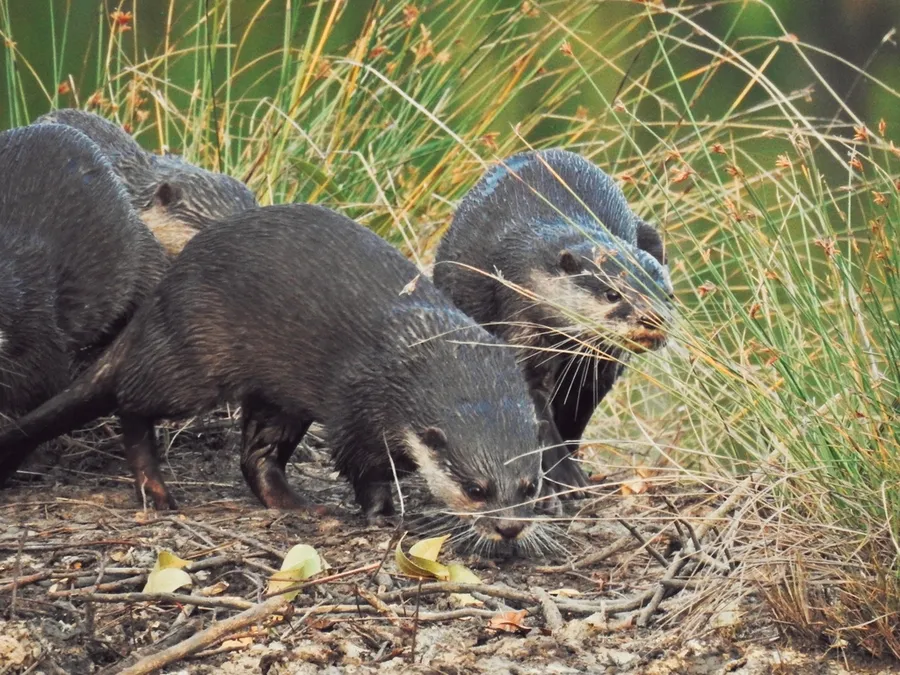
The Asian small-clawed otter (Aonyx cinereus) is the smallest of the world's 13 otter species. The IUCN SSC Otter Specialist Group gives a total length of 65–94 cm, including a 25–35 cm tail, and a weight of 2–5 kg. It is dark brown above and paler below, often with grey or white markings on the face and throat. True to its name, its claws are short and do not reach beyond the finger pads, and its fingers are only partly webbed, which makes its hands very dexterous. The Mammal Diversity Database now places it in Lutra, as Lutra cinerea, but IUCN and CITES still use Aonyx cinereus.
Evidence: IUCN SSC Otter Specialist Group — Aonyx cinereus ↗ · Smithsonian's National Zoo and Conservation Biology Institute — Asian small-clawed otter ↗ · Mammal Diversity Database (ASM) — Lutra cinerea, Asian Small-clawed Otter ↗
Where does the Asian small-clawed otter live?
In Indonesia, the Asian small-clawed otter lives in Sumatra, Java and Borneo, in rivers, lakes, swamps, rice fields and mangrove forests. An article by a conservation cadre of the South Sumatra conservation agency, published by the forestry ministry's KSDAE directorate, calls it native to Sumatra and notes its liking for sandy, grassy rivers, where family groups dig dens in the banks. The IUCN SSC Otter Specialist Group describes it as highly adaptable, from fast streams in Thailand to still pools in West Java, swamps, paddies, peat and mangroves. When foraging, it roams further from water than other Asian otters.
Evidence: Ditjen KSDAE — Aonyx cinereus si Berang-Berang Cakar Kecil Penghuni Sungai Sumatera ↗ · IUCN SSC Otter Specialist Group — Aonyx cinereus ↗ · Smithsonian's National Zoo and Conservation Biology Institute — Asian small-clawed otter ↗
What does the Asian small-clawed otter eat?
The Asian small-clawed otter feeds mainly on crabs, shrimps and other crustaceans, plus snails, shellfish, small fish and insects. Unlike most otters, it catches food with its hands rather than its mouth. Smithsonian's National Zoo explains that its sensitive finger pads let it feel for prey under rocks or in murky water, and it cracks shells with its hands or its broad, strong teeth. The South Sumatra conservation article also lists frogs, snakes and small mammals as prey. Because it eats crabs that are pests in rice paddies, some rice farmers regard it as an asset.
Evidence: IUCN SSC Otter Specialist Group — Aonyx cinereus ↗ · Smithsonian's National Zoo and Conservation Biology Institute — Asian small-clawed otter ↗ · Ditjen KSDAE — Aonyx cinereus si Berang-Berang Cakar Kecil Penghuni Sungai Sumatera ↗
How do Asian small-clawed otters live and breed?
Asian small-clawed otters live in family groups made up of a lifelong breeding pair and their young. The South Sumatra conservation article reports groups of 5–12, and the IUCN SSC Otter Specialist Group notes that groups of up to 20 are sometimes seen. According to Smithsonian's National Zoo, pregnancy lasts 68–72 days and produces one to six pups, typically twice a year. The whole family helps to feed and raise the young. The species is also very vocal, with at least twelve different calls, and marks its range with scent from glands at the base of the tail, often at shared latrines.
Evidence: Ditjen KSDAE — Aonyx cinereus si Berang-Berang Cakar Kecil Penghuni Sungai Sumatera ↗ · IUCN SSC Otter Specialist Group — Aonyx cinereus ↗ · Smithsonian's National Zoo and Conservation Biology Institute — Asian small-clawed otter ↗
Why are Asian small-clawed otters traded as pets?
Asian small-clawed otters are taken for the pet trade because they are small and look cute, and they are widely sold on social media. A 2018 report by TRAFFIC and the IUCN SSC Otter Specialist Group found at least 560 online adverts offering 734–1,189 otters in Indonesia, Malaysia, the Philippines and Thailand between January and April 2017. On average, 711 of these were offered in Indonesia. Over 70% were under a year old, and small-clawed otters were the most traded species, with at least 700 animals. Mothers may be killed so their cubs can be taken. Japan has been identified as a smuggling destination.
Evidence: TRAFFIC — Illegal otter trade in Southeast Asia (2018) ↗ · Mongabay Indonesia — Nasib Berang-berang, Terancam Punah di Alam Liar (2024) ↗ · Ditjen KSDAE — Aonyx cinereus si Berang-Berang Cakar Kecil Penghuni Sungai Sumatera ↗
How can the Asian small-clawed otter be protected?
The most important way to protect the Asian small-clawed otter is not to buy, keep or promote pet otters on social media. Since the CITES CoP18 meeting in Geneva in 2019, the species has been listed on Appendix I, which bans international commercial trade in wild-caught animals. The IUCN Red List classes it as Vulnerable and declining. Otter cubs are hard to hand-rear and catch the same diseases as cats and dogs. Other threats include the loss of rivers and wetlands, pollution, and conflict with people who see otters as pests. Keep rivers clean and report wildlife sales to the local BKSDA.
Evidence: Monitor Conservation Research Society — Otters at CITES CoP18: Stronger protection from over-exploitation (2019) ↗ · TRAFFIC — Illegal otter trade in Southeast Asia (2018) ↗ · Ditjen KSDAE — Aonyx cinereus si Berang-Berang Cakar Kecil Penghuni Sungai Sumatera ↗
Explore related habitats
These habitat relationships are supported by species sources in this guide. This is not a complete range map.
Scientific classification of the Asian small-clawed otter
| Kingdom | Animalia |
|---|---|
| Phylum | Chordata |
| Class | Mammalia |
| Order | Carnivora |
| Family | Mustelidae |
| Genus | Aonyx |
| Species | Aonyx cinereus |
Source: GBIF Backbone Taxonomy, adjusted to the ranks commonly used in school biology (for example class Reptilia).
Common questions about the Asian small-clawed otter
What is the scientific name of the Asian small-clawed otter?
The scientific name of the Asian small-clawed otter is Aonyx cinereus, in the family Mustelidae. In Indonesian it is called Berang-berang cakar kecil.
What kind of animal is the Asian small-clawed otter?
The Asian small-clawed otter is a mammal in the family Mustelidae. By diet it is a carnivore (meat-eater): a crabs, clams and other small aquatic animals (crustaceans and molluscs).
Where does the Asian small-clawed otter live in Indonesia?
In Indonesia, this guide records the Asian small-clawed otter in: Sumatra, Java and Borneo.
Source-supported habitats: Freshwater Wetlands, Mangroves.
What does the Asian small-clawed otter eat?
Diet of the Asian small-clawed otter: crabs, shrimps, snails, shellfish, small fish, frogs and insects. That makes it a carnivore (meat-eater). Source: Animal Diversity Web.
How does the Asian small-clawed otter reproduce?
The Asian small-clawed otter reproduces by giving birth to live young (viviparous). Source: Animal Diversity Web.
Is the Asian small-clawed otter nocturnal?
The cited source records the Asian small-clawed otter as diurnal (active by day). Reported to become nocturnal or crepuscular when living close to people. Source: Handbook of the Mammals of the World, Vol. 1 Carnivores (Wilson & Mittermeier eds., Lynx Edicions 2009), Mustelidae: Aonyx cinereus account (Plazi treatment).
See also the list of nocturnal and diurnal animals in Indonesia.
What are the main features of the Asian small-clawed otter?
Key features of the Asian small-clawed otter, from this guide’s sources: Key feature: world's smallest otter; short claws and very nimble hands.
What is the scientific classification of the Asian small-clawed otter?
Scientific classification of the Asian small-clawed otter: kingdom Animalia, phylum Chordata, class Mammalia, order Carnivora, family Mustelidae, genus Aonyx, species Aonyx cinereus.
Source: GBIF Backbone Taxonomy, adjusted to the ranks commonly used in school biology.
Is the Asian small-clawed otter endangered?
Yes. The global conservation status of the Asian small-clawed otter: Vulnerable. In the IUCN system, this category means it is considered to face a high risk of extinction in the wild. Source: IUCN SSC Otter Specialist Group — Aonyx cinereus.
This global category is separate from legal protection in Indonesia. To check whether the Asian small-clawed otter is a protected species, consult the current national list of protected species or contact the local BKSDA (natural resources conservation office).
Sources & references
- IUCN SSC Otter Specialist Group — Aonyx cinereus ↗
- Smithsonian's National Zoo and Conservation Biology Institute — Asian small-clawed otter ↗
- Ditjen KSDAE — Aonyx cinereus si Berang-Berang Cakar Kecil Penghuni Sungai Sumatera ↗
- Mammal Diversity Database (ASM) — Lutra cinerea, Asian Small-clawed Otter ↗
- TRAFFIC — Illegal otter trade in Southeast Asia (2018) ↗
- Mongabay Indonesia — Nasib Berang-berang, Terancam Punah di Alam Liar (2024) ↗
- Monitor Conservation Research Society — Otters at CITES CoP18: Stronger protection from over-exploitation (2019) ↗
- Animal Diversity Web ↗
- Animal Diversity Web ↗
- Handbook of the Mammals of the World, Vol. 1 Carnivores (Wilson & Mittermeier eds., Lynx Edicions 2009), Mustelidae: Aonyx cinereus account (Plazi treatment) ↗
- GBIF Backbone Taxonomy (GBIF) ↗
References can change. Check dates and context in the original source. How we use sources and data →
National parks where it is recorded
According to the official national park profiles from the KSDAE directorate. The animal may also live elsewhere.
Further reading
Otter: facts, threats and conservation ↗ — World Animal Rescue Network. A broader overview that covers this animal.
Related site: PanduanHewan’s founder is also a director of World Animal Rescue Network.
Cite this page
Credit PanduanHewan when referring to this page. Check the original evidence sources before reusing a claim.
PanduanHewan. Asian small-clawed otter (Aonyx cinereus). Last substantive update: 1 October 2026. https://panduanhewan.org/en/species/asian-small-clawed-otter/