Quick answer
IUCN status: Least ConcernSouthern red muntjac at a glance
The Southern red muntjac (Muntiacus muntjak) is a mammal in the family Cervidae. Its IUCN Red List category is Least Concern.
| Scientific name | Muntiacus muntjak |
|---|---|
| Indonesian name | Kijang muncak |
| Group | Mammals |
| Family | Cervidae |
| Range in Indonesia | Sumatra, Borneo, Java, Bali, Lombok and many smaller islands |
| Linked habitats | Tropical Rainforests |
| Diet | Leaves, grass, shoots and fruit; sometimes eggs and small animals |
| Range in Indonesia | Sumatra, Borneo, Java, Bali, Lombok and smaller islands |
| Key feature | Males have short antlers and tusks; dog-like barking call |
| Other names | Kijang, barking deer, Sunda red muntjac |
| IUCN Red List status | Least Concern |
| Legal protection in Indonesia | Protected (Ministerial Regulation P.106/2018) |
| IUCN status | Least Concern · IUCN Red List (via GBIF) · checked 25 September 2026 |
In this guide (10)
What is the southern red muntjac?
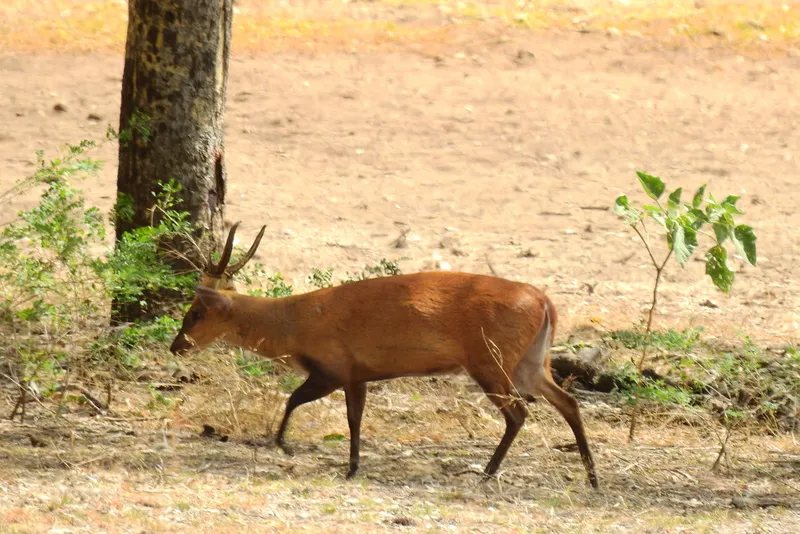
The southern red muntjac (Muntiacus muntjak) is a small reddish-brown deer; males carry short antlers and tusk-like canines. It is smaller and more slender than other deer. Farida and colleagues (2003) describe a darker back and a white chin, throat and belly, with paler females and young. Animal Diversity Web gives the male's upper canines as about 2.5 cm long. All Asian red muntjacs were once lumped in M. muntjak. Several authorities, including the Mammal Diversity Database, now treat mainland animals as M. vaginalis, leaving M. muntjak for the Malay Peninsula and the Sunda Islands. Unlike mouse-deer, male muntjacs have antlers.
Evidence: Biodiversitas — Farida et al. (2003), Habitat dan keragaman tumbuhan pakan kancil (Tragulus javanicus) dan kijang (Muntiacus muntjak) di Cagar Alam Nusakambangan ↗ · Animal Diversity Web — Muntiacus muntjak (Indian muntjac) ↗ · Mammal Diversity Database (ASM) — Muntiacus muntjak, Southern Red Muntjac ↗
Where does the southern red muntjac live?
In Indonesia, the southern red muntjac occurs in Sumatra, Borneo, Java, Bali, Lombok and many smaller islands, according to the Mammal Diversity Database; its range also includes the Malay Peninsula. It prefers dense scrub at forest edges, overgrown old fields and teak forest, from the lowlands up to mountains at 2,400 m. In Gunung Halimun National Park it was recorded up to 1,600 m on Gunung Botol and was often seen in the afternoon on open ground with tall, coarse grass. It also lives in West Bali National Park, where park staff estimated about 400 muntjacs in 2017.
Evidence: Mammal Diversity Database (ASM) — Muntiacus muntjak, Southern Red Muntjac ↗ · Tropics (J-STAGE) — Farida et al. (2006), Habitat distribution and diversity of plants as feed resources for mouse deer and barking deer in Gunung Halimun National Park ↗ · Mongabay Indonesia — Kijang Mati Diburu di Taman Nasional Bali Barat. Kok Bisa? (2017) ↗
What does the southern red muntjac eat?
The southern red muntjac eats leaves, grass, shoots, seeds and fruit, and occasionally birds' eggs and small animals; Animal Diversity Web describes red muntjacs as omnivores. On Nusakambangan, Farida and colleagues (2003) recorded 19 food plants, mostly leaves, such as mahang (Macaranga), anggrung (Trema), Leucaena and cassava leaves. In Gunung Halimun, muntjacs ate every plant species eaten by mouse-deer plus six more, including cogon grass (Imperata cylindrica) and several figs. Like mouse-deer, muntjacs usually feed at night and in the early morning.
Evidence: Animal Diversity Web — Muntiacus muntjak (Indian muntjac) ↗ · Biodiversitas — Farida et al. (2003), Habitat dan keragaman tumbuhan pakan kancil (Tragulus javanicus) dan kijang (Muntiacus muntjak) di Cagar Alam Nusakambangan ↗ · Tropics (J-STAGE) — Farida et al. (2006), Habitat distribution and diversity of plants as feed resources for mouse deer and barking deer in Gunung Halimun National Park ↗
Why is the muntjac called the barking deer?
The muntjac is called the barking deer because it gives a dog-like bark when it senses a predator. According to Animal Diversity Web, it may keep barking for more than an hour to make the predator reveal itself or leave. Adult males and females are mostly solitary and pair up only in the mating season. Muntjacs are active both by day and at night. They can breed at any time of year and usually have a single fawn. The young leave the mother's territory at about six months old and must then find a territory of their own.
Evidence: Animal Diversity Web — Muntiacus muntjak (Indian muntjac) ↗ · Biodiversitas — Farida et al. (2003), Habitat dan keragaman tumbuhan pakan kancil (Tragulus javanicus) dan kijang (Muntiacus muntjak) di Cagar Alam Nusakambangan ↗
Is the southern red muntjac endangered?
The southern red muntjac is not globally threatened, but hunting and forest loss are putting pressure on its populations. The IUCN Red List classes it as Least Concern. A 2017 genetic study by Martins and colleagues notes that habitat loss and hunting have already caused significant declines in red muntjacs across their range, although they cope with disturbance better than many other hoofed mammals. On Nusakambangan, local people report that muntjacs are still hunted for meat, some of which is sold. In January 2017, four female muntjacs shot by poachers were found in West Bali National Park.
Evidence: BMC Evolutionary Biology (PMC) — Martins et al. (2017), Phylogeography of red muntjacs reveals three distinct mitochondrial lineages ↗ · Biodiversitas — Farida et al. (2003), Habitat dan keragaman tumbuhan pakan kancil (Tragulus javanicus) dan kijang (Muntiacus muntjak) di Cagar Alam Nusakambangan ↗ · Mongabay Indonesia — Kijang Mati Diburu di Taman Nasional Bali Barat. Kok Bisa? (2017) ↗
What should you do if a muntjac wanders into a village?
If a muntjac wanders into a village or building, do not chase, catch or hurt it; contact the conservation agency (BKSDA) or the nearest national park office. In August 2019, a young male muntjac entered a classroom at a vocational school in Turi, Sleman. The Yogyakarta BKSDA quick response team, Mount Merapi National Park staff and local people removed it. It was injured, probably from hitting desks, and was treated by a vet. The southern red muntjac is listed as protected under Ministerial Regulation P.106/2018, so do not buy its meat or live animals, and report poaching to the authorities.
Evidence: Ditjen KSDAE — Kijang Masuk SMK Muhammadiyah II Turi, Tim Quick Response Segera Evakuasi (2019) ↗ · JDIH Kemenko Infrastruktur — Permen LHK P.106/MENLHK/SETJEN/KUM.1/12/2018 tentang Jenis Tumbuhan dan Satwa yang Dilindungi (PDF) ↗
Explore related habitats
These habitat relationships are supported by species sources in this guide. This is not a complete range map.
Common questions about the Southern red muntjac
What is the scientific name of the Southern red muntjac?
The scientific name of the Southern red muntjac is Muntiacus muntjak, in the family Cervidae. In Indonesian it is called Kijang muncak.
Where can the Southern red muntjac be found in Indonesia?
In Indonesia, this guide records the Southern red muntjac in: Sumatra, Borneo, Java, Bali, Lombok and many smaller islands.
Source-supported habitats: Tropical Rainforests.
What does the Southern red muntjac eat?
Diet of the Southern red muntjac: leaves, grass, shoots and fruit; sometimes eggs and small animals.
What is the conservation status of the Southern red muntjac?
On the IUCN Red List, the Southern red muntjac is listed as Least Concern: it does not currently qualify for a threatened category in the global assessment. Source: IUCN Red List (via GBIF), checked 25 September 2026.
This global category is separate from legal protection in Indonesia. To check whether the Southern red muntjac is a protected species, consult the current national list of protected species or contact the local BKSDA (natural resources conservation office).
Sources & references
- Animal Diversity Web — Muntiacus muntjak (Indian muntjac) ↗
- Mammal Diversity Database (ASM) — Muntiacus muntjak, Southern Red Muntjac ↗
- BMC Evolutionary Biology (PMC) — Martins et al. (2017), Phylogeography of red muntjacs reveals three distinct mitochondrial lineages ↗
- Biodiversitas — Farida et al. (2003), Habitat dan keragaman tumbuhan pakan kancil (Tragulus javanicus) dan kijang (Muntiacus muntjak) di Cagar Alam Nusakambangan ↗
- Tropics (J-STAGE) — Farida et al. (2006), Habitat distribution and diversity of plants as feed resources for mouse deer and barking deer in Gunung Halimun National Park ↗
- Mongabay Indonesia — Kijang Mati Diburu di Taman Nasional Bali Barat. Kok Bisa? (2017) ↗
- Ditjen KSDAE — Kijang Masuk SMK Muhammadiyah II Turi, Tim Quick Response Segera Evakuasi (2019) ↗
- JDIH Kemenko Infrastruktur — Permen LHK P.106/MENLHK/SETJEN/KUM.1/12/2018 tentang Jenis Tumbuhan dan Satwa yang Dilindungi (PDF) ↗
- IUCN Red List of Threatened Species, version 2026-1, via GBIF (CC BY 4.0) ↗
References can change. Check dates and context in the original source.
Cite this page
PanduanHewan. (2026, 25 September). Southern red muntjac (Muntiacus muntjak). PanduanHewan.org. https://panduanhewan.org/en/species/southern-red-muntjac/