Quick answer
IUCN status: VulnerableBinturong at a glance
The Binturong (Arctictis binturong) is a mammal in the family Viverridae. Its IUCN Red List category is Vulnerable.
| Scientific name | Arctictis binturong |
|---|---|
| Group | Mammals |
| Family | Viverridae |
| Range in Indonesia | Sumatra, Borneo, Java, Bangka and Nias |
| Linked habitats | Tropical Rainforests |
| Diet | Mainly figs and other fruit; also small animals, eggs, carrion |
| Range in Indonesia | Sumatra, Borneo, Java, plus Bangka and Nias |
| Key feature | Shaggy black fur, prehensile tail, buttered-popcorn smell |
| Other names | Bearcat, binturung, kucing beruang |
| IUCN Red List status | Vulnerable (since 2008) |
| Legal protection in Indonesia | Protected (Ministerial Regulation P.106/2018) |
| IUCN status | Vulnerable · IUCN Red List (via GBIF) · checked 25 September 2026 |
In this guide (10)
What is a binturong?
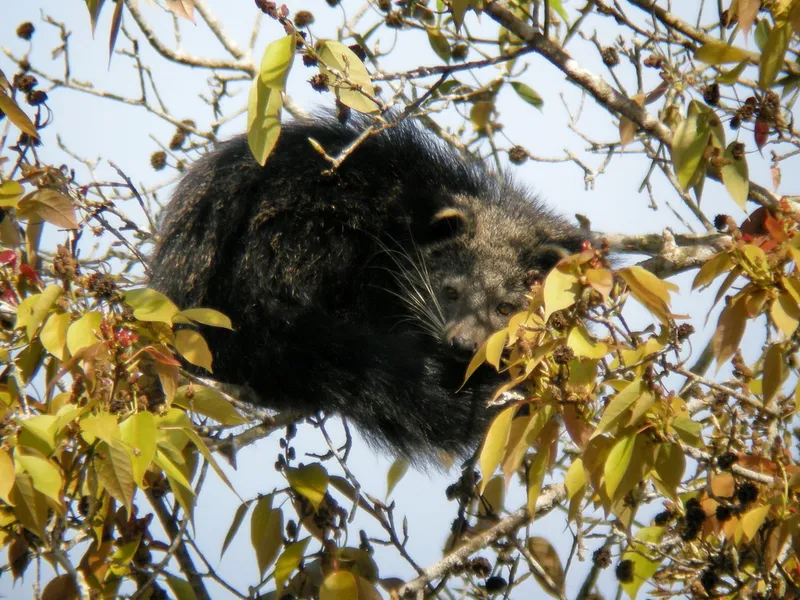
The binturong (Arctictis binturong) is the largest member of the civet family (Viverridae): a tree-dwelling mammal with coarse black fur and a prehensile tail. It is nicknamed the bearcat, but it is not closely related to bears or cats. Animal Diversity Web gives a weight of 9–20 kg and a body length of 61–96 cm, with a tail almost as long. Females are larger than males. It has small ears with long tufts and white whiskers. It is one of only two carnivores with a prehensile tail, the other being the kinkajou, and uses its tail like a fifth limb when climbing.
Evidence: Animal Diversity Web — Arctictis binturong (binturong) ↗ · Smithsonian's National Zoo and Conservation Biology Institute — Binturong ↗ · Mongabay — What is a binturong? (2016) ↗
Where does the binturong live?
In Indonesia, the binturong lives in the forests of Sumatra, Borneo and Java, and on islands such as Bangka and Nias. The Mammal Diversity Database lists Kalimantan, Java and Sumatra, and Animal Diversity Web also mentions Nias and Bangka. Beyond Indonesia, its range runs from India and Nepal across mainland South-east Asia to Palawan in the Philippines. It lives in the canopy of tall, dense tropical forest and sleeps in the branches. Too heavy to leap between trees, it often comes down to the ground to cross. Records from Java are scarcer; one appeared in Pandeglang, Banten, in January 2026.
Evidence: Mammal Diversity Database (ASM) — Arctictis binturong, Binturong ↗ · Animal Diversity Web — Arctictis binturong (binturong) ↗ · Mongabay Indonesia — Binturong, Satwa Langka Dilindungi yang Dijuluki Kucing Beruang (2026) ↗
What does the binturong eat?
Although it belongs to the order Carnivora, the binturong eats mainly fruit, especially strangler figs. Animal Diversity Web and Smithsonian's National Zoo add that it also catches small animals such as insects, birds, fish and rodents, and eats carrion, eggs, shoots and leaves. It has even been recorded swimming and diving for food. It plays an important role in the forest: strangler fig seeds germinate better after passing through a binturong's gut, so it helps to spread them. On Bangka, local traditions that treat fig trees as sacred are seen as supporting its conservation.
Evidence: Animal Diversity Web — Arctictis binturong (binturong) ↗ · Smithsonian's National Zoo and Conservation Biology Institute — Binturong ↗ · Mongabay Indonesia — Binturong dan Kearifan Masyarakat Pulau Bangka Menjaganya (2023) ↗
Why does a binturong smell like popcorn?
A binturong smells like buttered popcorn because its urine contains 2-acetyl-1-pyrroline, the compound that gives popcorn its aroma, according to Smithsonian's National Zoo. The scent tells other binturongs that it is around. Binturongs also have scent glands near the base of the tail, which they rub on branches as they climb to mark their trail. They communicate by sound too: they purr or chuckle when content, and scream, hiss or howl when frightened or angry. Binturongs are mostly active at night and live alone except when mating.
Evidence: Smithsonian's National Zoo and Conservation Biology Institute — Binturong ↗ · Animal Diversity Web — Arctictis binturong (binturong) ↗ · Mongabay Indonesia — Binturong, Satwa Langka Dilindungi yang Dijuluki Kucing Beruang (2026) ↗
Why is the binturong threatened?
The binturong is threatened mainly by forest loss, along with hunting and illegal trade; the IUCN has classed it as Vulnerable since 2008. Mongabay reports that its numbers fell by about 30% over the three generations before that assessment. Much lowland forest in Sumatra, Borneo and Java has been turned into oil palm plantations. Binturongs are also hunted for meat, traditional medicine and the pet trade. Ignorance can be deadly too. In January 2026, villagers in Pandeglang, Banten, mistook a binturong for a wolf or a supernatural creature. It was brought down and died, and the conservation agency found snare and gunshot wounds on its neck.
Evidence: Mongabay — What is a binturong? (2016) ↗ · Mongabay Indonesia — Binturong, Satwa Langka Dilindungi yang Dijuluki Kucing Beruang (2026) ↗
What should you do if you meet a binturong?
If you meet a binturong, do not approach, catch or harm it; keep your distance and contact the local conservation agency (BKSDA) or forestry officers. Arctictis binturong is listed as protected under Ministerial Regulation P.106/2018, so it must not be hunted, kept or traded. Although it looks slow, a wild binturong can be aggressive: researcher Lonnie Grassman reported that binturongs released from traps may chase nearby people. The Banten case shows why recognising the animal matters. On Bangka, the Mapur and Jerieng communities traditionally neither hunt nor eat binturongs, a custom that helps to protect them.
Evidence: JDIH Kemenko Infrastruktur — Permen LHK P.106/MENLHK/SETJEN/KUM.1/12/2018 tentang Jenis Tumbuhan dan Satwa yang Dilindungi (PDF) ↗ · Mongabay — What is a binturong? (2016) ↗ · Mongabay Indonesia — Binturong dan Kearifan Masyarakat Pulau Bangka Menjaganya (2023) ↗
Explore related habitats
These habitat relationships are supported by species sources in this guide. This is not a complete range map.
Common questions about the Binturong
What is the scientific name of the Binturong?
The scientific name of the Binturong is Arctictis binturong, in the family Viverridae.
Where can the Binturong be found in Indonesia?
In Indonesia, this guide records the Binturong in: Sumatra, Borneo, Java, Bangka and Nias.
Source-supported habitats: Tropical Rainforests.
What does the Binturong eat?
Diet of the Binturong: mainly figs and other fruit; also small animals, eggs, carrion.
What is the conservation status of the Binturong?
On the IUCN Red List, the Binturong is listed as Vulnerable: it is considered to face a high risk of extinction in the wild. Source: IUCN Red List (via GBIF), checked 25 September 2026.
This global category is separate from legal protection in Indonesia. To check whether the Binturong is a protected species, consult the current national list of protected species or contact the local BKSDA (natural resources conservation office).
Sources & references
- Animal Diversity Web — Arctictis binturong (binturong) ↗
- Smithsonian's National Zoo and Conservation Biology Institute — Binturong ↗
- Mammal Diversity Database (ASM) — Arctictis binturong, Binturong ↗
- Mongabay — What is a binturong? (2016) ↗
- Mongabay Indonesia — Binturong, Satwa Langka Dilindungi yang Dijuluki Kucing Beruang (2026) ↗
- Mongabay Indonesia — Binturong dan Kearifan Masyarakat Pulau Bangka Menjaganya (2023) ↗
- JDIH Kemenko Infrastruktur — Permen LHK P.106/MENLHK/SETJEN/KUM.1/12/2018 tentang Jenis Tumbuhan dan Satwa yang Dilindungi (PDF) ↗
- IUCN Red List of Threatened Species, version 2026-1, via GBIF (CC BY 4.0) ↗
References can change. Check dates and context in the original source.
Further reading
Binturong: facts, threats and conservation ↗ — World Animal Rescue Network.
Cite this page
PanduanHewan. (2026, 25 September). Binturong (Arctictis binturong). PanduanHewan.org. https://panduanhewan.org/en/species/binturong/