Quick answer
IUCN status: Least ConcernBlack rat at a glance
The Black rat (Rattus rattus) is a mammal in the family Muridae. Its IUCN Red List category is Least Concern.
| Scientific name | Rattus rattus |
|---|---|
| Indonesian name | Tikus rumah |
| Group | Mammals |
| Family | Muridae |
| Range in Indonesia | Settlements, including on Java, Bali, Nusa Tenggara and Sulawesi |
| Linked habitats | Urban Habitats |
| Diet | Fruit, grain, plants, human food, sometimes insects |
| Range in Indonesia | Settlements, including Java, Bali, Nusa Tenggara and Sulawesi |
| Key feature | Tail longer than its body; agile climber |
| Other names | Roof rat, ship rat, house rat; Rattus tanezumi in Indonesian surveys |
| Risk to people | Source of leptospirosis; its fleas can transmit plague |
| IUCN status | Least Concern · IUCN Red List (via GBIF) · checked 25 September 2026 |
In this guide (10)
What is the black rat?
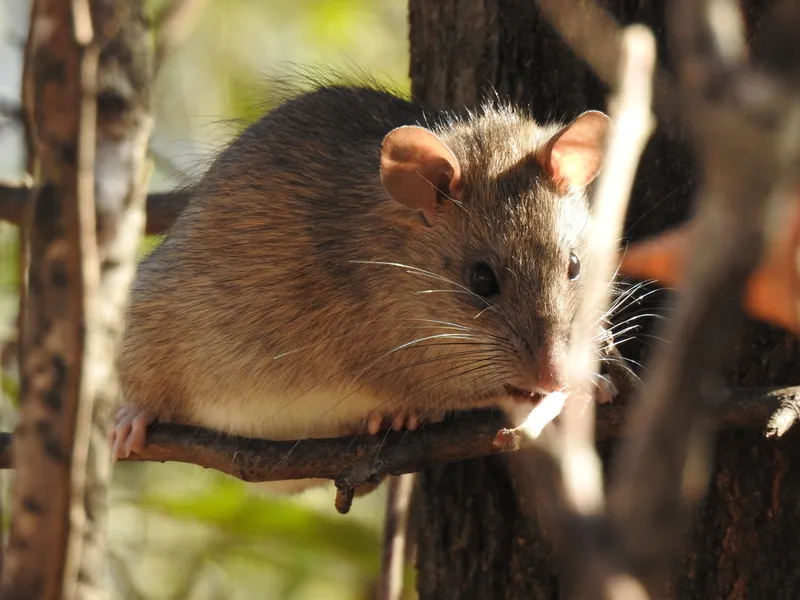
The black rat (Rattus rattus) is a medium-sized, agile climbing rat that lives alongside people. According to Animal Diversity Web, it weighs 70–300 g, measures 16–22 cm in head and body, and its tail is nearly always longer than its body. Many are black with a paler belly, but colour varies, and the ears are relatively large.
Its classification is still debated. Indonesian health surveys, such as one in Purworejo, Central Java, record house-dwelling rats as Rattus tanezumi, the Asian form of the black rat group. A genetic study by Aplin and colleagues (2011) in PLOS ONE, however, recommends dropping the split between R. tanezumi and R. rattus.
Evidence: Animal Diversity Web — Rattus rattus (black rat) ↗ · PLOS ONE — Aplin et al. (2011), Multiple geographic origins of commensalism and complex dispersal history of black rats ↗ · Jurnal MKMI (Universitas Hasanuddin) — Ningsih & Sholichah (2018), Kajian reservoir leptospira di daerah sporadis leptospirosis Kabupaten Purworejo, Jawa Tengah ↗
Where does the black rat live?
The black rat lives in settlements and nests in high, enclosed places such as ceilings, attics, wall cavities and cupboards. UC IPM notes that it also nests in shrubs and trees. In buildings shared with brown rats, black rats usually take the upper floors and brown rats the ground floor.
A survey in Purworejo, Central Java, found that two-thirds of the rats and shrews caught were R. tanezumi, and two-thirds were caught indoors. Genetic work by Aplin and colleagues shows that black rats reached eastern Indonesian islands such as Sulawesi, Flores and Timor in prehistoric times, with the oldest evidence in Timor dating to about 3,000 years ago.
Evidence: UC Statewide IPM Program — Pest Notes: Rats ↗ · Jurnal MKMI (Universitas Hasanuddin) — Ningsih & Sholichah (2018), Kajian reservoir leptospira di daerah sporadis leptospirosis Kabupaten Purworejo, Jawa Tengah ↗ · PLOS ONE — Aplin et al. (2011), Multiple geographic origins of commensalism and complex dispersal history of black rats ↗
What does the black rat eat?
The black rat is an omnivore that eats mainly fruit, grain and other plant matter. Animal Diversity Web records that it eats about 15 g of food and drinks 15 ml of water a day, and will eat insects when needed. UC IPM lists fruit, nuts, berries, snails, and young birds and bird eggs among its preferred foods.
Indoors it eats and contaminates stored food. Animal Diversity Web explains that black rats often spoil more than they eat, because they urinate and defecate on the remains of their meals. According to UC IPM, black rats also tend to carry food away to eat it somewhere else.
Evidence: Animal Diversity Web — Rattus rattus (black rat) ↗ · UC Statewide IPM Program — Pest Notes: Rats ↗
How does the black rat breed?
Black rats can breed all year round when conditions allow. According to Animal Diversity Web, a female can give birth up to five times a year after a pregnancy of 21–29 days. The young are born helpless, open their eyes at about 15 days and are weaned at 3–4 weeks. UC IPM notes that a litter can contain up to eight young.
Young rats can breed at 3–5 months old, so numbers rise quickly when food, water and shelter are available. Black rats live in groups with one dominant male. In the wild they usually live only about a year, but in captivity they can reach four years.
Evidence: Animal Diversity Web — Rattus rattus (black rat) ↗ · UC Statewide IPM Program — Pest Notes: Rats ↗
What diseases can the black rat spread?
The black rat can spread leptospirosis through its urine, and its fleas can transmit plague. The Ministry of Health names rats as the main animal source of leptospirosis. Leptospira bacteria live in a rat’s kidneys without making it ill, leave in its urine, and survive for months in moist soil.
Plague spread across Java from 1910, starting with infected rats that arrived with rice imported from Burma, Mongabay Indonesia reports. The ministry still monitors plague in Pasuruan, Boyolali, Sleman and Bandung. Early signs of leptospirosis include fever, headache, muscle and calf pain, and tiredness. Anyone who develops them after contact with floodwater or puddles should visit a health facility promptly.
Evidence: Ayo Sehat Kemenkes — Hujan, Tikus, dan Leptospirosis ↗ · Mongabay Indonesia — Tangani pandemi corona, belajar dari wabah pes di Jawa (2020) ↗ · Balai Besar Laboratorium Kesehatan Lingkungan (Kemenkes) — Pinjal tikus, ektoparasit populer yang dimiliki oleh tikus ↗
How can you keep black rats out of your home?
The best way to prevent black rats is to keep things clean and block their way in. UC IPM advises sealing gaps wider than 1/4 inch (about 6 mm) with wire mesh or sheet metal, because rats can gnaw through plastic and wood. Store food and rubbish in lidded containers, prune branches near the roof, and clear clutter where rats nest.
Never touch rats, alive or dead, with bare hands; UC IPM advises disposable gloves. Rat poisons are also dangerous to children, pets and other animals. The Ministry of Health urges clean, healthy living habits (PHBS), removing rat nests, and wearing rubber boots and gloves to clean up after floods.
Evidence: UC Statewide IPM Program — Pest Notes: Rats ↗ · Ayo Sehat Kemenkes — Waspadai Musim Hujan dan Banjir! Leptospirosis Diam-diam Mematikan ↗ · Ayo Sehat Kemenkes — Hujan, Tikus, dan Leptospirosis ↗
Explore related habitats
These habitat relationships are supported by species sources in this guide. This is not a complete range map.
Common questions about the Black rat
What is the scientific name of the Black rat?
The scientific name of the Black rat is Rattus rattus, in the family Muridae. In Indonesian it is called Tikus rumah.
Where can the Black rat be found in Indonesia?
In Indonesia, this guide records the Black rat in: Settlements, including on Java, Bali, Nusa Tenggara and Sulawesi.
Source-supported habitats: Urban Habitats.
What does the Black rat eat?
Diet of the Black rat: fruit, grain, plants, human food, sometimes insects.
What is the conservation status of the Black rat?
On the IUCN Red List, the Black rat is listed as Least Concern: it does not currently qualify for a threatened category in the global assessment. Source: IUCN Red List (via GBIF), checked 25 September 2026.
This global category is separate from legal protection in Indonesia. To check whether the Black rat is a protected species, consult the current national list of protected species or contact the local BKSDA (natural resources conservation office).
Sources & references
- Animal Diversity Web — Rattus rattus (black rat) ↗
- UC Statewide IPM Program — Pest Notes: Rats ↗
- PLOS ONE — Aplin et al. (2011), Multiple geographic origins of commensalism and complex dispersal history of black rats ↗
- Jurnal MKMI (Universitas Hasanuddin) — Ningsih & Sholichah (2018), Kajian reservoir leptospira di daerah sporadis leptospirosis Kabupaten Purworejo, Jawa Tengah ↗
- Ayo Sehat Kemenkes — Hujan, Tikus, dan Leptospirosis ↗
- Ayo Sehat Kemenkes — Waspadai Musim Hujan dan Banjir! Leptospirosis Diam-diam Mematikan ↗
- Mongabay Indonesia — Tangani pandemi corona, belajar dari wabah pes di Jawa (2020) ↗
- Balai Besar Laboratorium Kesehatan Lingkungan (Kemenkes) — Pinjal tikus, ektoparasit populer yang dimiliki oleh tikus ↗
- IUCN Red List of Threatened Species, version 2026-1, via GBIF (CC BY 4.0) ↗
References can change. Check dates and context in the original source.
Cite this page
PanduanHewan. (2026, 25 September). Black rat (Rattus rattus). PanduanHewan.org. https://panduanhewan.org/en/species/black-rat/