Quick answer
IUCN status: Least ConcernBrown rat at a glance
The brown rat (Rattus norvegicus) is a mammal in the family Muridae. Range in Indonesia: Towns and ports, including on Java and Sulawesi. Diet: omnivore: grain, meat, fish and human food waste; a omnivore. IUCN Red List status: Least Concern.
| Scientific name | Rattus norvegicus |
|---|---|
| Indonesian name | Tikus got |
| Group | Mammals |
| Family | Muridae |
| Range in Indonesia | Towns and ports, including on Java and Sulawesi |
| Linked habitats | Urban Habitats |
| Diet | Omnivore: grain, meat, fish and human food waste |
| Range in Indonesia | Towns and ports, including on Java and Sulawesi |
| Key feature | Stocky body, short ears, tail shorter than body |
| Other names | Norway rat, sewer rat, barn rat |
| Risk to people | Spreads leptospirosis; can carry plague-vector fleas |
| IUCN status | Least Concern · IUCN Red List (via GBIF) · checked 1 October 2026 |
| Lifespan | About 2 years in the wild; up to 4 years in captivity · Animal Diversity Web — Rattus norvegicus |
| Diet type | Omnivore (eats plants and animals) — eats almost anything: grain, human food waste and small animals · Animal Diversity Web |
| Reproduction | Giving birth to live young (viviparous) · Animal Diversity Web |
| Active | Nocturnal (active at night) — Also active at dusk. · Rattus norvegicus (brown rat) – Animal Diversity Web |
In this guide (12)
What is the brown rat?
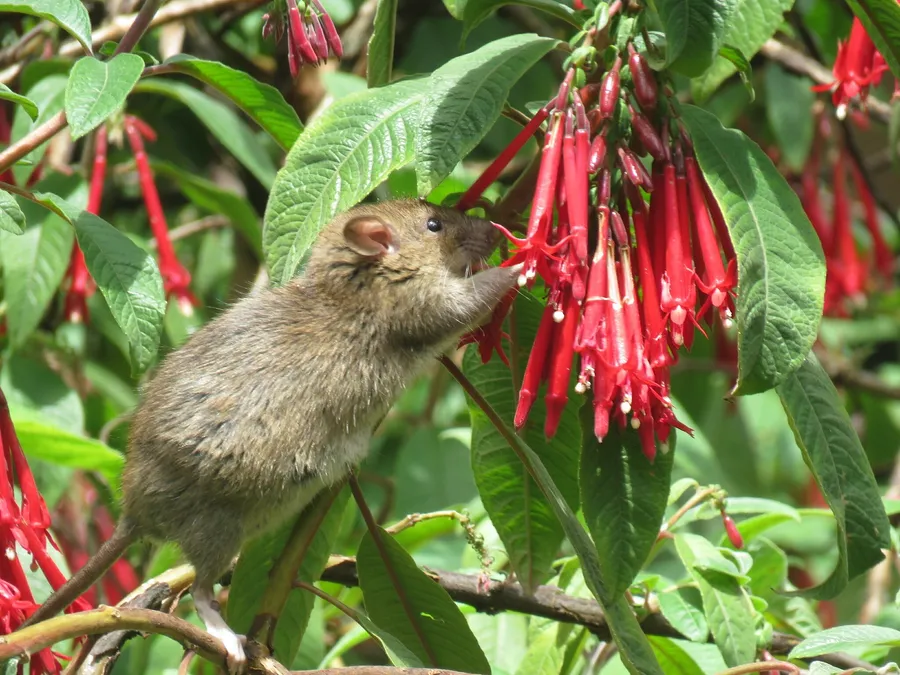
The brown rat (Rattus norvegicus) is a large, stocky rat that lives in drains, burrows and around buildings. According to Animal Diversity Web, it reaches nearly 40 cm from nose to tail tip and weighs 140–500 g. Its coarse fur is brown above and paler below, and its ears and tail are hairless.
It is often confused with the black rat (Rattus rattus). UC IPM explains that the brown rat is larger and stockier, with a tail shorter than its head and body, whereas the black rat’s tail is longer than its body. The two species cannot interbreed. Despite the name Norway rat, it is native to northern China.
Evidence: Animal Diversity Web — Rattus norvegicus (brown rat) ↗ · UC Statewide IPM Program — Pest Notes: Rats ↗
Where does the brown rat live?
The brown rat lives close to people, in places such as drains, rubbish dumps, open ground and basements. Animal Diversity Web notes that nearly every port city in the world has a large brown rat population. It often lives near water and digs branching burrows with chambers for storing food and nesting.
In Indonesia, a 2021 survey by the Makassar Port Health Office found that 9 of the 10 rats caught at Soekarno-Hatta Port were R. norvegicus. Ports carry risk because rats travel on ships. A study at Ketapang Port, Banyuwangi, also found only brown rats, caught in a drain beside an office and in bushes.
Evidence: Animal Diversity Web — Rattus norvegicus (brown rat) ↗ · Balai Besar Kekarantinaan Kesehatan Makassar (Kemenkes) — Pengamatan dan pengendalian tikus di wilayah kerja KKP Soekarno-Hatta Makassar tahun 2021 ↗ · Jurnal Nusantara Community (Universitas Gresik) — Imalia & Diyanah (2023), Gambaran kepadatan populasi tikus di wilayah Pelabuhan Ketapang ↗
What does the brown rat eat?
The brown rat is an omnivore that eats almost anything available. UC IPM notes that it prefers cereal grains, meat, fish, nuts and some fruit, but readily switches to food waste around rubbish bins. Animal Diversity Web says brown rats in cities survive mainly on food thrown away by people.
Brown rats also hunt. Animal Diversity Web records them preying on chicks, mice, birds and small lizards, and brown rats living near the sea have been seen catching fish with their paws. They rely on their sense of smell, forage mainly at night, and often stay close to their nests to reduce the risk of being caught by predators.
Evidence: UC Statewide IPM Program — Pest Notes: Rats ↗ · Animal Diversity Web — Rattus norvegicus (brown rat) ↗
How does the brown rat behave and breed?
Brown rats are active mainly at night or at dusk and live in groups ranked by body size. Animal Diversity Web notes that they memorise complex routes through sewers and burrows. UC IPM adds that they swim better than black rats and can enter buildings through broken drains.
Females are pregnant for 22–24 days and give birth to about eight young per litter. Animal Diversity Web records that a female can give birth up to seven times a year and mates again about 18 hours after giving birth. Males mature at about three months and females at four. Several mothers often share a nest and nurse each other’s young.
Evidence: Animal Diversity Web — Rattus norvegicus (brown rat) ↗ · UC Statewide IPM Program — Pest Notes: Rats ↗
Is the brown rat a health risk?
Yes: the brown rat spreads leptospirosis in Indonesia, and the Ministry of Health lists it among the main rodent sources. Leptospira bacteria leave in rat urine and enter people through broken skin or mucous membranes, for example via floodwater, drains, mud or contaminated soil.
In 2023, Universitas Gadjah Mada researchers found Leptospira-positive brown rats at primary schools and housing areas in Yogyakarta. At Ketapang Port, brown rats carried the plague flea Xenopsylla cheopis. Warning signs of leptospirosis include fever of 38°C or more, headache, calf pain, red eyes, and yellow eyes and skin. Anyone with these signs should go to a health centre or hospital promptly.
Evidence: Ayo Sehat Kemenkes — Waspadai Musim Hujan dan Banjir! Leptospirosis Diam-diam Mematikan ↗ · Indonesian Journal of Tropical and Infectious Disease — Wibawaning Astuti et al. (2023), The existence of Leptospira interrogans on rats and the transmission potency in public areas in Yogyakarta ↗ · Jurnal Nusantara Community (Universitas Gresik) — Imalia & Diyanah (2023), Gambaran kepadatan populasi tikus di wilayah Pelabuhan Ketapang ↗
How can you keep brown rats away from your home?
Brown rats are best prevented through good sanitation and by blocking their way into buildings. UC IPM advises collecting rubbish often, using bins with tight lids, storing pet food in rodent-proof containers, and sealing gaps in foundations and around pipes. Broken drains should also be repaired, because rats can get in through them.
Never handle rats, alive or dead, with bare hands. Indonesia’s Ministry of Health recommends rubber boots, gloves and covering clothes when cleaning up floods or standing water, and washing with soap afterwards. Keeping surroundings clean and removing rat nests are part of the clean and healthy living habits the ministry promotes.
Evidence: UC Statewide IPM Program — Pest Notes: Rats ↗ · Ayo Sehat Kemenkes — Hujan, Tikus, dan Leptospirosis ↗ · Ayo Sehat Kemenkes — Waspadai Musim Hujan dan Banjir! Leptospirosis Diam-diam Mematikan ↗
Explore related habitats
These habitat relationships are supported by species sources in this guide. This is not a complete range map.
Scientific classification of the Brown rat
| Kingdom | Animalia |
|---|---|
| Phylum | Chordata |
| Class | Mammalia |
| Order | Rodentia |
| Family | Muridae |
| Genus | Rattus |
| Species | Rattus norvegicus |
Source: GBIF Backbone Taxonomy, adjusted to the ranks commonly used in school biology (for example class Reptilia).
Common questions about the brown rat
What is the scientific name of the brown rat?
The scientific name of the brown rat is Rattus norvegicus, in the family Muridae. In Indonesian it is called Tikus got.
What kind of animal is the brown rat?
The brown rat is a mammal in the family Muridae. By diet it is a omnivore (eats plants and animals): a eats almost anything: grain, human food waste and small animals.
Where does the brown rat live in Indonesia?
In Indonesia, this guide records the brown rat in: Towns and ports, including on Java and Sulawesi.
Source-supported habitats: Urban Habitats.
What does the brown rat eat?
Diet of the brown rat: omnivore: grain, meat, fish and human food waste. That makes it a omnivore (eats plants and animals). Source: Animal Diversity Web.
How does the brown rat reproduce?
The brown rat reproduces by giving birth to live young (viviparous). Source: Animal Diversity Web.
Is the brown rat nocturnal?
The cited source records the brown rat as nocturnal (active at night). Also active at dusk. Source: Rattus norvegicus (brown rat) – Animal Diversity Web.
See also the list of nocturnal and diurnal animals in Indonesia.
What are the main features of the brown rat?
Key features of the brown rat, from this guide’s sources: Key feature: stocky body, short ears, tail shorter than body.
Is the brown rat dangerous to people?
Spreads leptospirosis; can carry plague-vector fleas.
Do not approach, catch or handle wild animals. If you are injured or bitten, get medical care at a health facility straight away.
What is the scientific classification of the brown rat?
Scientific classification of the brown rat: kingdom Animalia, phylum Chordata, class Mammalia, order Rodentia, family Muridae, genus Rattus, species Rattus norvegicus.
Source: GBIF Backbone Taxonomy, adjusted to the ranks commonly used in school biology.
Is the brown rat endangered?
No, according to the global IUCN assessment. On the IUCN Red List, the brown rat is listed as Least Concern: it does not qualify for a threatened category or for Near Threatened in the global assessment. Source: IUCN Red List (via GBIF), checked 1 October 2026.
This global category is separate from legal protection in Indonesia. To check whether the brown rat is a protected species, consult the current national list of protected species or contact the local BKSDA (natural resources conservation office).
Compare with similar animals
Sources & references
- Animal Diversity Web — Rattus norvegicus (brown rat) ↗
- UC Statewide IPM Program — Pest Notes: Rats ↗
- Balai Besar Kekarantinaan Kesehatan Makassar (Kemenkes) — Pengamatan dan pengendalian tikus di wilayah kerja KKP Soekarno-Hatta Makassar tahun 2021 ↗
- Jurnal Nusantara Community (Universitas Gresik) — Imalia & Diyanah (2023), Gambaran kepadatan populasi tikus di wilayah Pelabuhan Ketapang ↗
- Indonesian Journal of Tropical and Infectious Disease — Wibawaning Astuti et al. (2023), The existence of Leptospira interrogans on rats and the transmission potency in public areas in Yogyakarta ↗
- Ayo Sehat Kemenkes — Waspadai Musim Hujan dan Banjir! Leptospirosis Diam-diam Mematikan ↗
- Ayo Sehat Kemenkes — Hujan, Tikus, dan Leptospirosis ↗
- Animal Diversity Web ↗
- GBIF Backbone Taxonomy (GBIF) ↗
- IUCN Red List of Threatened Species, version 2026-1, via GBIF (CC BY 4.0) ↗
References can change. Check dates and context in the original source. How we use sources and data →
Further reading
Brown rat: facts, threats and conservation ↗ — World Animal Rescue Network.
Related site: PanduanHewan’s founder is also a director of World Animal Rescue Network.
Cite this page
Credit PanduanHewan when referring to this page. Check the original evidence sources before reusing a claim.
PanduanHewan. Brown rat (Rattus norvegicus). Last substantive update: 1 October 2026. https://panduanhewan.org/en/species/brown-rat/