Quick answer
IUCN status: Least ConcernAsian house shrew at a glance
The Asian house shrew (Suncus murinus) is a mammal in the family Soricidae. Its IUCN Red List category is Least Concern.
| Scientific name | Suncus murinus |
|---|---|
| Indonesian name | Cecurut rumah |
| Group | Mammals |
| Family | Soricidae |
| Range in Indonesia | Malay Archipelago; recorded in settlements on Java |
| Linked habitats | Urban Habitats |
| Diet | Mainly insects and other invertebrates, plus food scraps |
| Range in Indonesia | Malay Archipelago; recorded in settlements on Java |
| Key feature | Long pointed snout, velvety grey fur, strong musky smell |
| Other names | House shrew, Asian musk shrew, celurut, munggis rumah |
| Risk to people | Can carry Leptospira, the cause of leptospirosis |
| IUCN status | Least Concern · IUCN Red List (via GBIF) · checked 25 September 2026 |
In this guide (10)
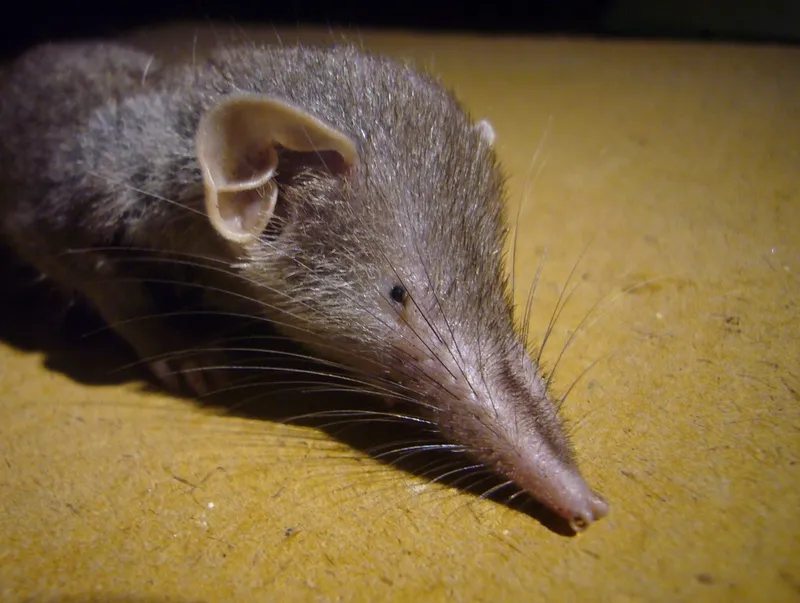
What is the Asian house shrew?
The Asian house shrew (Suncus murinus) is a small insect-eating mammal that often enters houses and is mistaken for a rat. Animal Diversity Web gives a total length of 10–15 cm, including the tail. Males are much heavier, at 33.2–147.3 g, than females at 23.5–82 g. Its short fur is velvety, light grey to black, and it has a long, pointed snout.
Its other English name, musk shrew, comes from the strong musky smell produced by a large scent gland, especially in males. In Indonesian it is also called celurut, cencurut or munggis rumah. In China, Animal Diversity Web notes, its constant chattering is likened to jingling coins.
Evidence: Animal Diversity Web — Suncus murinus (Asian house shrew) ↗ · Wikipedia bahasa Indonesia — Munggis rumah (supplementary, names only) ↗
Where does the Asian house shrew live?
The Asian house shrew lives in forests, farmland and, above all, around human settlements. Animal Diversity Web says it originated on the Indian subcontinent and ranges from southern Asia to the Malay Archipelago and southern Japan, and people have carried it to Africa and the Middle East. Inside houses it nests in dark, hidden places.
Rodent surveys on Java often find it. In Yogyakarta, Universitas Gadjah Mada researchers caught 13 shrews among 40 small mammals trapped at primary schools, traditional markets and housing areas. In 2023, shrews were also caught alongside several rat species in the plague-enzootic area of Pasuruan Regency, East Java.
Evidence: Animal Diversity Web — Suncus murinus (Asian house shrew) ↗ · Indonesian Journal of Tropical and Infectious Disease — Wibawaning Astuti et al. (2023), The existence of Leptospira interrogans on rats and the transmission potency in public areas in Yogyakarta ↗ · Jurnal Sain Veteriner (UGM) — Cahyaningrum et al., Kepadatan dan dominasi pinjal pada beberapa jenis tikus dan habitat di daerah enzootik pes di Kabupaten Pasuruan, Jawa Timur ↗
What does the Asian house shrew eat?
The Asian house shrew eats mainly insects, but it is an opportunist that also takes other invertebrates, plant material and human food. According to Animal Diversity Web, it forages at night in forests, fields and settlements. Like other shrews, it has a high metabolism and a large appetite, so it needs several feeding periods.
Because it eats many insects, the shrew probably helps keep pest insects in check, Animal Diversity Web notes. However, its high numbers in homes and shops make it a pest, as it can damage food and other goods. Its strong musky smell means few predators will eat it.
Evidence: Animal Diversity Web — Suncus murinus (Asian house shrew) ↗ · Animal Diversity Web — Soricidae (shrews) ↗
How does the Asian house shrew breed?
The Asian house shrew breeds all year round. According to Animal Diversity Web, pregnancy usually lasts 30 days and a litter holds 4–8 young. The young are weaned at 15–20 days, and females reach sexual maturity at about 35 days old. Because it breeds fast and adapts easily, the shrew can live at high densities.
Both parents gather nesting material before the young are born, and the young stay in the nest until they are about three-quarters grown. In the wild the shrew usually lives one to two years. It is active at night throughout the year, lives alone and is intolerant of others of its kind.
Evidence: Animal Diversity Web — Suncus murinus (Asian house shrew) ↗
How is a shrew different from a rat?
A shrew is not a rat. Animal Diversity Web places the Asian house shrew in the shrew family (Soricidae) within an order of insect-eating mammals, while the black rat belongs to the family Muridae in the rodent order (Rodentia). The two look alike in body shape but are not close relatives.
There are several ways to tell them apart. The shrew has a long, pointed snout, tiny eyes and a strong musky smell from its scent gland. It eats mainly insects and other invertebrates, whereas the black rat feeds mostly on fruit and grain. The black rat also has relatively large ears and a tail longer than its body.
Evidence: Animal Diversity Web — Suncus murinus (Asian house shrew) ↗ · Animal Diversity Web — Soricidae (shrews) ↗ · Animal Diversity Web — Rattus rattus (black rat) ↗
What should you do if there is a shrew in your house?
If a shrew is in your house, do not touch it and keep the house clean, because shrews can carry Leptospira bacteria. Indonesia’s Ministry of Health lists Suncus murinus among leptospirosis sources. Leptospira-positive shrews were found at primary schools in Yogyakarta, and a shrew in Purworejo carried the Sejroe serovar.
The ministry urges clean, healthy habits and removal of rat nests, since Leptospira spreads through contact with animal urine or contaminated water and soil. Warning signs of leptospirosis include fever of 38°C or more, headache, weakness, calf pain, red eyes, and yellow eyes and skin. Anyone with these signs should go to a health centre or hospital promptly.
Evidence: Ayo Sehat Kemenkes — Waspadai Musim Hujan dan Banjir! Leptospirosis Diam-diam Mematikan ↗ · Indonesian Journal of Tropical and Infectious Disease — Wibawaning Astuti et al. (2023), The existence of Leptospira interrogans on rats and the transmission potency in public areas in Yogyakarta ↗ · Jurnal MKMI (Universitas Hasanuddin) — Ningsih & Sholichah (2018), Kajian reservoir leptospira di daerah sporadis leptospirosis Kabupaten Purworejo, Jawa Tengah ↗
Explore related habitats
These habitat relationships are supported by species sources in this guide. This is not a complete range map.
Common questions about the Asian house shrew
What is the scientific name of the Asian house shrew?
The scientific name of the Asian house shrew is Suncus murinus, in the family Soricidae. In Indonesian it is called Cecurut rumah.
Where can the Asian house shrew be found in Indonesia?
In Indonesia, this guide records the Asian house shrew in: Malay Archipelago; recorded in settlements on Java.
Source-supported habitats: Urban Habitats.
What does the Asian house shrew eat?
Diet of the Asian house shrew: mainly insects and other invertebrates, plus food scraps.
What is the conservation status of the Asian house shrew?
On the IUCN Red List, the Asian house shrew is listed as Least Concern: it does not currently qualify for a threatened category in the global assessment. Source: IUCN Red List (via GBIF), checked 25 September 2026.
This global category is separate from legal protection in Indonesia. To check whether the Asian house shrew is a protected species, consult the current national list of protected species or contact the local BKSDA (natural resources conservation office).
Sources & references
- Animal Diversity Web — Suncus murinus (Asian house shrew) ↗
- Animal Diversity Web — Soricidae (shrews) ↗
- Animal Diversity Web — Rattus rattus (black rat) ↗
- Indonesian Journal of Tropical and Infectious Disease — Wibawaning Astuti et al. (2023), The existence of Leptospira interrogans on rats and the transmission potency in public areas in Yogyakarta ↗
- Jurnal MKMI (Universitas Hasanuddin) — Ningsih & Sholichah (2018), Kajian reservoir leptospira di daerah sporadis leptospirosis Kabupaten Purworejo, Jawa Tengah ↗
- Jurnal Sain Veteriner (UGM) — Cahyaningrum et al., Kepadatan dan dominasi pinjal pada beberapa jenis tikus dan habitat di daerah enzootik pes di Kabupaten Pasuruan, Jawa Timur ↗
- Ayo Sehat Kemenkes — Waspadai Musim Hujan dan Banjir! Leptospirosis Diam-diam Mematikan ↗
- Wikipedia bahasa Indonesia — Munggis rumah (supplementary, names only) ↗
- IUCN Red List of Threatened Species, version 2026-1, via GBIF (CC BY 4.0) ↗
References can change. Check dates and context in the original source.
Cite this page
PanduanHewan. (2026, 25 September). Asian house shrew (Suncus murinus). PanduanHewan.org. https://panduanhewan.org/en/species/asian-house-shrew/