Quick answer
IUCN status: VulnerableSelayar tarsier at a glance
The Selayar tarsier (Tarsius tarsier) is a mammal in the family Tarsiidae. Its IUCN Red List category is Vulnerable.
| Scientific name | Tarsius tarsier |
|---|---|
| Indonesian name | Tarsius Selayar |
| Group | Mammals |
| Family | Tarsiidae |
| Range in Indonesia | Selayar Island, South Sulawesi |
| Diet | Mainly insects hunted at night |
| Range in Indonesia | Only Selayar Island, South Sulawesi |
| Key feature | Light brownish fur, thin and sparse tail hair |
| Other names | Spectral tarsier; podi (local name on Selayar) |
| Legal protection in Indonesia | Protected under ministerial regulation P.106/2018 |
| IUCN status | Vulnerable · IUCN Red List (via GBIF) · checked 25 September 2026 |
In this guide (10)
What is the Selayar tarsier?
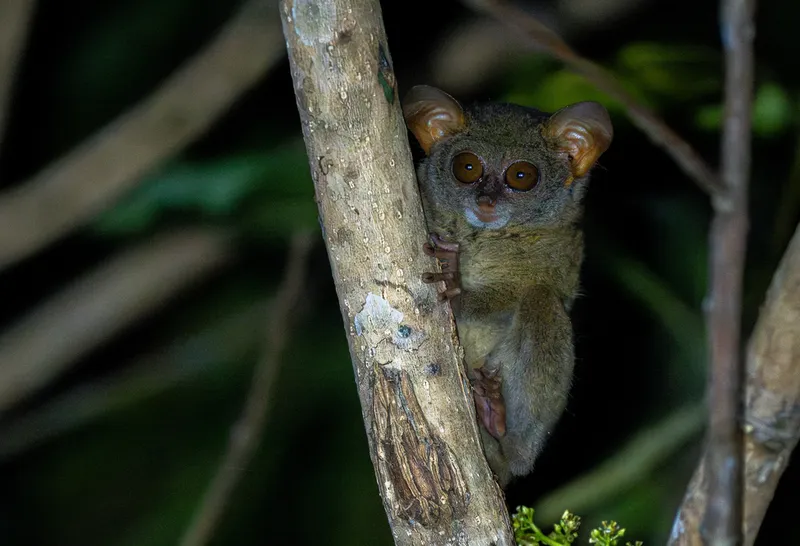
The Selayar tarsier (Tarsius tarsier) is a tiny nocturnal primate that lives only on Selayar Island, off the southern tip of Sulawesi. The Mammal Diversity Database calls it the Selayar or spectral tarsier and lists it as Vulnerable on the IUCN Red List.
LIPI researchers Wirdateti and Dahrudin (2008) found that Selayar tarsiers have lighter brownish fur and thinner, sparser tail hair than tarsiers from Patunuang in Maros. It can turn its head through 180 degrees. People on Selayar call it podi, meaning a frightening, monkey-like face, and some regard it as a kind of rat rather than a primate.
Evidence: Mammal Diversity Database (ASM) — Tarsius tarsier, Selayar Tarsier ↗ · Biodiversitas — Wirdateti & Dahrudin (2008), Pengamatan habitat, pakan dan distribusi Tarsius tarsier di Pulau Selayar dan TWA Patunuang, Sulawesi Selatan (PDF) ↗
Where does the Selayar tarsier live?
The Selayar tarsier lives only on Selayar Island in South Sulawesi. In 2010 Groves and Shekelle fixed Selayar as the type locality of Tarsius tarsier. In a July 2006 survey, tarsiers were found in the centre of the island, along the east coast and on part of the south coast, from beach forest up to 250 m.
They live in secondary forest and forest gardens planted with maize, bananas and coconuts. Local people also report tarsiers on Jampea Island, but the survey covered Selayar only. The Selayar tourism office says visitors can see them with an experienced guide on the east coast, at Bonetappalang and Pinang beaches.
Evidence: Mammal Diversity Database (ASM) — Tarsius tarsier, Selayar Tarsier ↗ · Biodiversitas — Wirdateti & Dahrudin (2008), Pengamatan habitat, pakan dan distribusi Tarsius tarsier di Pulau Selayar dan TWA Patunuang, Sulawesi Selatan (PDF) ↗ · Dinas Pariwisata dan Kebudayaan Kabupaten Kepulauan Selayar — Tarsius, Hewan Unik dan Langka ini ada di Selayar (2017) ↗
What does the Selayar tarsier eat?
The Selayar tarsier mainly eats insects that it hunts at night. Researchers watched one tarsier eye a beetle on a tree trunk from about 6 metres away, leap to catch it, then return to its perch to eat it. Tarsiers also snatch prey quickly to the left and right.
Farmers on Selayar believe tarsiers eat young maize, kenari nuts and fruit, and some call them maize pests. Wirdateti and Dahrudin say this needs scientific proof; they suggest tarsiers visit maize fields to catch insects. The local tourism office notes that tarsiers mainly eat insects such as cockroaches and crickets, and sometimes small reptiles, birds and bats.
Evidence: Biodiversitas — Wirdateti & Dahrudin (2008), Pengamatan habitat, pakan dan distribusi Tarsius tarsier di Pulau Selayar dan TWA Patunuang, Sulawesi Selatan (PDF) ↗ · Dinas Pariwisata dan Kebudayaan Kabupaten Kepulauan Selayar — Tarsius, Hewan Unik dan Langka ini ada di Selayar (2017) ↗
How does the Selayar tarsier behave?
The Selayar tarsier is active at night and lives in family groups. In the 2006 survey, each sleeping site held three to six animals, including young, juveniles and adults, with 200–500 metres between sites. Most sleeping sites were in dense clumps of thorny bamboo (Bambusa multiflex), about 2–3 metres above the ground, where predators struggle to reach them.
They called at set times: around 18:00, 20:00, 22:00 and 04:00–05:00. Unusually, Selayar tarsiers were seen playing around their sleeping trees until 10:00 in the morning, behaviour the researchers had not seen in other tarsiers. Shekelle and colleagues (2010) also note that the Selayar tarsier's duet call is distinctive.
Evidence: Biodiversitas — Wirdateti & Dahrudin (2008), Pengamatan habitat, pakan dan distribusi Tarsius tarsier di Pulau Selayar dan TWA Patunuang, Sulawesi Selatan (PDF) ↗ · International Journal of Primatology — Shekelle et al. (2010), Molecular phylogenetics and chronometrics of Tarsiidae based on 12S mtDNA haplotypes (PDF) ↗
How is the Selayar tarsier different from the Tangkoko tarsier?
The Selayar tarsier and the Tangkoko tarsier of North Sulawesi are now separate species; the Tangkoko tarsier is Tarsius spectrumgurskyae. Sulawesi's tarsiers were once lumped as T. spectrum, later merged into T. tarsier. Because the type specimen of T. tarsier probably came from Selayar, that name now applies only to Selayar tarsiers, with T. spectrum as a synonym.
In 2017 Shekelle and colleagues named the Tangkoko tarsier T. spectrumgurskyae, honouring Sharon Gursky, who studied that population for years under the name T. spectrum. Older books on the spectral tarsier of Tangkoko therefore describe a different species. Tarsiers around Makassar have also been separated as T. fuscus.
Evidence: International Journal of Primatology — Shekelle et al. (2010), Molecular phylogenetics and chronometrics of Tarsiidae based on 12S mtDNA haplotypes (PDF) ↗ · Sci.News — Two new species of tarsiers discovered in Indonesia (2017) ↗ · Mammal Diversity Database (ASM) — Tarsius fuscus, Makassar Tarsier ↗
How can the Selayar tarsier be protected?
The Selayar tarsier is protected in Indonesia: the annex to ministerial regulation P.106/2018 lists Tarsius tarsier as a protected species, under the Indonesian name krabuku tangkasi. In their 2006 survey, Wirdateti and Dahrudin found no trade or trapping of tarsiers and judged the population at their study sites to be stable.
However, Selayar tarsiers depend on bamboo clumps and forest gardens next to farmland, and some farmers see them as pests. Visitors should watch tarsiers at night with a guide and never catch, handle or keep them. Local people can help by keeping the bamboo clumps where tarsiers sleep.
Evidence: JDIH Kemenko Infrastruktur — Permen LHK P.106/MENLHK/SETJEN/KUM.1/12/2018 tentang Jenis Tumbuhan dan Satwa yang Dilindungi (PDF) ↗ · Biodiversitas — Wirdateti & Dahrudin (2008), Pengamatan habitat, pakan dan distribusi Tarsius tarsier di Pulau Selayar dan TWA Patunuang, Sulawesi Selatan (PDF) ↗ · Dinas Pariwisata dan Kebudayaan Kabupaten Kepulauan Selayar — Tarsius, Hewan Unik dan Langka ini ada di Selayar (2017) ↗
Common questions about the Selayar tarsier
What is the scientific name of the Selayar tarsier?
The scientific name of the Selayar tarsier is Tarsius tarsier, in the family Tarsiidae. In Indonesian it is called Tarsius Selayar.
Where can the Selayar tarsier be found in Indonesia?
In Indonesia, this guide records the Selayar tarsier in: Selayar Island, South Sulawesi.
What does the Selayar tarsier eat?
Diet of the Selayar tarsier: mainly insects hunted at night.
What is the conservation status of the Selayar tarsier?
On the IUCN Red List, the Selayar tarsier is listed as Vulnerable: it is considered to face a high risk of extinction in the wild. Source: IUCN Red List (via GBIF), checked 25 September 2026.
This global category is separate from legal protection in Indonesia. To check whether the Selayar tarsier is a protected species, consult the current national list of protected species or contact the local BKSDA (natural resources conservation office).
Sources & references
- Mammal Diversity Database (ASM) — Tarsius tarsier, Selayar Tarsier ↗
- Biodiversitas — Wirdateti & Dahrudin (2008), Pengamatan habitat, pakan dan distribusi Tarsius tarsier di Pulau Selayar dan TWA Patunuang, Sulawesi Selatan (PDF) ↗
- International Journal of Primatology — Shekelle et al. (2010), Molecular phylogenetics and chronometrics of Tarsiidae based on 12S mtDNA haplotypes (PDF) ↗
- Sci.News — Two new species of tarsiers discovered in Indonesia (2017) ↗
- Mammal Diversity Database (ASM) — Tarsius fuscus, Makassar Tarsier ↗
- Dinas Pariwisata dan Kebudayaan Kabupaten Kepulauan Selayar — Tarsius, Hewan Unik dan Langka ini ada di Selayar (2017) ↗
- JDIH Kemenko Infrastruktur — Permen LHK P.106/MENLHK/SETJEN/KUM.1/12/2018 tentang Jenis Tumbuhan dan Satwa yang Dilindungi (PDF) ↗
- IUCN Red List of Threatened Species, version 2026-1, via GBIF (CC BY 4.0) ↗
References can change. Check dates and context in the original source.
Further reading
Tarsier: facts, threats and conservation ↗ — World Animal Rescue Network. A broader overview that covers this animal.
Cite this page
PanduanHewan. (2026, 25 September). Selayar tarsier (Tarsius tarsier). PanduanHewan.org. https://panduanhewan.org/en/species/selayar-tarsier/