Quick answer
IUCN status: Least ConcernBanded krait at a glance
The Banded krait (Bungarus fasciatus) is a reptile in the family Elapidae. Its IUCN Red List category is Least Concern.
| Scientific name | Bungarus fasciatus |
|---|---|
| Indonesian name | Ular welang |
| Group | Reptiles |
| Family | Elapidae |
| Range in Indonesia | Sumatra, Java, Borneo and Bali |
| Linked habitats | Tropical Rainforests, Freshwater Wetlands, Urban Habitats |
| Diet | Other snakes, lizards and small mammals |
| Range in Indonesia | Sumatra, Java, Borneo and Bali |
| Key feature | Bands ring the belly; triangular body cross-section |
| Length | Up to 225 cm |
| Other names | Ular welang (Indonesian) |
| Risk to people | Neurotoxic venom; bites very rarely recorded |
| IUCN status | Least Concern · IUCN Red List (via GBIF) · checked 25 September 2026 |
In this guide (10)
What is the banded krait?
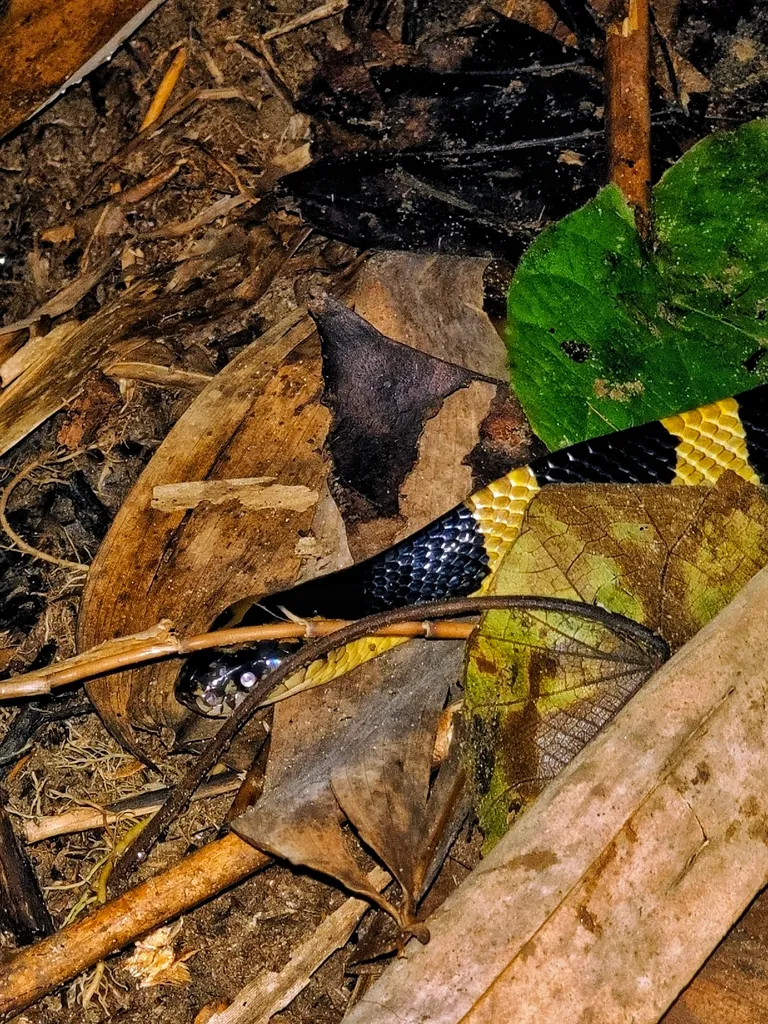
The banded krait (Bungarus fasciatus), or ular welang, is a venomous krait with black and yellow, or black and white, bands that ring its whole body. According to the Indonesian Herpetological Society, its head bears a V-shaped mark and its body is triangular in cross-section. WHO guidance notes a blunt tail tip. It can reach 2.25 metres. A 2023 genetic study found at least three lineages within B. fasciatus; populations from Java and the Greater Sunda Islands form a Sundaic lineage whose taxonomic status still needs review. It is most often confused with the Malayan krait (Bungarus candidus), which has a plain white belly.
Evidence: Perhimpunan Herpetologi Indonesia — Ular Welang (Bungarus fasciatus) (salinan arsip Wayback Machine, April 2026) ↗ · WHO Regional Office for South-East Asia — Guidelines for the management of snakebites, 2nd edition (2016) ↗ · Scientific Reports — Biakzuala et al. (2023), Molecular phylogeny reveals distinct evolutionary lineages of the banded krait ↗
Where does the banded krait live?
In Indonesia, the banded krait is recorded from Sumatra, Java, Borneo and Bali. The Indonesian Herpetological Society describes varied habitats, from forest and settlements to disturbed land, at 20–2,300 metres above sea level, with a preference for open areas near water. A record from the southern slope of Mount Merapi, Yogyakarta, was published in 2013. A telemetry study in rice-growing country in Thailand found that banded kraits sheltered by day along waterways and paddy dykes, and avoided regularly worked monoculture fields. Beyond Indonesia, the range stretches from India and Nepal to southern China and the Malay Peninsula.
Evidence: The Reptile Database — Bungarus fasciatus ↗ · Perhimpunan Herpetologi Indonesia — Ular Welang (Bungarus fasciatus) (salinan arsip Wayback Machine, April 2026) ↗ · The Herpetological Bulletin — Knierim et al. (2019), Spatial ecology study reveals nest attendance and habitat preference of banded kraits ↗
What does the banded krait eat?
The banded krait eats other snakes, lizards and small mammals, according to the Indonesian Herpetological Society, citing a field guide by Cox and colleagues (1998). It is active at night and hunts on the ground. WHO guidance explains that kraits, the genus Bungarus, sometimes enter homes at night in search of prey such as other snakes, lizards, frogs and mice. This habit means encounters with people can happen in or around houses. The genus name Bungarus comes from the Telugu word bangaru, meaning golden, a reference to the banded krait's yellow bands.
Evidence: Perhimpunan Herpetologi Indonesia — Ular Welang (Bungarus fasciatus) (salinan arsip Wayback Machine, April 2026) ↗ · WHO Regional Office for South-East Asia — Guidelines for the management of snakebites, 2nd edition (2016) ↗ · The Reptile Database — Bungarus fasciatus ↗
How does the banded krait breed?
The banded krait lays eggs, about 4–14 at a time according to the Indonesian Herpetological Society, and the female stays with them until they hatch. A telemetry study by Knierim and colleagues (2019) in Thailand confirmed this nest attendance. Two radio-tracked females moved less while attending nests in a shared burrow complex, and 15 hatchlings were seen emerging from the site. In the same study, three adult kraits had average home ranges of about 21 hectares and moved an average of about 47 metres between shelters. The researchers call for further study of banded krait reproduction.
Evidence: Perhimpunan Herpetologi Indonesia — Ular Welang (Bungarus fasciatus) (salinan arsip Wayback Machine, April 2026) ↗ · The Herpetological Bulletin — Knierim et al. (2019), Spatial ecology study reveals nest attendance and habitat preference of banded kraits ↗
Is the banded krait dangerous?
The banded krait is highly venomous and potentially deadly, but bites on people are very rarely recorded. Its venom is neurotoxic, meaning it attacks the nerves. WHO lists it as Category 2 (secondary medical importance) in Indonesia and notes that no banded krait bites are known there. The same guidance says the species rarely, if ever, bites humans. By contrast, deaths from bites by its relative, the Malayan krait, have been reported in Java. Because its venom is potent, it should never be handled. If bitten, seek medical care at a health facility immediately.
Evidence: WHO Regional Office for South-East Asia — Guidelines for the management of snakebites, 2nd edition (2016) ↗ · Perhimpunan Herpetologi Indonesia — Ular Welang (Bungarus fasciatus) (salinan arsip Wayback Machine, April 2026) ↗
What should you do if you meet a banded krait?
If you meet a banded krait, keep your distance and do not catch, handle or kill it; call trained officers such as Damkar, the fire and rescue service. Let the snake leave on its own; snakes prefer to avoid people when given the chance. In Greater Jakarta, fire departments are among the groups that respond to snake reports in residential areas, although banded kraits appeared only twice in records from 2015–2019. Because kraits are active at night, WHO advises extra care at night, after rain and during floods, and using a light when walking outside. The banded krait is listed as Least Concern on the IUCN Red List.
Evidence: Media Konservasi — Khoerunisa, Kusrini & Mardiastuti (2021), Diversity of snake rescued from residential areas in Greater Jakarta Metropolitan Area ↗ · WHO Regional Office for South-East Asia — Guidelines for the management of snakebites, 2nd edition (2016) ↗ · Scientific Reports — Biakzuala et al. (2023), Molecular phylogeny reveals distinct evolutionary lineages of the banded krait ↗
Explore related habitats
These habitat relationships are supported by species sources in this guide. This is not a complete range map.
Common questions about the Banded krait
What is the scientific name of the Banded krait?
The scientific name of the Banded krait is Bungarus fasciatus, in the family Elapidae. In Indonesian it is called Ular welang.
Where can the Banded krait be found in Indonesia?
In Indonesia, this guide records the Banded krait in: Sumatra, Java, Borneo and Bali.
Source-supported habitats: Tropical Rainforests, Freshwater Wetlands, Urban Habitats.
What does the Banded krait eat?
Diet of the Banded krait: other snakes, lizards and small mammals.
What is the conservation status of the Banded krait?
On the IUCN Red List, the Banded krait is listed as Least Concern: it does not currently qualify for a threatened category in the global assessment. Source: IUCN Red List (via GBIF), checked 25 September 2026.
This global category is separate from legal protection in Indonesia. To check whether the Banded krait is a protected species, consult the current national list of protected species or contact the local BKSDA (natural resources conservation office).
Sources & references
- The Reptile Database — Bungarus fasciatus ↗
- Perhimpunan Herpetologi Indonesia — Ular Welang (Bungarus fasciatus) (salinan arsip Wayback Machine, April 2026) ↗
- The Herpetological Bulletin — Knierim et al. (2019), Spatial ecology study reveals nest attendance and habitat preference of banded kraits ↗
- Scientific Reports — Biakzuala et al. (2023), Molecular phylogeny reveals distinct evolutionary lineages of the banded krait ↗
- WHO Regional Office for South-East Asia — Guidelines for the management of snakebites, 2nd edition (2016) ↗
- Media Konservasi — Khoerunisa, Kusrini & Mardiastuti (2021), Diversity of snake rescued from residential areas in Greater Jakarta Metropolitan Area ↗
- IUCN Red List of Threatened Species, version 2026-1, via GBIF (CC BY 4.0) ↗
References can change. Check dates and context in the original source.
Cite this page
PanduanHewan. (2026, 25 September). Banded krait (Bungarus fasciatus). PanduanHewan.org. https://panduanhewan.org/en/species/banded-krait/