Quick answer
Sunda king cobra at a glance
The Sunda king cobra (Ophiophagus bungarus) is a reptile.
| Scientific name | Ophiophagus bungarus |
|---|---|
| Indonesian name | King kobra |
| Group | Reptiles |
| Range in Indonesia | Sumatra, Java, Borneo, Bali and nearby islands |
| Linked habitats | Tropical Rainforests, Mangroves |
| Diet | Mainly other snakes, including rat snakes, pythons and cobras |
| Range in Indonesia | Sumatra, Java, Borneo, Bali and nearby islands |
| Key feature | Adults mostly plain brown; juveniles with 57–87 pale bands |
| Other names | King cobra; formerly included in Ophiophagus hannah |
| Risk to people | Neurotoxic venom; bites can be fatal |
In this guide (10)
What is the Sunda king cobra?
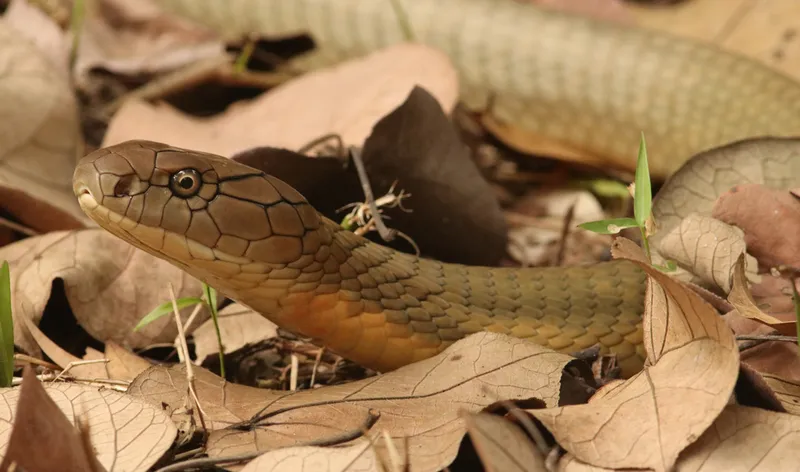
The Sunda king cobra (Ophiophagus bungarus) is the king cobra of western Indonesia, one of four king cobra species recognised since a 2024 taxonomic revision. Writing in the European Journal of Taxonomy, Das and colleagues restricted O. hannah to mainland Asia and revived the name bungarus for populations on the Sunda Shelf. Juveniles have 57–87 narrow pale bands on the body. Adults are yellowish-brown to mahogany, some grey-black, and are mostly unbanded. People often confuse it with true cobras (Naja), which in Indonesia do not exceed about 2 metres, according to LIPI researcher Amir Hamidy.
Evidence: European Journal of Taxonomy — Das et al. (2024), Taxonomic revision of the king cobra Ophiophagus hannah species complex ↗ · Mongabay Indonesia — Ular King Cobra Resmi Dikelompokkan Menjadi Empat Spesies yang Berbeda (2024) ↗ · Mongabay Indonesia — Urusan King Kobra dan Kobra, Amir Hamidy Pakarnya (2020) ↗
Where does the Sunda king cobra live?
The Sunda king cobra lives in Sumatra, Java, Borneo and Bali, as well as the Malay Peninsula and parts of the Philippines, according to the 2024 revision. Museum specimens examined for the revision came from places including Aceh, North Sumatra, West Sumatra, Bengkulu, West Java, Central and East Kalimantan, Bangka and Belitung. In the Sunda region, king cobras are recorded from lowland forests, including dipterocarp forests and mangroves. Amir Hamidy adds forest edges and oil palm plantations. King cobras have also been reported from Sulawesi, but the revision's authors say this eastern edge of the range needs new samples before its status is clear.
Evidence: European Journal of Taxonomy — Das et al. (2024), Taxonomic revision of the king cobra Ophiophagus hannah species complex ↗ · The Reptile Database — Ophiophagus bungarus ↗ · Mongabay Indonesia — Urusan King Kobra dan Kobra, Amir Hamidy Pakarnya (2020) ↗
What does the Sunda king cobra eat?
The Sunda king cobra feeds mainly on other snakes, including venomous ones. Its genus name, Ophiophagus, means snake-eater. According to Amir Hamidy, the king cobra evolved as a specialist snake-eater, and its favourite prey are rat snakes and pythons. Mongabay's report on the 2024 revision notes that king cobras also eat other cobras. Its neurotoxic venom subdues prey quickly. As a top predator among snakes, the king cobra helps to control other snake populations. The authors of the 2024 revision suggest the name bungarus refers to its likeness to kraits (genus Bungarus), either in its snake-eating habit or in its partly undivided tail scales.
Evidence: Mongabay Indonesia — Urusan King Kobra dan Kobra, Amir Hamidy Pakarnya (2020) ↗ · Mongabay — Four of a kind: King cobra is a quad of species, not one, study finds (2024) ↗ · European Journal of Taxonomy — Das et al. (2024), Taxonomic revision of the king cobra Ophiophagus hannah species complex ↗
How does the Sunda king cobra behave and breed?
The Sunda king cobra lays eggs, and according to Amir Hamidy the female builds a nest and guards it, behaviour he describes as unique among snakes. He also says few young survive, so populations of this top predator never become abundant. When threatened, a king cobra can raise the front of its body and spread its hood. The 2024 revision notes two important scientific findings for this species. The king cobra genome sequenced by Vonk and colleagues in 2013 came from a Bali specimen. In 2021, Card and colleagues documented facultative parthenogenesis, in which females produce offspring without mating, in this species.
Evidence: Mongabay Indonesia — Urusan King Kobra dan Kobra, Amir Hamidy Pakarnya (2020) ↗ · European Journal of Taxonomy — Das et al. (2024), Taxonomic revision of the king cobra Ophiophagus hannah species complex ↗
Is the Sunda king cobra dangerous?
Yes, the Sunda king cobra is dangerous to people: its venom is neurotoxic and a bite can kill. According to Amir Hamidy, the venom attacks the nerves that control breathing, so a victim may stop breathing, with effects within minutes to hours. He estimates that a single bite delivers about seven millilitres of venom. In Indonesia, several people have died after bites from king cobras kept as pets or used in shows, including in Bandung Regency in 2019 and Palangka Raya in 2018. WHO lists the king cobra as Category 2, of secondary medical importance, in Sumatra, Borneo and Java. If bitten, seek medical care at a health facility immediately.
Evidence: Mongabay Indonesia — Urusan King Kobra dan Kobra, Amir Hamidy Pakarnya (2020) ↗ · WHO Regional Office for South-East Asia — Guidelines for the management of snakebites, 2nd edition (2016) ↗
What should you do if you meet a king cobra?
If you meet a king cobra, keep your distance and do not approach, catch, handle or kill it; call trained officers such as Damkar, the fire and rescue service. In Greater Jakarta, fire departments are among the groups that respond to snake reports in residential areas; records from 2015–2019 include four king cobra reports there. King cobras mostly live in natural areas but are also popular as pets, so escaped animals may turn up in cities. Amir Hamidy lists the threats as habitat loss, killing during conflicts, trade, and keeping for shows. The 2024 revision notes that the split has wide implications for conservation.
Evidence: Media Konservasi — Khoerunisa, Kusrini & Mardiastuti (2021), Diversity of snake rescued from residential areas in Greater Jakarta Metropolitan Area ↗ · Mongabay Indonesia — Urusan King Kobra dan Kobra, Amir Hamidy Pakarnya (2020) ↗ · European Journal of Taxonomy — Das et al. (2024), Taxonomic revision of the king cobra Ophiophagus hannah species complex ↗
Explore related habitats
These habitat relationships are supported by species sources in this guide. This is not a complete range map.
Common questions about the Sunda king cobra
What is the scientific name of the Sunda king cobra?
The scientific name of the Sunda king cobra is Ophiophagus bungarus. In Indonesian it is called King kobra.
Where can the Sunda king cobra be found in Indonesia?
In Indonesia, this guide records the Sunda king cobra in: Sumatra, Java, Borneo, Bali and nearby islands.
Source-supported habitats: Tropical Rainforests, Mangroves.
What does the Sunda king cobra eat?
Diet of the Sunda king cobra: mainly other snakes, including rat snakes, pythons and cobras.
Sources & references
- European Journal of Taxonomy — Das et al. (2024), Taxonomic revision of the king cobra Ophiophagus hannah species complex ↗
- The Reptile Database — Ophiophagus bungarus ↗
- Mongabay — Four of a kind: King cobra is a quad of species, not one, study finds (2024) ↗
- Mongabay Indonesia — Ular King Cobra Resmi Dikelompokkan Menjadi Empat Spesies yang Berbeda (2024) ↗
- Mongabay Indonesia — Urusan King Kobra dan Kobra, Amir Hamidy Pakarnya (2020) ↗
- Media Konservasi — Khoerunisa, Kusrini & Mardiastuti (2021), Diversity of snake rescued from residential areas in Greater Jakarta Metropolitan Area ↗
- WHO Regional Office for South-East Asia — Guidelines for the management of snakebites, 2nd edition (2016) ↗
References can change. Check dates and context in the original source.
Further reading
Cobra: facts, threats and conservation ↗ — World Animal Rescue Network. A broader overview that covers this animal.
Cite this page
PanduanHewan. (2026, 25 September). Sunda king cobra (Ophiophagus bungarus). PanduanHewan.org. https://panduanhewan.org/en/species/sunda-king-cobra/