Quick answer
IUCN status: EndangeredFalse gharial at a glance
The False gharial (Tomistoma schlegelii) is a reptile in the family Crocodylidae. Its IUCN Red List category is Endangered.
| Scientific name | Tomistoma schlegelii |
|---|---|
| Indonesian name | Buaya senyulong |
| Group | Reptiles |
| Family | Crocodylidae |
| Range in Indonesia | Sumatra and Kalimantan (Borneo), with old records from Java |
| Linked habitats | Freshwater Wetlands, Tropical Rainforests |
| Diet | Fish, birds, monkeys, wild pigs and reptiles |
| Range in Indonesia | Sumatra and Kalimantan; old records from Java |
| Key feature | Long, slender snout that widens at the base |
| Other names | Sunda gharial, Sunda gavial, senyulong |
| Risk to people | Usually avoids people; attacks rare, one recorded death |
| Legal protection in Indonesia | Protected under ministerial regulation P.106/2018 |
| IUCN status | Endangered · IUCN Red List (via GBIF) · checked 25 September 2026 |
In this guide (10)
What is the false gharial?
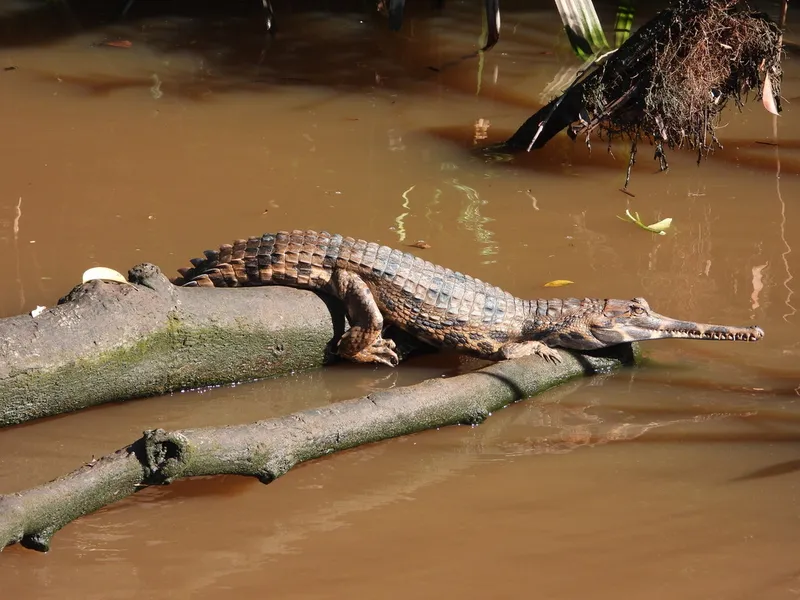
The false gharial (Tomistoma schlegelii) is a large freshwater crocodilian with a long, slender snout that widens at the base, giving it a look between typical crocodiles and gharials. Animal Diversity Web gives a length of 4–5 metres and 76–84 sharp teeth. It is dark brown with black bands on the body and tail.
It was long classed with the true crocodiles (Crocodylidae), but molecular studies from 2007 onwards place it in Gavialidae with the Indian gharial, and the Reptile Database lists Tomistoma as the closest relative of Gavialis. Its narrow snout separates it from the broad-snouted saltwater crocodile.
Evidence: Animal Diversity Web — Tomistoma schlegelii (false gharial) ↗ · The Reptile Database — Tomistoma schlegelii ↗ · Mongabay Indonesia — Senyulong, penjaga rawa gambut yang kehilangan ruang hidup (2025) ↗
Where does the false gharial live?
In Indonesia the false gharial lives in peat swamps, freshwater swamp forest, lakes and blackwater rivers on Sumatra and Borneo. On Sumatra, populations are recorded in Jambi (Berbak National Park), Riau (the Kampar river system) and South Sumatra (the Merang River).
In Kalimantan, relatively dense populations are known from Tanjung Puting National Park in Central Kalimantan and Lake Mesangat in East Kalimantan. Two animals were once recorded in Ujung Kulon, Java, but researchers consider the species likely close to disappearing from Java. Reports from Sulawesi are unconfirmed.
Evidence: IUCN SSC Crocodile Specialist Group — A report on the status of the false gharial (T. schlegelii) in Sumatra, 2016 ↗ · Animal Diversity Web — Tomistoma schlegelii (false gharial) ↗ · The Reptile Database — Tomistoma schlegelii ↗
What does the false gharial eat?
The false gharial is an opportunistic predator that eats fish, birds and land animals that come close to the water. Animal Diversity Web lists crab-eating macaques snatched from riverbanks, wild pigs, mouse deer, dogs, otters, turtles, snakes, monitor lizards, and aquatic and land invertebrates. Large prey is drowned or beaten against the bank.
A researcher quoted by Mongabay Indonesia says its snout makes it quick at catching fish. Where habitat is damaged and prey declines, false gharials are pushed to hunt elsewhere, including near villages and fishing spots.
Evidence: Animal Diversity Web — Tomistoma schlegelii (false gharial) ↗ · Mongabay Indonesia — Senyulong, penjaga rawa gambut yang kehilangan ruang hidup (2025) ↗
How does the false gharial breed?
The false gharial lays its eggs in a mound nest that the female builds from peat, twigs and dry leaves, usually at the shaded base of a tree near water. According to Animal Diversity Web, a clutch holds 20–60 very large eggs that hatch after about 90–100 days. Nest temperature decides the sex of the young.
Females sometimes guard the nest but more often move away when approached. Both sexes are thought to mature at about 20 years old. Much of this information comes from captive animals, because breeding in the wild is still poorly known.
Evidence: Animal Diversity Web — Tomistoma schlegelii (false gharial) ↗
Is the false gharial dangerous to people?
The false gharial is known as shy and tends to avoid people, but as a large crocodilian it can still be dangerous. A researcher interviewed by Mongabay Indonesia describes it as less aggressive than the saltwater crocodile, which causes most crocodile attacks in Indonesia. Even so, a report on crocodile–human conflict from 2014 to 2023 recorded one death caused by a false gharial.
Researchers say conflict is rising as swamp forest shrinks and prey declines, bringing the species closer to villages and fishing areas. If bitten, seek medical care at a health facility immediately.
Evidence: Mongabay Indonesia — Senyulong, penjaga rawa gambut yang kehilangan ruang hidup (2025) ↗ · Mongabay Indonesia — Senyulong, buaya pemalu yang habitatnya menghilang dan kini terpaksa mendekati manusia (2026) ↗
Why is the false gharial threatened, and how can it be protected?
The false gharial is threatened mainly because its peat swamp forest keeps disappearing. Its IUCN status rose from Vulnerable in 2014 to Endangered in 2024. Riau, South Sumatra and West, Central and East Kalimantan, the heart of its range, lost the most tree cover in Indonesia in 2002–2024. A Riau survey also found one drowned in a fish trap.
It is protected under Indonesian regulation P.106/2018 and listed on CITES Appendix I. Do not approach, catch, harm or kill it, and do not buy its eggs or body parts. If one appears near homes, keep your distance and ask trained officers, such as the local BKSDA, for help.
Evidence: JDIH Kemenko Infrastruktur — Permen LHK P.106/MENLHK/SETJEN/KUM.1/12/2018 (lampiran jenis satwa dilindungi) ↗ · Mongabay Indonesia — Senyulong, buaya pemalu yang habitatnya menghilang dan kini terpaksa mendekati manusia (2026) ↗ · IUCN SSC Crocodile Specialist Group — A report on the status of the false gharial (T. schlegelii) in Sumatra, 2016 ↗
Explore related habitats
These habitat relationships are supported by species sources in this guide. This is not a complete range map.
Common questions about the False gharial
What is the scientific name of the False gharial?
The scientific name of the False gharial is Tomistoma schlegelii, in the family Crocodylidae. In Indonesian it is called Buaya senyulong.
Where can the False gharial be found in Indonesia?
In Indonesia, this guide records the False gharial in: Sumatra and Kalimantan (Borneo), with old records from Java.
Source-supported habitats: Freshwater Wetlands, Tropical Rainforests.
What does the False gharial eat?
Diet of the False gharial: fish, birds, monkeys, wild pigs and reptiles.
What is the conservation status of the False gharial?
On the IUCN Red List, the False gharial is listed as Endangered: it is considered to face a very high risk of extinction in the wild. Source: IUCN Red List (via GBIF), checked 25 September 2026.
This global category is separate from legal protection in Indonesia. To check whether the False gharial is a protected species, consult the current national list of protected species or contact the local BKSDA (natural resources conservation office).
Sources & references
- The Reptile Database — Tomistoma schlegelii ↗
- Animal Diversity Web — Tomistoma schlegelii (false gharial) ↗
- Mongabay Indonesia — Senyulong, penjaga rawa gambut yang kehilangan ruang hidup (2025) ↗
- Mongabay Indonesia — Senyulong, buaya pemalu yang habitatnya menghilang dan kini terpaksa mendekati manusia (2026) ↗
- IUCN SSC Crocodile Specialist Group — A report on the status of the false gharial (T. schlegelii) in Sumatra, 2016 ↗
- JDIH Kemenko Infrastruktur — Permen LHK P.106/MENLHK/SETJEN/KUM.1/12/2018 (lampiran jenis satwa dilindungi) ↗
- Wikipedia bahasa Indonesia — Buaya sepit ↗
- IUCN Red List of Threatened Species, version 2026-1, via GBIF (CC BY 4.0) ↗
References can change. Check dates and context in the original source.
Cite this page
PanduanHewan. (2026, 25 September). False gharial (Tomistoma schlegelii). PanduanHewan.org. https://panduanhewan.org/en/species/false-gharial/