Quick answer
IUCN status: Critically EndangeredRote Island snake-necked turtle at a glance
The Rote Island snake-necked turtle (Chelodina mccordi) is a reptile in the family Chelidae. Its IUCN Red List category is Critically Endangered.
| Scientific name | Chelodina mccordi |
|---|---|
| Indonesian name | Kura-kura leher ular Rote |
| Group | Reptiles |
| Family | Chelidae |
| Range in Indonesia | Rote Island, East Nusa Tenggara |
| Linked habitats | Freshwater Wetlands |
| Diet | Small fish, insects and aquatic plants |
| Range in Indonesia | Only Rote Island, Rote Ndao Regency, East Nusa Tenggara |
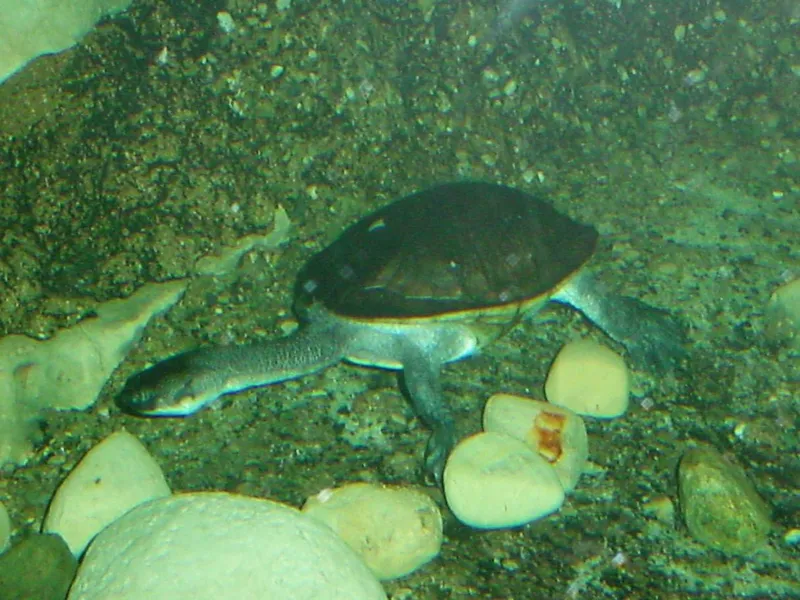
| Key feature | Long neck folded sideways under the shell |
| Other names | Roti Island snake-necked turtle, McCord's snakeneck turtle |
| Legal protection in Indonesia | Protected under ministerial regulation P.106/2018 |
| IUCN status | Critically Endangered · IUCN Red List (via GBIF) · checked 25 September 2026 |
In this guide (10)

What is the Rote Island snake-necked turtle?
The Rote Island snake-necked turtle (Chelodina mccordi) is a freshwater turtle of the family Chelidae whose very long neck cannot be pulled into the shell. Instead, it folds the neck sideways under the rim of the shell. Mongabay Indonesia gives a shell length of 18–24 cm, grey-brown to reddish-brown in colour.
It was once treated as Chelodina novaeguineae, a species of New Guinea and Australia, and was described as a separate species in 1994. Compared with that species, it has a wider shell and a shallower, less robust head. The Timor-Leste population is treated as the subspecies C. m. timorensis.
Evidence: IUCN/TRAFFIC — Analysis of CITES CoP16 Prop. 28: Roti Island snake-necked turtle Chelodina mccordi ↗ · Turtle Conservancy — Species highlight: Roti Island snake-necked turtle ↗ · Mongabay Indonesia — Kura-kura leher ular, jenis unik yang hanya ada di lahan basah Pulau Rote (2015) ↗
Where does the Rote Island snake-necked turtle live?
In Indonesia the Rote Island snake-necked turtle is known only from Rote Island in Rote Ndao Regency, East Nusa Tenggara. Another population lives around Lake Iralalaro in Timor-Leste. It uses small, shallow, nutrient-rich lakes, swamps, and nearby rice fields and irrigation ditches.
According to the East Nusa Tenggara conservation agency (BBKSDA NTT), quoted by Mongabay Indonesia, only nine of 35 former habitat lakes still held the species in 2005, and only three in 2012. Lakes Ledulu and Lende Oen in East Rote and Lake Peto in Central Rote are rated most suitable for releases, but all lie outside protected areas.
Evidence: IUCN/TRAFFIC — Analysis of CITES CoP16 Prop. 28: Roti Island snake-necked turtle Chelodina mccordi ↗ · Mongabay Indonesia — Kura-kura leher ular Rote dan masa depan konservasinya (2023) ↗ · WCS Indonesia — Rote Island snake-necked turtle ↗
What does the Rote Island snake-necked turtle eat?
The Rote Island snake-necked turtle feeds mainly on small fish, insects and aquatic plants, according to the Turtle Conservancy. It is mostly active at night.
Turtles returned from zoos are used to being fed. The East Nusa Tenggara conservation agency therefore trains them to find their own food during quarantine and adaptation, which takes about six months, before release. Ahead of the 2025 release, officers also spent three months checking each turtle's hunting ability, health and breeding behaviour.
Evidence: Turtle Conservancy — Species highlight: Roti Island snake-necked turtle ↗ · Mongabay Indonesia — Belasan kura-kura leher ular Rote yang terancam punah dipulangkan dari Singapura (2021) ↗ · BKSDA Yogyakarta — Menteri Kehutanan lepasliarkan 20 kura-kura Rote, satwa endemik terlangka di dunia (2025) ↗
How does the Rote Island snake-necked turtle breed?
The Rote Island snake-necked turtle starts breeding at about six years old and can then lay several times a year. Data from the Kupang forestry research centre, quoted by Mongabay Indonesia, show females lay two or three times a year, up to 20 eggs at a time. An IUCN–TRAFFIC analysis for CITES reports average captive clutches of 9.9–12.2 eggs.
According to Mongabay Indonesia (2015), hatchlings emerge after about three months and measure about 28 by 20 mm. The Kupang centre began breeding the species in 2009 with four turtles and held 35 by 2021.
Evidence: Mongabay Indonesia — Belasan kura-kura leher ular Rote yang terancam punah dipulangkan dari Singapura (2021) ↗ · IUCN/TRAFFIC — Analysis of CITES CoP16 Prop. 28: Roti Island snake-necked turtle Chelodina mccordi ↗ · Mongabay Indonesia — Kura-kura leher ular, jenis unik yang hanya ada di lahan basah Pulau Rote (2015) ↗
Why is the Rote Island snake-necked turtle nearly extinct?
The Rote Island snake-necked turtle is close to extinction in the wild mainly because it was collected heavily for the international pet trade. An IUCN–TRAFFIC analysis says collecting began in the 1980s, when it was still sold as C. novaeguineae, and grew after its 1994 description. Most demand came from hobbyists in western Europe, the USA and Japan, and prices reached USD 2,000 per animal by the late 1990s.
Indonesia set a zero export quota in 2002, and the species was added to CITES Appendix II in 2004. Wetland conversion to rice fields, pesticides and introduced predatory fish add pressure. The IUCN lists it as Critically Endangered.
Evidence: IUCN/TRAFFIC — Analysis of CITES CoP16 Prop. 28: Roti Island snake-necked turtle Chelodina mccordi ↗ · Turtle Survival Alliance — Rote Island snake-necked turtle ↗ · WCS Indonesia — Rote Island snake-necked turtle ↗
How is the Rote Island snake-necked turtle being saved?
Saving the Rote Island snake-necked turtle now relies on legal protection, repatriation from overseas zoos and releases into Rote's lakes. It is protected under Indonesian regulation P.106/2018. After 13 turtles were returned in 2021, another 33 came home from the Bronx Zoo in the United States in August 2023.
On 21 October 2025 the Minister of Forestry released 20 turtles into Lake Ledulu, with support from local customary (Papadak) groups. People can help by not buying or keeping these turtles and by supporting the protection of Rote's lakes.
Evidence: JDIH Kemenko Infrastruktur — Permen LHK P.106/MENLHK/SETJEN/KUM.1/12/2018 (lampiran jenis satwa dilindungi) ↗ · BKSDA Yogyakarta — Menteri Kehutanan lepasliarkan 20 kura-kura Rote, satwa endemik terlangka di dunia (2025) ↗ · Mongabay Indonesia — Dipulangkan, 33 kura-kura leher ular Rote dari Amerika ke habitat aslinya (2023) ↗
Explore related habitats
These habitat relationships are supported by species sources in this guide. This is not a complete range map.
Common questions about the Rote Island snake-necked turtle
What is the scientific name of the Rote Island snake-necked turtle?
The scientific name of the Rote Island snake-necked turtle is Chelodina mccordi, in the family Chelidae. In Indonesian it is called Kura-kura leher ular Rote.
Where can the Rote Island snake-necked turtle be found in Indonesia?
In Indonesia, this guide records the Rote Island snake-necked turtle in: Rote Island, East Nusa Tenggara.
Source-supported habitats: Freshwater Wetlands.
What does the Rote Island snake-necked turtle eat?
Diet of the Rote Island snake-necked turtle: small fish, insects and aquatic plants.
What is the conservation status of the Rote Island snake-necked turtle?
On the IUCN Red List, the Rote Island snake-necked turtle is listed as Critically Endangered: it is considered to face an extremely high risk of extinction in the wild. Source: IUCN Red List (via GBIF), checked 25 September 2026.
This global category is separate from legal protection in Indonesia. To check whether the Rote Island snake-necked turtle is a protected species, consult the current national list of protected species or contact the local BKSDA (natural resources conservation office).
Sources & references
- The Reptile Database — Chelodina mccordi ↗
- Turtle Conservancy — Species highlight: Roti Island snake-necked turtle ↗
- IUCN/TRAFFIC — Analysis of CITES CoP16 Prop. 28: Roti Island snake-necked turtle Chelodina mccordi ↗
- Turtle Survival Alliance — Rote Island snake-necked turtle ↗
- WCS Indonesia — Rote Island snake-necked turtle ↗
- Mongabay Indonesia — Kura-kura leher ular, jenis unik yang hanya ada di lahan basah Pulau Rote (2015) ↗
- Mongabay Indonesia — Belasan kura-kura leher ular Rote yang terancam punah dipulangkan dari Singapura (2021) ↗
- Mongabay Indonesia — Kura-kura leher ular Rote dan masa depan konservasinya (2023) ↗
- Mongabay Indonesia — Dipulangkan, 33 kura-kura leher ular Rote dari Amerika ke habitat aslinya (2023) ↗
- BKSDA Yogyakarta — Menteri Kehutanan lepasliarkan 20 kura-kura Rote, satwa endemik terlangka di dunia (2025) ↗
- JDIH Kemenko Infrastruktur — Permen LHK P.106/MENLHK/SETJEN/KUM.1/12/2018 (lampiran jenis satwa dilindungi) ↗
- IUCN Red List of Threatened Species, version 2026-1, via GBIF (CC BY 4.0) ↗
References can change. Check dates and context in the original source.
Cite this page
PanduanHewan. (2026, 25 September). Rote Island snake-necked turtle (Chelodina mccordi). PanduanHewan.org. https://panduanhewan.org/en/species/rote-island-snake-necked-turtle/