Quick answer
IUCN status: EndangeredPig-nosed turtle at a glance
The Pig-nosed turtle (Carettochelys insculpta) is a reptile in the family Carettochelyidae. Its IUCN Red List category is Endangered.
| Scientific name | Carettochelys insculpta |
|---|---|
| Indonesian name | Labi-labi moncong babi |
| Group | Reptiles |
| Family | Carettochelyidae |
| Range in Indonesia | Southern Papua |
| Linked habitats | Freshwater Wetlands, Mangroves |
| Diet | Fruit, flowers, leaves, molluscs and insects |
| Range in Indonesia | Lowland rivers and swamps of southern Papua |
| Key feature | Fleshy pig-like snout and flipper-shaped limbs |
| Other names | Fly River turtle, pitted-shelled turtle |
| Legal protection in Indonesia | Protected under ministerial regulation P.106/2018 |
| IUCN status | Endangered · IUCN Red List (via GBIF) · checked 25 September 2026 |
In this guide (10)
What is the pig-nosed turtle?
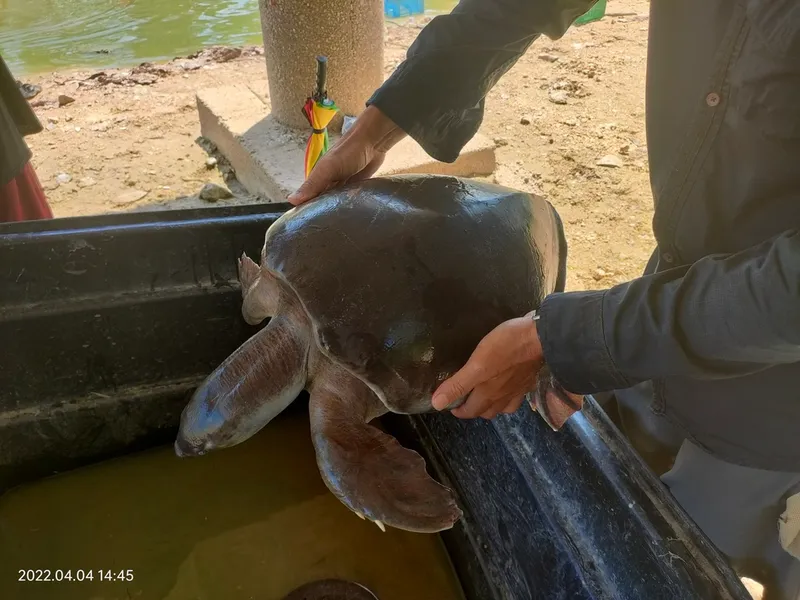
The pig-nosed turtle (Carettochelys insculpta) is a large freshwater turtle with a fleshy, pig-like snout and paddle-shaped flippers like a sea turtle's. It is the only living species of the family Carettochelyidae. Instead of hard scutes, its shell is covered with soft, pitted, grey to olive skin. A TRAFFIC report gives a maximum shell length of 56 cm and a weight of up to 22.5 kg.
Although its Indonesian name calls it a labi-labi (softshell turtle), its shell edges are stiff and joined to the lower shell by a bony ridge, unlike the flexible edges of true softshells (Trionychidae).
Evidence: TRAFFIC — Assessing the trade in pig-nosed turtles Carettochelys insculpta in Papua, Indonesia (Burgess & Lilley, 2014) ↗ · Animal Diversity Web — Carettochelys insculpta (pig-nosed turtle) ↗ · The Reptile Database — Carettochelys insculpta ↗
Where does the pig-nosed turtle live?
In Indonesia the pig-nosed turtle lives in rivers, freshwater swamps and mangrove swamps in the lowlands of southern Papua. A 2014 TRAFFIC report records it in the regencies of Merauke, Asmat, Mappi, Boven Digoel, Mimika and Dogiyai. In Asmat it occurs in the Vriendschap, Eilanden, Brassa and Lorentz river systems and their tributaries.
Outside Indonesia it lives in southern Papua New Guinea and the Northern Territory of Australia. Its habitat includes rivers, estuaries, lagoons, lakes and pools, usually in heavily forested country. Males never leave the water.
Evidence: TRAFFIC — Assessing the trade in pig-nosed turtles Carettochelys insculpta in Papua, Indonesia (Burgess & Lilley, 2014) ↗ · WWF Indonesia — Kura-kura moncong babi ↗ · Animal Diversity Web — Carettochelys insculpta (pig-nosed turtle) ↗
What does the pig-nosed turtle eat?
Adult pig-nosed turtles are omnivores but eat more plant matter, such as flowers, fruit and leaves from the riverbank. Animal Diversity Web says they also eat molluscs and insects. Newly hatched young live on leftover yolk, then eat small aquatic animals such as insect larvae, small shrimp and snails.
The snout works as a snorkel in murky water and carries sensory receptors that help it find prey. Because the water is often turbid, sight probably plays only a secondary role.
Evidence: Animal Diversity Web — Carettochelys insculpta (pig-nosed turtle) ↗
How does the pig-nosed turtle breed?
Female pig-nosed turtles leave the water only to lay eggs on sandy riverbanks in the dry season. According to TRAFFIC, nesting in New Guinea runs from about September to February. Females often nest in groups, with up to 16 recorded on one sandbank in Australia. An Australian study found clutches of 10 ± 2 eggs and two clutches per season.
Temperature sets the sex of the young. Animal Diversity Web reports that 32°C produces both sexes, slightly cooler nests produce males and slightly warmer nests produce females.
Evidence: TRAFFIC — Assessing the trade in pig-nosed turtles Carettochelys insculpta in Papua, Indonesia (Burgess & Lilley, 2014) ↗ · Animal Diversity Web — Carettochelys insculpta (pig-nosed turtle) ↗ · The Reptile Database — Carettochelys insculpta ↗
Why are pig-nosed turtles smuggled in such numbers?
Pig-nosed turtles are smuggled in large numbers because their hatchlings sell abroad as pets, food and traditional medicine. TRAFFIC (2014) found that villagers dig eggs from river sandbanks, hatch them and sell the young to traders. An estimate it cites puts the harvest at 1.5–2 million eggs a year from rivers in Merauke. It recorded 32 seizures totalling 81,689 turtles between 2003 and 2012.
Hatchlings move through Timika, Merauke and Jayapura to larger cities, then on to Hong Kong, China, Malaysia and Singapore. WWF Indonesia gives its IUCN status as Endangered.
Evidence: TRAFFIC — Assessing the trade in pig-nosed turtles Carettochelys insculpta in Papua, Indonesia (Burgess & Lilley, 2014) ↗ · TRAFFIC — Large seizures of protected pig-nosed turtles in Indonesia highlight magnitude of illegal trade (2016) ↗ · WWF Indonesia — Kura-kura moncong babi ↗
How can the pig-nosed turtle be protected?
The pig-nosed turtle is protected in Indonesia under regulation P.106/2018. TRAFFIC notes that, because it is protected, no capture or export quota is set for it. It is also listed on CITES Appendix II. Seized turtles can be returned to the wild. In February 2016, for example, conservation (BKSDA) and quarantine officers at Jakarta's Soekarno-Hatta airport seized 3,737 bound for Hong Kong, and the BKSDA said they would be returned to the wild as soon as possible.
People can help by not buying pig-nosed turtles as pets, including online, and by reporting illegal trade to the BKSDA or the police.
Evidence: JDIH Kemenko Infrastruktur — Permen LHK P.106/MENLHK/SETJEN/KUM.1/12/2018 (lampiran jenis satwa dilindungi) ↗ · TRAFFIC — Large seizures of protected pig-nosed turtles in Indonesia highlight magnitude of illegal trade (2016) ↗ · TRAFFIC — Assessing the trade in pig-nosed turtles Carettochelys insculpta in Papua, Indonesia (Burgess & Lilley, 2014) ↗
Explore related habitats
These habitat relationships are supported by species sources in this guide. This is not a complete range map.
Common questions about the Pig-nosed turtle
What is the scientific name of the Pig-nosed turtle?
The scientific name of the Pig-nosed turtle is Carettochelys insculpta, in the family Carettochelyidae. In Indonesian it is called Labi-labi moncong babi.
Where can the Pig-nosed turtle be found in Indonesia?
In Indonesia, this guide records the Pig-nosed turtle in: Southern Papua.
Source-supported habitats: Freshwater Wetlands, Mangroves.
What does the Pig-nosed turtle eat?
Diet of the Pig-nosed turtle: fruit, flowers, leaves, molluscs and insects.
What is the conservation status of the Pig-nosed turtle?
On the IUCN Red List, the Pig-nosed turtle is listed as Endangered: it is considered to face a very high risk of extinction in the wild. Source: IUCN Red List (via GBIF), checked 25 September 2026.
This global category is separate from legal protection in Indonesia. To check whether the Pig-nosed turtle is a protected species, consult the current national list of protected species or contact the local BKSDA (natural resources conservation office).
Sources & references
- The Reptile Database — Carettochelys insculpta ↗
- Animal Diversity Web — Carettochelys insculpta (pig-nosed turtle) ↗
- TRAFFIC — Assessing the trade in pig-nosed turtles Carettochelys insculpta in Papua, Indonesia (Burgess & Lilley, 2014) ↗
- TRAFFIC — Large seizures of protected pig-nosed turtles in Indonesia highlight magnitude of illegal trade (2016) ↗
- WWF Indonesia — Kura-kura moncong babi ↗
- JDIH Kemenko Infrastruktur — Permen LHK P.106/MENLHK/SETJEN/KUM.1/12/2018 (lampiran jenis satwa dilindungi) ↗
- IUCN Red List of Threatened Species, version 2026-1, via GBIF (CC BY 4.0) ↗
References can change. Check dates and context in the original source.
Cite this page
PanduanHewan. (2026, 25 September). Pig-nosed turtle (Carettochelys insculpta). PanduanHewan.org. https://panduanhewan.org/en/species/pig-nosed-turtle/