Quick answer
IUCN status: Least ConcernCrocodile monitor at a glance
The Crocodile monitor (Varanus salvadorii) is a reptile in the family Varanidae. Its IUCN Red List category is Least Concern.
| Scientific name | Varanus salvadorii |
|---|---|
| Indonesian name | Biawak Papua |
| Group | Reptiles |
| Family | Varanidae |
| Range in Indonesia | Papua (Indonesian New Guinea) |
| Linked habitats | Tropical Rainforests, Mangroves |
| Diet | Birds, small mammals, fish, eggs and carrion |
| Range in Indonesia | Lowland forest and mangroves in Papua |
| Key feature | Tail up to two-thirds of total length |
| Other names | Papuan monitor, Salvadori's monitor |
| Risk to people | Bite and tail lash can cause serious injury |
| IUCN status | Least Concern · IUCN Red List (via GBIF) · checked 25 September 2026 |
In this guide (10)
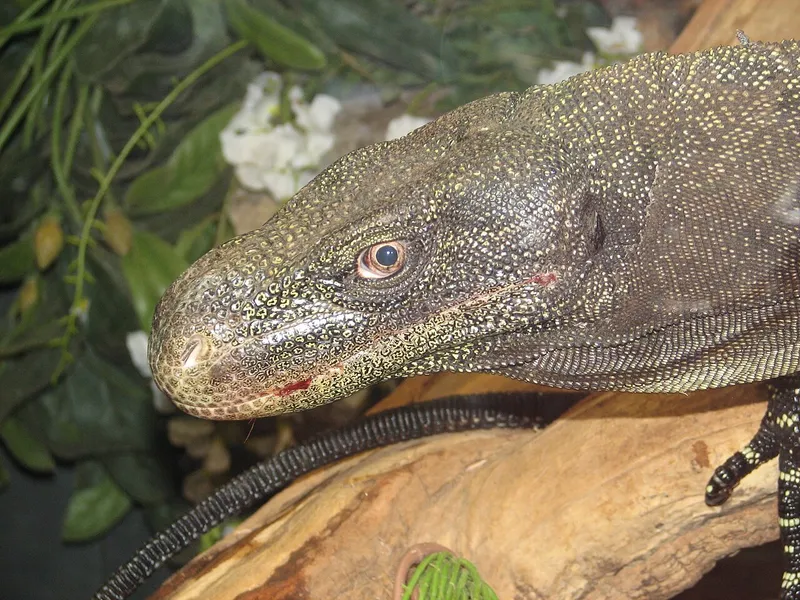

What is the crocodile monitor?
The crocodile monitor (Varanus salvadorii) is a large tree-climbing monitor lizard from New Guinea and one of the longest lizards in the world. Smithsonian's National Zoo says it can exceed 2.4 metres in total length and weigh up to 20 kg, with the tail making up to two-thirds of that length. It is blackish-green with bright yellow spots and stripes. Its teeth are flat, very sharp and serrated.
The Reptile Database places it in the subgenus Papusaurus. It is named after the ornithologist Tommaso Salvadori, and its type specimen came from Dorei, today's Manokwari.
Evidence: Smithsonian's National Zoo and Conservation Biology Institute — Crocodile monitor ↗ · The Reptile Database — Varanus salvadorii ↗ · Journal of Threatened Taxa — Range extension and new ecoregion records of the crocodile monitor Varanus salvadorii in Papua New Guinea (2022) ↗
Where does the crocodile monitor live?
The crocodile monitor lives only on New Guinea, in both Indonesian Papua and Papua New Guinea. Smithsonian's National Zoo describes its populations as fragmented and records it in Papua and West Papua. It lives in lowland rainforest, floodplain forest, mangrove swamps and riverside woodland that are undisturbed by people.
It is usually found from sea level to about 740 metres, but camera traps in the Torricelli Mountains of Papua New Guinea recorded one at 1,500 metres. It spends much of its time in trees but also comes down to the ground near water.
Evidence: Smithsonian's National Zoo and Conservation Biology Institute — Crocodile monitor ↗ · Animal Diversity Web — Varanus salvadorii (crocodile monitor) ↗ · Journal of Threatened Taxa — Range extension and new ecoregion records of the crocodile monitor Varanus salvadorii in Papua New Guinea (2022) ↗
What does the crocodile monitor eat?
The crocodile monitor is a carnivore that preys on birds, mammals, fish and other small animals. Smithsonian's National Zoo says its wild diet is poorly known but is thought to include birds, mammals and fish, and occasionally eggs, small reptiles and carrion. Animal Diversity Web adds rodents, amphibians and insects.
Long, sharp teeth and powerful jaws seize the prey, which is swallowed whole. As an apex predator in New Guinea's forests, it helps keep populations of smaller animals in check.
Evidence: Smithsonian's National Zoo and Conservation Biology Institute — Crocodile monitor ↗ · Animal Diversity Web — Varanus salvadorii (crocodile monitor) ↗ · Journal of Threatened Taxa — Range extension and new ecoregion records of the crocodile monitor Varanus salvadorii in Papua New Guinea (2022) ↗
How does the crocodile monitor behave?
The crocodile monitor is an agile climber that usually lives alone. Animal Diversity Web says it basks during the day and uses its long tail for balance when jumping between branches. Smithsonian's National Zoo notes it is aggressive towards other individuals, especially those of the same sex.
Its breeding in the wild is almost unknown. In captivity, females lay 4–12 eggs four to six weeks after mating, up to three times a year, and the eggs incubate for five to eight months. Hatchlings measure about 35–41 cm.
Evidence: Animal Diversity Web — Varanus salvadorii (crocodile monitor) ↗ · Smithsonian's National Zoo and Conservation Biology Institute — Crocodile monitor ↗
Is the crocodile monitor dangerous?
The crocodile monitor can be dangerous if disturbed, because its bite and tail lash can cause serious injury. Animal Diversity Web notes it can do severe damage to people who disturb it, and that attacks on livestock are not uncommon. Smithsonian's National Zoo says it uses its tail like a whip in defence, and its sharp, serrated teeth for defence and catching prey.
Do not approach, catch, handle or kill it. Keep a safe distance and ask trained officers for help. If bitten, seek medical care at a health facility immediately.
Evidence: Animal Diversity Web — Varanus salvadorii (crocodile monitor) ↗ · Smithsonian's National Zoo and Conservation Biology Institute — Crocodile monitor ↗
What threatens the crocodile monitor, and how can it be protected?
The biggest threat to the crocodile monitor is forest loss from logging and clearing for agriculture, because it avoids areas disturbed by people. Smithsonian's National Zoo also lists hunting for skin and meat, and notes that the species has recently entered the pet trade. According to Animal Diversity Web, its skin has traditionally been used for clothing and ritual drum heads.
The IUCN rates it Least Concern, but its population is thought to be declining, and international trade is controlled under CITES Appendix II. Do not buy wild-caught monitors, and support the protection of Papua's lowland forests.
Evidence: Smithsonian's National Zoo and Conservation Biology Institute — Crocodile monitor ↗ · Animal Diversity Web — Varanus salvadorii (crocodile monitor) ↗
Explore related habitats
These habitat relationships are supported by species sources in this guide. This is not a complete range map.
Common questions about the Crocodile monitor
What is the scientific name of the Crocodile monitor?
The scientific name of the Crocodile monitor is Varanus salvadorii, in the family Varanidae. In Indonesian it is called Biawak Papua.
Where can the Crocodile monitor be found in Indonesia?
In Indonesia, this guide records the Crocodile monitor in: Papua (Indonesian New Guinea).
Source-supported habitats: Tropical Rainforests, Mangroves.
What does the Crocodile monitor eat?
Diet of the Crocodile monitor: birds, small mammals, fish, eggs and carrion.
What is the conservation status of the Crocodile monitor?
On the IUCN Red List, the Crocodile monitor is listed as Least Concern: it does not currently qualify for a threatened category in the global assessment. Source: IUCN Red List (via GBIF), checked 25 September 2026.
This global category is separate from legal protection in Indonesia. To check whether the Crocodile monitor is a protected species, consult the current national list of protected species or contact the local BKSDA (natural resources conservation office).
Sources & references
- The Reptile Database — Varanus salvadorii ↗
- Animal Diversity Web — Varanus salvadorii (crocodile monitor) ↗
- Smithsonian's National Zoo and Conservation Biology Institute — Crocodile monitor ↗
- Journal of Threatened Taxa — Range extension and new ecoregion records of the crocodile monitor Varanus salvadorii in Papua New Guinea (2022) ↗
- Wikipedia bahasa Indonesia — Biawak Papua ↗
- IUCN Red List of Threatened Species, version 2026-1, via GBIF (CC BY 4.0) ↗
References can change. Check dates and context in the original source.
Further reading
Monitor lizard: facts, threats and conservation ↗ — World Animal Rescue Network. A broader overview that covers this animal.
Cite this page
PanduanHewan. (2026, 25 September). Crocodile monitor (Varanus salvadorii). PanduanHewan.org. https://panduanhewan.org/en/species/crocodile-monitor/