
More than one island
Komodo dragons do not live only on Komodo Island. Their range includes several islands around the national park and parts of Flores. Island size, prey availability, and human pressures differ between populations. Avoid using one number or one visitor experience as a description of the whole species.
A hunter’s body
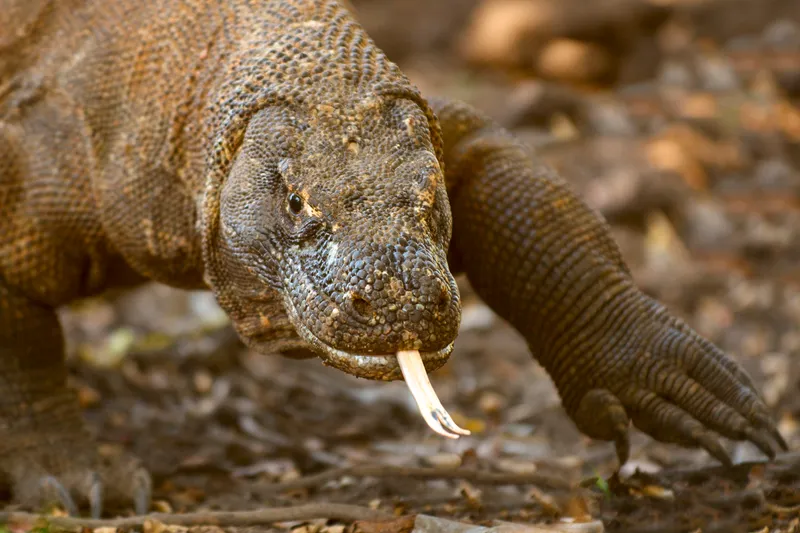
A forked tongue helps a dragon sample chemical clues from its surroundings. A powerful body, teeth, and venomous bite support its predatory way of life; carrion is also food. Large size does not mean it is always slow or safe to approach, even when it appears to be resting.
Savanna, woodland, and prey
Dragon landscapes include savanna and wooded areas. Protecting dragons therefore also means maintaining prey and habitat structure. Deer hunting and land-use change can affect this predator even when dragons themselves are not being hunted. The savanna guide helps place these relationships within a connected ecological system.
Conservation must fit each island
Komodo Survival Program distinguishes challenges inside the national park from those on Flores, including habitat outside protected areas. IUCN also highlights climate-related risks to habitat. An Endangered classification describes extinction risk; it does not mean every population is changing at the same speed or for the same reason.
Why repeated monitoring matters
Researchers use individual tagging and camera traps to study survival, occurrence, and population change. Different methods answer different questions. When you encounter a claimed dragon count, check its year, survey area, and counting method before comparing it with another report; mismatched surveys can produce misleading comparisons.
Observation that preserves space
Follow site rules and the instructions of authorised local guides. Do not feed, attract, or block a dragon’s path for a photograph. Plan visits using current official information because access and rules can change. Conservation can also be supported without travelling into sensitive habitat.
Sources & references
- Smithsonian’s National Zoo — Komodo dragon ↗
- Komodo Survival Program — Conservation status ↗
- Komodo Survival Program — Population monitoring ↗
- IUCN — 2021 Red List update ↗
References can change. Check dates and context in the original source.