Quick answer
IUCN status: Critically EndangeredSunda pangolin at a glance
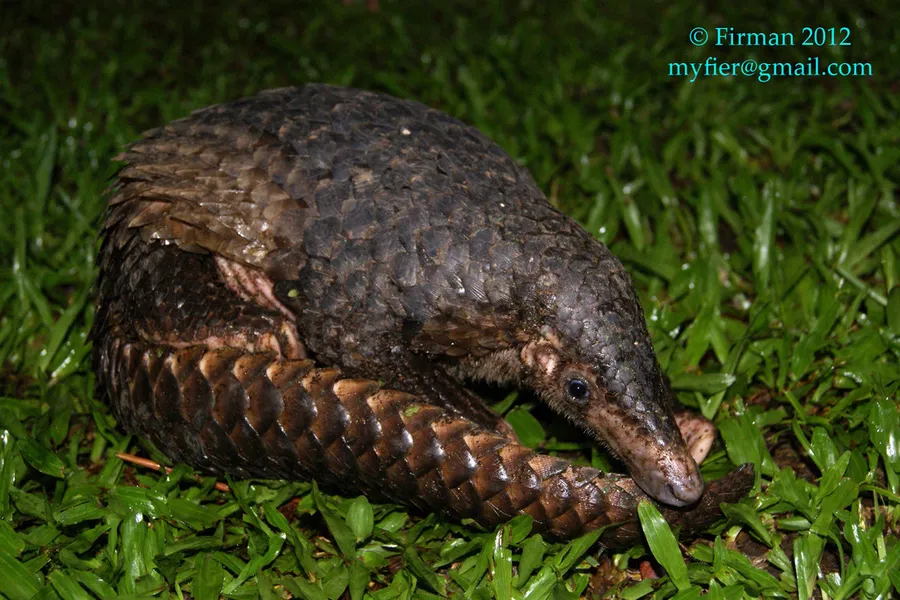
The Sunda pangolin (Manis javanica) is a mammal in the family Manidae. Range in Indonesia: Sumatra, Java and Kalimantan. Diet: ants and termites; a carnivore. IUCN Red List status: Critically Endangered. It is a legally protected species in Indonesia (Regulation P.106/2018).
| Scientific name | Manis javanica |
|---|---|
| Indonesian name | Trenggiling Sunda |
| Group | Mammals |
| Family | Manidae |
| Range in Indonesia | Sumatra, Java and Kalimantan |
| Linked habitats | Tropical Rainforests |
| Diet | Ants and termites |
| Scale material | Keratin |
| Animal class | Mammal |
| IUCN status | Critically Endangered · IUCN SSC Pangolin Specialist Group — Sunda pangolin |
| Legal protection in Indonesia | Protected · Regulation P.106/2018 · annex no. 84 |
| Reproduction | Usually a single young after a 6–7 month gestation · IUCN SSC Pangolin Specialist Group — Sunda pangolin |
| Diet type | Carnivore (meat-eater) — ant and termite eater (insectivore) · Animal Diversity Web |
| Reproduction | Giving birth to live young (viviparous) · Animal Diversity Web |
| Observance days | World Pangolin Day (Third Saturday of February (2026: 21 February; 2027: 20 February)) |
| Active | Nocturnal (active at night) — Activity peaks in the hours before dawn; young animals are sometimes active by day. · Handbook of the Mammals of the World, Vol. 2 Hoofed Mammals (Wilson & Mittermeier eds., Lynx Edicions 2011), Manidae: Manis javanica account (Plazi treatment) |
In this guide (11)
A mammal with scales
Pangolins are mammals despite their covering of scales, which are made of keratin. Appearance alone does not determine animal classification: comparing a pangolin with a Komodo dragon helps distinguish visual similarity from biological relationship. The two have very different living requirements.
Evidence: IUCN SSC Pangolin Specialist Group — Pangolin biology ↗
A specialist in small prey
Ants and termites are the principal foods of pangolins. This specialised diet differs from that of omnivores such as sun bears. An apparently quiet animal can still have needs difficult for people to meet. Do not take one into captivity or experiment with household foods when encountering it.
Evidence: IUCN SSC Pangolin Specialist Group — Pangolin biology ↗
Trees, shelter, and range
Sunda pangolins are more arboreal than Chinese pangolins and occur across Southeast Asia, including Sumatra, Java and Borneo. Nursamsi et al.’s 2023 analysis was strongly influenced by low-poaching Singapore. It distinguished active clearing from previously degraded forest; persistence with poaching control does not guarantee the same outcome at every Indonesian site.
Evidence: IUCN SSC Pangolin Specialist Group — Sunda pangolin ↗ · Nursamsi et al. — Habitat disturbance research, 2023 ↗ · Pangolin Specialist Group — Regional strategy and distribution, 2018–2028 ↗
Reading wildlife-trade data
TRAFFIC’s Scaly Nexus report, published in 2017, examines seizures involving Indonesia during 2010–2015. These records describe detected trade in that period, not all trafficking or the current wild population. Enforcement effort can affect recorded cases; seized quantities cannot simply be converted into a population estimate.
Evidence: TRAFFIC — Scaly Nexus: Indonesian pangolin seizures, 2010–2015 ↗
Helping without buying
TRAFFIC and the specialist group document illegal trade as a threat. PanduanHewan recommends safely preserving evidence of sale offers and using wildlife-trade reporting channels. Avoid buying to rescue, because payment still reaches the seller. Provide precise wild-animal locations privately to responders who can act on the information.
Evidence: TRAFFIC — Scaly Nexus: Indonesian pangolin seizures, 2010–2015 ↗ · IUCN SSC Pangolin Specialist Group — Pangolin biology ↗
Explore related habitats
These habitat relationships are supported by species sources in this guide. This is not a complete range map.
Scientific classification of the Sunda pangolin
| Kingdom | Animalia |
|---|---|
| Phylum | Chordata |
| Class | Mammalia |
| Order | Pholidota |
| Family | Manidae |
| Genus | Manis |
| Species | Manis javanica |
Source: GBIF Backbone Taxonomy, adjusted to the ranks commonly used in school biology (for example class Reptilia).
Common questions about the Sunda pangolin
What is the scientific name of the Sunda pangolin?
The scientific name of the Sunda pangolin is Manis javanica, in the family Manidae. In Indonesian it is called Trenggiling Sunda.
What kind of animal is the Sunda pangolin?
The Sunda pangolin is a mammal in the family Manidae. By diet it is a carnivore (meat-eater): a ant and termite eater (insectivore).
Where does the Sunda pangolin live in Indonesia?
In Indonesia, this guide records the Sunda pangolin in: Sumatra, Java and Kalimantan.
Source-supported habitats: Tropical Rainforests.
What does the Sunda pangolin eat?
Diet of the Sunda pangolin: ants and termites. That makes it a carnivore (meat-eater). Source: Animal Diversity Web.
How does the Sunda pangolin reproduce?
The Sunda pangolin reproduces by giving birth to live young (viviparous). Source: Animal Diversity Web.
Is the Sunda pangolin nocturnal?
The cited source records the Sunda pangolin as nocturnal (active at night). Activity peaks in the hours before dawn; young animals are sometimes active by day. Source: Handbook of the Mammals of the World, Vol. 2 Hoofed Mammals (Wilson & Mittermeier eds., Lynx Edicions 2011), Manidae: Manis javanica account (Plazi treatment).
See also the list of nocturnal and diurnal animals in Indonesia.
What is the scientific classification of the Sunda pangolin?
Scientific classification of the Sunda pangolin: kingdom Animalia, phylum Chordata, class Mammalia, order Pholidota, family Manidae, genus Manis, species Manis javanica.
Source: GBIF Backbone Taxonomy, adjusted to the ranks commonly used in school biology.
Is the Sunda pangolin endangered?
Yes. The global conservation status of the Sunda pangolin: Critically Endangered. In the IUCN system, this category means it is considered to face an extremely high risk of extinction in the wild. Source: IUCN SSC Pangolin Specialist Group — Sunda pangolin.
This global category is separate from national legal protection. Is the Sunda pangolin protected in Indonesia?
Is the Sunda pangolin protected in Indonesia?
Yes. The Sunda pangolin (Manis javanica) is a protected species in Indonesia under Environment and Forestry Ministerial Regulation No. P.106/MENLHK/SETJEN/KUM.1/12/2018 on protected plant and animal species (annex, entry 84).
Article 21(2) of Law No. 5 of 1990, as amended by Law No. 32 of 2024, prohibits anyone from hunting, catching, injuring, killing, storing, owning, keeping, transporting or trading a protected animal, alive or dead, including its body parts, eggs and nests.
If you see this animal being traded, kept or injured, contact the local BKSDA office.
Can the Sunda pangolin be kept as a pet?
No. Because the Sunda pangolin is a protected species, catching, owning, keeping, transporting or trading it without a permit is prohibited by law. Trading without a permit through electronic media is also prohibited.
If you see this animal for sale or being kept, report it to the local BKSDA office.
Sources & references
- IUCN SSC Pangolin Specialist Group — Sunda pangolin ↗
- IUCN SSC Pangolin Specialist Group — Pangolin biology ↗
- Pangolin Specialist Group — Regional strategy and distribution, 2018–2028 ↗
- Nursamsi et al. — Habitat disturbance research, 2023 ↗
- TRAFFIC — Scaly Nexus: Indonesian pangolin seizures, 2010–2015 ↗
- Peraturan Menteri LHK Nomor P.106/MENLHK/SETJEN/KUM.1/12/2018 tentang Jenis Tumbuhan dan Satwa yang Dilindungi ↗
- Animal Diversity Web ↗
- Animal Diversity Web ↗
- Handbook of the Mammals of the World, Vol. 2 Hoofed Mammals (Wilson & Mittermeier eds., Lynx Edicions 2011), Manidae: Manis javanica account (Plazi treatment) ↗
- GBIF Backbone Taxonomy (GBIF) ↗
References can change. Check dates and context in the original source. How we use sources and data →
National parks where it is recorded
According to the official national park profiles from the KSDAE directorate. The animal may also live elsewhere.
Related causes and news
Help from outside Indonesia
If you live outside Indonesia, you can help pangolins through rescue and rehabilitation with World Animal Rescue Network.
Related site: PanduanHewan’s founder is also a director of World Animal Rescue Network. PanduanHewan itself does not accept donations, and this invitation is not directed at people in Indonesia.
Further reading
Pangolin: facts, threats and conservation ↗ — World Animal Rescue Network. A broader overview that covers this animal.
Related site: PanduanHewan’s founder is also a director of World Animal Rescue Network.
Cite this page
Credit PanduanHewan when referring to this page. Check the original evidence sources before reusing a claim.
PanduanHewan. Sunda pangolin (Manis javanica). Last substantive update: 7 October 2026. https://panduanhewan.org/en/species/sunda-pangolin/