Quick answer
IUCN status: VulnerableSun bear at a glance
The sun bear (Helarctos malayanus) is a mammal in the family Ursidae. Range in Indonesia: Sumatra and Kalimantan. Diet: omnivore; a omnivore. IUCN Red List status: Vulnerable. It is a legally protected species in Indonesia (Regulation P.106/2018).
| Scientific name | Helarctos malayanus |
|---|---|
| Indonesian name | Beruang madu |
| Group | Mammals |
| Family | Ursidae |
| Range in Indonesia | Sumatra and Kalimantan |
| Linked habitats | Tropical Rainforests |
| Diet | Omnivore |
| Relative size | Smallest bear species |
| Feature | Pale chest marking |
| IUCN status | Vulnerable · Bornean Sun Bear Conservation Centre — Species facts |
| Legal protection in Indonesia | Protected · Regulation P.106/2018 · annex no. 130 |
| Body weight | 20–70 kg; body length 120–150 cm · Bornean Sun Bear Conservation Centre — Sun bear facts |
| Tongue length | 20–25 cm · Bornean Sun Bear Conservation Centre — Sun bear facts |
| Diet type | Omnivore (eats plants and animals) — insects (termites, bees), honey, earthworms and fruit · Animal Diversity Web |
| Reproduction | Giving birth to live young (viviparous) · Animal Diversity Web |
| Active | Diurnal (active by day) — This pattern comes from study sites in Riau, central Sumatra; activity differed among sites and was associated with human disturbance. · Widodo et al. (2022) — Carnivore activity in protected areas of central Sumatra, PLOS ONE |
In this guide (11)
Recognising a sun bear
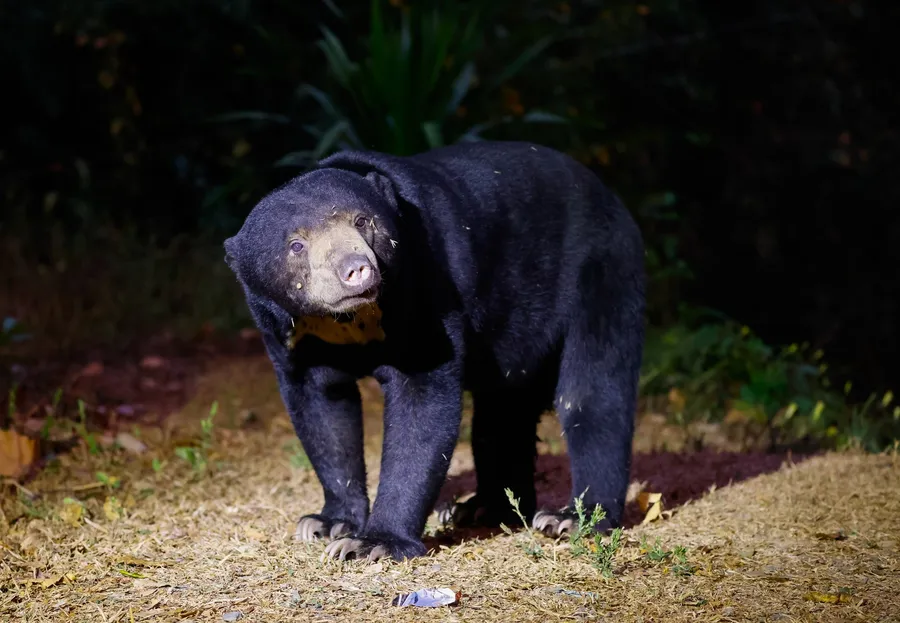
The pale chest marking gives the sun bear its English name. Marking shapes differ among individuals, as described by San Diego Zoo. Its size is smaller than other bears, but it remains wildlife with its own space and behavioural needs; small does not mean suitable for handling or keeping.
More than a honey eater
Sun bears eat fruit, invertebrates, and honey. A long tongue helps reach otherwise inaccessible food. The common name highlights only one part of their feeding behaviour. In natural habitat, food diversity makes trees, other vegetation, and small forest organisms relevant together.
Evidence: Bornean Sun Bear Conservation Centre — Sun bear facts ↗ · San Diego Zoo — Sun bear identification ↗
Trees are resting places too
Sun bears climb and make resting places in trees. This tropical forest bear does not hibernate like some bears in cold climates. Images of bears in snowy landscapes are a poor guide to an Indonesian species; different environments shape feeding and the use of time.
Evidence: Bornean Sun Bear Conservation Centre — Sun bear facts ↗
Connected habitats within Sumatra and Borneo
Sun bears form part of forest diversity on Sumatra and Borneo. Habitat connectivity here means safe routes within an island landscape, not a physical connection between the islands. Wildlife needs and local livelihoods should be considered together when planning land use.
Evidence: WWF — Borneo and Sumatra landscapes ↗ · Bornean Sun Bear Conservation Centre — Sun bear facts ↗
Rehabilitation needs survival skills
BSBCC in Sabah describes rehabilitation through foraging, climbing, and independence; not every rescued bear can be released. This Malaysian example explains a process rather than promising outcomes for every Indonesian animal. Assess programmes through welfare and follow-up, rather than opportunities for photographs while holding bears.
Evidence: Bornean Sun Bear Conservation Centre — Rehabilitation and welfare ↗
Explore related habitats
These habitat relationships are supported by species sources in this guide. This is not a complete range map.
Scientific classification of the Sun bear
| Kingdom | Animalia |
|---|---|
| Phylum | Chordata |
| Class | Mammalia |
| Order | Carnivora |
| Family | Ursidae |
| Genus | Helarctos |
| Species | Helarctos malayanus |
Source: GBIF Backbone Taxonomy, adjusted to the ranks commonly used in school biology (for example class Reptilia).
Common questions about the sun bear
What is the scientific name of the sun bear?
The scientific name of the sun bear is Helarctos malayanus, in the family Ursidae. In Indonesian it is called Beruang madu.
What kind of animal is the sun bear?
The sun bear is a mammal in the family Ursidae. By diet it is a omnivore (eats plants and animals): a insects (termites, bees), honey, earthworms and fruit.
Where does the sun bear live in Indonesia?
In Indonesia, this guide records the sun bear in: Sumatra and Kalimantan.
Source-supported habitats: Tropical Rainforests.
What does the sun bear eat?
Diet of the sun bear: omnivore. That makes it a omnivore (eats plants and animals). Source: Animal Diversity Web.
How does the sun bear reproduce?
The sun bear reproduces by giving birth to live young (viviparous). Source: Animal Diversity Web.
Is the sun bear nocturnal?
The cited source records the sun bear as diurnal (active by day). This pattern comes from study sites in Riau, central Sumatra; activity differed among sites and was associated with human disturbance. Source: Widodo et al. (2022) — Carnivore activity in protected areas of central Sumatra, PLOS ONE.
See also the list of nocturnal and diurnal animals in Indonesia.
What are the main features of the sun bear?
Key features of the sun bear, from this guide’s sources: Relative size: smallest bear species; Feature: pale chest marking; Body weight: 20–70 kg; body length 120–150 cm.
How big is the sun bear?
Body weight: 20–70 kg; body length 120–150 cm. Source: Bornean Sun Bear Conservation Centre — Sun bear facts.
What is the scientific classification of the sun bear?
Scientific classification of the sun bear: kingdom Animalia, phylum Chordata, class Mammalia, order Carnivora, family Ursidae, genus Helarctos, species Helarctos malayanus.
Source: GBIF Backbone Taxonomy, adjusted to the ranks commonly used in school biology.
Is the sun bear endangered?
Yes. The global conservation status of the sun bear: Vulnerable. In the IUCN system, this category means it is considered to face a high risk of extinction in the wild. Source: Bornean Sun Bear Conservation Centre — Species facts.
This global category is separate from national legal protection. Is the sun bear protected in Indonesia?
Is the sun bear protected in Indonesia?
Yes. The sun bear (Helarctos malayanus) is a protected species in Indonesia under Environment and Forestry Ministerial Regulation No. P.106/MENLHK/SETJEN/KUM.1/12/2018 on protected plant and animal species (annex, entry 130).
Article 21(2) of Law No. 5 of 1990, as amended by Law No. 32 of 2024, prohibits anyone from hunting, catching, injuring, killing, storing, owning, keeping, transporting or trading a protected animal, alive or dead, including its body parts, eggs and nests.
If you see this animal being traded, kept or injured, contact the local BKSDA office.
Can the sun bear be kept as a pet?
No. Because the sun bear is a protected species, catching, owning, keeping, transporting or trading it without a permit is prohibited by law. Trading without a permit through electronic media is also prohibited.
If you see this animal for sale or being kept, report it to the local BKSDA office.
Sources & references
- Bornean Sun Bear Conservation Centre — Sun bear facts ↗
- San Diego Zoo — Sun bear identification ↗
- WWF — Borneo and Sumatra landscapes ↗
- Bornean Sun Bear Conservation Centre — Rehabilitation and welfare ↗
- Peraturan Menteri LHK Nomor P.106/MENLHK/SETJEN/KUM.1/12/2018 tentang Jenis Tumbuhan dan Satwa yang Dilindungi ↗
- Animal Diversity Web ↗
- Animal Diversity Web ↗
- Widodo et al. (2022) — Carnivore activity in protected areas of central Sumatra, PLOS ONE ↗
- GBIF Backbone Taxonomy (GBIF) ↗
References can change. Check dates and context in the original source. How we use sources and data →
National parks where it is recorded
According to the official national park profiles from the KSDAE directorate. The animal may also live elsewhere.
Related causes and news
Further reading
Sun bear: facts, threats and conservation ↗ — World Animal Rescue Network.
Related site: PanduanHewan’s founder is also a director of World Animal Rescue Network.
Cite this page
Credit PanduanHewan when referring to this page. Check the original evidence sources before reusing a claim.
PanduanHewan. Sun bear (Helarctos malayanus). Last substantive update: 7 October 2026. https://panduanhewan.org/en/species/sun-bear/