Quick answer
The issue in brief
Yes. The Sunda pangolin (Manis javanica) is listed in the annex to Environment and Forestry Regulation P.106/2018 (entry 84), so Law 5/1990 as amended by Law 32/2024 bans catching, keeping, transporting or trading pangolins, alive or dead, and their scales, with up to 15 years in prison. Pangolin scales are made of keratin and have no proven medical effect: do not buy pangolin products, and report any sale to Gakkum Kehutanan (forestry law enforcement), the BKSDA or the police on 110.
- Legal status in Indonesia
- Protected: listed in the P.106/2018 annex (entry 84) source ↗
- IUCN status
- Critically Endangered (assessed 2019) source ↗
- Population decline
- Inferred 80% fall over 21 years (1998–2019) source ↗
- CITES
- Appendix I since 2 January 2017 source ↗
- Pangolins poached (Gakkum data)
- About 11,402 in 2015–2024 source ↗
- Tanjung Priok scale seizure
- 3,053 kg at Tanjung Priok, bound for Cambodia (February 2026) source ↗
- Maximum penalty
- 15 years in prison and/or a Rp5 billion fine (Article 40A(1)) source ↗
- Medical value of scales
- No reliable evidence (2021 systematic review) source ↗
Is the pangolin protected in Indonesia?
Yes. The Sunda pangolin (Manis javanica), which lives on Sumatra, Java, Borneo (Kalimantan) and nearby islands, is listed as entry 84 in the annex to Environment and Forestry Ministerial Regulation P.106/MENLHK/SETJEN/KUM.1/12/2018 on protected plant and animal species.
This protection is not new. According to the East Java BKSDA (natural resources conservation agency), the Indonesian government has protected the pangolin since 1931, under Wildlife Protection Ordinance No. 266.
Because it is listed in that annex, Article 21(2) of Law 5/1990, as amended by Law 32/2024, bans anyone from hunting, catching, killing, storing, owning, keeping, transporting or trading a live pangolin (point a) or a dead one (point b). The ban also covers its body parts (point c), moving them from one place to another or out of the country (point e), and trading them online without a permit (point g). In practice, investigators charge pangolin-scale dealers under point c.
Internationally, the Sunda pangolin has been in CITES Appendix I since 2 January 2017. The IUCN Red List has classed it as Critically Endangered since 2014, a status confirmed again in the 2019 assessment.
Evidence: Permen LHK No. P.106/MENLHK/SETJEN/KUM.1/12/2018, Lampiran: jenis satwa dilindungi (Manidae, no. 84) ↗ · IUCN Red List: Sunda Pangolin Manis javanica (Challender et al., assessed 2019) ↗ · Diskominfo Provinsi Jawa Timur — BBKSDA Jawa Timur selamatkan trenggiling (9 Januari 2025) ↗ · UU No. 32 Tahun 2024 tentang Perubahan atas UU No. 5 Tahun 1990 (JDIH BPK) ↗ · Gakkum Kehutanan — Siaran pers: WNA Vietnam ditahan, penyelundupan 796,34 kg sisik trenggiling di Pelabuhan Merak (13 April 2026) ↗ · Species+ (UNEP-WCMC and CITES Secretariat) — Manis javanica, CITES listing history (API data) ↗
Why are pangolins trafficked?
According to the IUCN, the main threat to the Sunda pangolin is overexploitation through hunting and poaching for local use and international trade, largely driven by demand in China and Viet Nam. There, pangolin meat is served as a luxury dish in high-end restaurants, and the scales go into traditional medicines that are claimed to cure skin ailments, improve blood circulation and increase breast-milk supply.
Indonesia is a major source. The IUCN notes that Indonesia has illegally exported large numbers of live pangolins and their meat, especially since 2000, and that targeted hunting is the biggest threat on Sumatra, Kalimantan and Java. Traditional-medicine practitioners in Indonesia also still recommend pangolin-scale products for heart and skin conditions.
The pattern is changing. According to case data from Gakkum Kehutanan (the forestry law-enforcement directorate), early cases mostly involved live pangolins, but in recent years the trade has shifted to ever-larger volumes of scales. The head of the Jakarta BKSDA has said that, according to expert studies, one kilogram of scales takes about four to six adult pangolins.
The scale is huge. Gakkum Kehutanan estimates that 11,402 pangolins were poached between 2015 and 2024. Worldwide, an IUCN report for the CITES Secretariat found that seizures of pangolin products in 2016–2024 involved more than half a million pangolins across 75 countries and 178 trade routes, and that scales made up 99% of the confiscated parts.
DNA analysis also shows where they come from. A 2026 study found that pangolins seized in the ports of Jakarta and Surabaya had been sourced from south-western Borneo, which it identified as the main international trafficking hotspot for the Sunda pangolin.
Evidence: IUCN Red List: Sunda Pangolin Manis javanica (Challender et al., assessed 2019) ↗ · Kementerian Kehutanan — Siaran pers SP.185/HKLN/05/2026: tersangka 3 ton sisik trenggiling tujuan Kamboja ditahan (24 Mei 2026) ↗ · Kompas.com — Sisik trenggiling diselundupkan 3 ton, BKSDA: 1 kg butuh 4–6 ekor trenggiling (4 Maret 2026) ↗ · Gakkum Kehutanan — Jangan biarkan kami punah, selamatkan trenggiling! (1 September 2025) ↗ · IUCN press release (27 August 2025): Lack of data and reporting gaps hamper global efforts to protect pangolins ↗ · Targeted sequencing enhances detection of pangolin trafficking hotspots and dynamics of both domestic and global trade markets (2026), PLoS Biology ↗
What are the biggest pangolin smuggling cases in Indonesia?
Medan, April 2015: on 23 April 2015, national police raided a warehouse in the Medan industrial estate and found 95 live pangolins, more pangolins already frozen and packed, and 70 kilograms of scales. The case became known as the five-tonne pangolin case.
Asahan, November 2024: a joint team from the environment and forestry ministry's law-enforcement directorate, military police and North Sumatra police stopped the sale of 1,180 kilograms of scales in Kisaran. The then head of law enforcement said this meant about 5,900 pangolins had been killed. On 15 December 2025, Kisaran District Court sentenced a police officer involved to nine years in prison and a Rp500 million fine.
Jakarta, April 2025: a joint operation by the Ministry of Forestry and national police stopped a deal for 165 kilograms of scales at a café in Grogol on 14 April 2025; the case began with an online patrol. Gakkum called it the fourth pangolin case in eight months, after Kisaran, Tembilahan and Tanjung Balai, and said the black market for scales was shifting from Sumatra to Java.
Tanjung Priok, February 2026: an inspection of a single container on 12 February 2026 found 99 cartons holding 3,053 kilograms of scales bound for Cambodia, declared on the export papers as sea cucumber and dried food.
Merak, April 2026: Gakkum Kehutanan detained a Vietnamese national and seized 26 packages containing 796.34 kilograms of scales from a Vietnamese-flagged cargo ship at Merak port, Banten. Investigators are looking into suspected ship-to-ship transfers at sea. Smaller cases keep appearing too, such as one live pangolin, one dead pangolin and about 500 grams of scales seized in Magelang in January 2026.
Seizures are only the tip of the iceberg. The IUCN records seizures of 11, 14 and 17 tonnes of Sunda pangolins between 2000 and 2013, each involving several thousand animals, and judges that they probably represent only a fraction of the trade because detection rates are low.
Evidence: Kompas.com — Sebelum sisiknya diambil, 5 ton trenggiling direbus (11 Agustus 2015) ↗ · ANTARA — Tim Gakkum KLHK gagalkan 1.180 kilogram sisik trenggiling di Sumut (26 November 2024) ↗ · detikSumut — Oknum polisi penjual 1,1 ton sisik trenggiling di Asahan divonis 9 tahun (15 Desember 2025) ↗ · Kementerian Kehutanan — Siaran pers SP.132/HUMAS/PP/HMS.3/7/2025: tersangka baru perdagangan sisik trenggiling (21 Juli 2025) ↗ · Gakkum Kehutanan — Sindikat perdagangan sisik trenggiling transnasional diseret ke meja hijau (6 Oktober 2025) ↗ · Kementerian Kehutanan — Siaran pers SP.185/HKLN/05/2026: tersangka 3 ton sisik trenggiling tujuan Kamboja ditahan (24 Mei 2026) ↗ · Gakkum Kehutanan — Siaran pers: WNA Vietnam ditahan, penyelundupan 796,34 kg sisik trenggiling di Pelabuhan Merak (13 April 2026) ↗ · Gakkum Kehutanan — Perdagangan satwa liar dilindungi di Magelang digagalkan (17 Januari 2026) ↗ · IUCN Red List: Sunda Pangolin Manis javanica (Challender et al., assessed 2019) ↗
What are pangolin scales used for, and do they work as medicine?
Pangolin scales are made of keratin. Structural studies describe the pangolin's body as protected by a flexible armour of overlapping keratin scales. Chemical analyses have also found that pangolin scales and pig hooves are similar in their trace elements and inorganic content.
In traditional medicine, the scales are claimed to cure skin ailments, improve blood circulation, increase breast-milk supply and even treat cancer. The evidence does not support this. A 2021 systematic review of 15 clinical studies concluded that there is no reliable evidence that pangolin scales have any special medicinal value; two of its four randomised controlled trials actually produced negative results. The same review noted a risk of allergic reactions such as dizziness, chills and shortness of breath.
In May 2020, China removed the pangolin from the Chinese Pharmacopoeia, the country's official technical standard for medicines, so it was no longer considered suitable as a medicinal ingredient. On 3 June 2020, China upgraded the pangolin to a Class I protected animal. The authors of the clinical review described the removal from the pharmacopoeia as rational.
Demand has not disappeared, however. Several patent medicines containing scales were still listed in the 2015 edition of the Chinese Pharmacopoeia, and a 2025 legal study found that pangolins were still being managed as a clinical resource in 2024. The head of the Jakarta BKSDA has also said that pangolin scales are often misused as an ingredient in cosmetics.
If you were searching for the price of pangolin scales: in Indonesia, storing, owning, transporting or trading parts of a protected animal, including pangolin scales, is banned under Article 21(2)(c) of Law 32/2024, and the scales have no proven medical effect.
Evidence: Wang et al. (2016), Pangolin armor: overlapping, structure, and mechanical properties of the keratinous scales, Acta Biomaterialia (abstract) ↗ · Jin et al. (2021), Evidence for the medicinal value of Squama Manitis (pangolin scale): a systematic review, Integrative Medicine Research ↗ · IUCN Red List: Sunda Pangolin Manis javanica (Challender et al., assessed 2019) ↗ · China's Legal Protection System for Pangolins: Past, Present, and Future (2025), Animals ↗ · Kompas.com — Sisik trenggiling diselundupkan 3 ton, BKSDA: 1 kg butuh 4–6 ekor trenggiling (4 Maret 2026) ↗ · UU No. 32 Tahun 2024 tentang Perubahan atas UU No. 5 Tahun 1990 (JDIH BPK) ↗
What is the penalty for keeping or selling a pangolin?
Keeping or trading a live pangolin, storing or selling its scales, and selling online without a permit are punishable under Article 40A(1) of Law 32/2024. As originally enacted, this article set three to 15 years in prison and a fine of category IV to VII.
Law 1/2026 on Criminal Penalty Adjustment, in force since 2 January 2026, removed special minimum sentences from laws outside the Criminal Code. After the adjustment, Article 40A(1) carries up to 15 years in prison and/or a fine of up to category VII, which Article 79 of the Criminal Code sets at Rp5 billion.
Moving a pangolin or its parts from one place to another, or out of the country, falls under Article 40A(2), which after the adjustment carries up to 10 years in prison and/or a fine of up to category VI (Rp2 billion). Penalties can be increased by a third if the crime is committed using information technology (Article 40C(2)).
Harming an animal can also be prosecuted under Article 337 of the new Criminal Code (Law 1/2023), in force since 2 January 2026, with up to 18 months in prison if the animal is ill for more than a week, disabled, seriously injured or killed. Article 66A of Law 41/2014 bans abusing or misusing animals, including animals living in their habitat, in ways that leave them disabled or unproductive, and requires anyone who knows of such abuse to report it to the authorities.
Evidence: UU No. 32 Tahun 2024 tentang Perubahan atas UU No. 5 Tahun 1990 (JDIH BPK) ↗ · UU No. 1 Tahun 2026 tentang Penyesuaian Pidana (JDIH BPK) ↗ · UU No. 1 Tahun 2023 tentang KUHP (JDIH BPK) ↗ · UU No. 41 Tahun 2014 tentang Perubahan atas UU No. 18 Tahun 2009 (Peternakan dan Kesehatan Hewan), JDIH BPK ↗
Why is the Sunda pangolin critically endangered?
The IUCN assessed the Sunda pangolin as Critically Endangered under criteria A2d+3d+4d on 2 May 2019. Its population is inferred to have fallen by 80% over 21 years (three generations, 1998–2019) because of overexploitation, and the IUCN expects a similar decline over the next three generations (2019–2040).
Its status has worsened quickly: Lower Risk/near threatened in 1996, Endangered in 2008 and Critically Endangered since 2014.
Nobody knows exactly how many pangolins are left in Indonesia. The IUCN says the scale of international trafficking from Indonesia over the past decade suggests the population is, or could be, in severe decline, but data on past and present population levels are lacking. In Bali, residents say pangolins used to wander into gardens around Ubud thirty years ago but are now hard to find.
Pangolins also breed slowly, usually producing a single young after a six- to seven-month pregnancy. Habitat loss from logging, mining, dams and road building is a secondary threat, and it opens previously inaccessible areas to hunters.
International protection has been tightened over time. CITES set a zero export quota for wild-caught Sunda pangolins traded for commercial purposes in 2000, then moved the species to Appendix I with effect from 2 January 2017. A 2025 IUCN report found that legal trade has fallen sharply since then, but trafficking remains extensive and highly organised.
Evidence: IUCN Red List: Sunda Pangolin Manis javanica (Challender et al., assessed 2019) ↗ · IUCN SSC Pangolin Specialist Group — Sunda pangolin species profile ↗ · Species+ (UNEP-WCMC and CITES Secretariat) — Manis javanica, CITES listing history (API data) ↗ · IUCN press release (27 August 2025): Lack of data and reporting gaps hamper global efforts to protect pangolins ↗
How does trafficking harm pangolins, and is there a disease risk?
Pangolins traded alive are often found tied tightly in net sacks, curled in their defensive ball and stacked on top of one another, unable to eat, drink, move or even uncurl. Confiscated pangolins are frequently covered in faeces and urine and suffer from a range of infectious diseases and parasites. There are also reports of pangolins being force-fed cement and plaster to raise their weight, and therefore their price.
Pangolins are typically killed by a blow or cut to the head and then boiled so the scales come off more easily. Because these methods are unreliable, some animals are still alive when they are put into boiling water. In the 2015 Medan case, a police witness told the court that pangolins were boiled before being skinned for their scales.
The suffering continues after seizure. A 2026 study reported that mortality among confiscated pangolins consistently exceeds 67% in the first 10 days after rescue, often linked to severe digestive distress and organ failure caused by trauma during trafficking.
The pangolin trade also carries a disease risk. In 2020, researchers found coronaviruses related to SARS-CoV-2 in Sunda pangolins seized in anti-smuggling operations in southern China. It has not been confirmed that pangolins were an intermediate host of SARS-CoV-2, but trafficking them clearly risks spreading viruses with zoonotic potential. A study of pangolin carcasses seized in Hong Kong found antibodies to SARS-related coronaviruses in one animal that probably came from Java.
A 2023 systematic review recorded 128 microbes in pangolins, 31 of which have also been reported in humans, and a 2026 study concluded that trafficked pangolins are highly susceptible to many infections. If you are bitten, scratched or injured by a wild animal, go to a health facility straight away.
Evidence: Chains of Commerce: a comprehensive review of animal welfare impacts in the international wildlife trade (2025), Animals ↗ · Kompas.com — Sebelum sisiknya diambil, 5 ton trenggiling direbus (11 Agustus 2015) ↗ · Multi-omics reveals functional recovery of the gut microbiome in rescued Sunda pangolins (2026), iScience ↗ · Lam et al. (2020), Identifying SARS-CoV-2-related coronaviruses in Malayan pangolins, Nature (abstract) ↗ · Serological evidence of sarbecovirus exposure along Sunda pangolin trafficking pathways (2024), BMC Biology ↗ · Systematic review and integrated data analysis reveal diverse pangolin-associated microbes with infection potential (2023), Nature Communications (abstract) ↗ · Multiple etiological agents associated with the deaths of trafficked pangolins (2026), Zoological Research (abstract) ↗
How have the 2026 forest fires affected pangolins?
The 2026 forest and land fires in Kalimantan have also driven pangolins out of their habitat. A Ministry of Forestry press release dated 17 September 2026 said the West Kalimantan BKSDA had evacuated 23 orangutans along with other animals, including nine pangolins. By 30 September 2026, the West Kalimantan BKSDA said it had rescued 12 pangolins, with most rescues in Ketapang and Kayong Utara.
In Central Kalimantan, a weak pangolin was found in a resident's yard in Palangka Raya on the night of 17 September 2026, apparently because its habitat had been hit by fire, and was handed to the BKSDA. On 22 September 2026, a female pangolin weighing about 10 kilograms, found by firefighters on burnt land in East Kotawaringin, was handed to the BKSDA post in Sampit. Because it was healthy, active and uninjured, it was released the next day to avoid stress.
Indonesia's wildlife rescue rules cover exactly this situation: Environment and Forestry Regulation 17/2024 defines species rescue as including preventing local extinction caused by natural disasters and/or human activity.
The Ministry of Forestry asks the public not to catch or move wild animals themselves. If you find an animal affected by the fires, contact the authorities, give the exact location, describe the animal's condition, take photos or video if it is safe to do so, and leave the handling to officers. Wildlife rescue hotlines: West Kalimantan BKSDA 0811-577-6767, Central Kalimantan BKSDA 0811-5218-500 and East Kalimantan BKSDA 0821-1333-8181.
Evidence: Kementerian Kehutanan — Siaran pers SP.534/HKLN/09/2026: rescue satwa liar terdampak karhutla (17 September 2026) ↗ · Kompas.id — Pemadaman karhutla di Kalbar tersisa di Kayong Utara dan Ketapang (1 Oktober 2026) ↗ · Prokalteng — Diduga terdampak karhutla, trenggiling lemah ditemukan di rumah warga Palangka Raya (18 September 2026) ↗ · CNN Indonesia — Induk orang utan hingga trenggiling dievakuasi dari karhutla Kotim (28 September 2026) ↗ · Permen LHK No. 17 Tahun 2024 tentang Penyelamatan Jenis Satwa (JDIH BPK) ↗
How are rescued pangolins rehabilitated and released?
In Indonesia, rescues are governed by Environment and Forestry Regulation 17/2024 on Species Rescue. A veterinarian must be involved in assessing an animal's medical condition and behaviour. Animals judged medically healthy and behaving naturally may be released; those not yet ready go through rehabilitation, consisting of quarantine (physical and health checks), isolation and/or recovery of natural behaviour.
Rehabilitation aims to restore an animal's health and behaviour so that it can survive and breed once returned to its natural habitat. IUCN guidelines on confiscated animals stress that they must be quarantined immediately because of the risk of disease spreading, including to people. The guidelines also warn that returning animals to the wild responsibly can be extremely difficult and needs long-term commitment and significant resources.
Two examples: on 6 January 2025, a resident of Kediri voluntarily handed over a pangolin found on a village road to the East Java BKSDA; after a health check it was released the next day, in the late afternoon to suit its nocturnal habits. In early October 2025, the Sampit BKSDA unit cared for a pangolin found weak, probably dehydrated, in a container port for about two days before releasing it.
The IUCN guidelines state that the best option of all is to stop live animals entering the illegal trade in the first place. Indonesia's environment ministry describes not buying protected animals, not sharing wildlife-trade content and reporting illegal activity as simple actions with a big impact.
Evidence: Permen LHK No. 17 Tahun 2024 tentang Penyelamatan Jenis Satwa (JDIH BPK) ↗ · IUCN (2019), Guidelines for the management of confiscated, live organisms ↗ · Diskominfo Provinsi Jawa Timur — BBKSDA Jawa Timur selamatkan trenggiling (9 Januari 2025) ↗ · ANTARA Kalteng — BKSDA Sampit lepas liarkan trenggiling temuan dari TPK Bagendang (5 Oktober 2025) ↗ · Kementerian Lingkungan Hidup/BPLH — Melawan perdagangan satwa liar demi masa depan Indonesia (5 Agustus 2026) ↗
How do I report pangolin trafficking?
Public tip-offs often start investigations. The Asahan 2024, Ambarawa 2025, Magelang 2026 and Medan 2026 cases all began with information from the public, while the Grogol 2025 case began with a Ministry of Forestry online patrol that spotted suspicious social-media activity.
Report anyone selling pangolins, pangolin meat or scales, including on social media and online marketplaces, through the Gakkum Kehutanan complaints app (pengaduan.gakkum.kehutanan.go.id), which accepts uploaded evidence, or by email to pengaduan.gakkum@kehutanan.go.id or setditjengakkum@kehutanan.go.id and by phone on (021) 5790 2925. You can also report to your local BKSDA. If a crime is under way, call the police on 110.
Do not contact or bargain with the seller, and do not buy a pangolin to "rescue" it. Keep screenshots that show the account, link, location and date, and hand them to the authorities.
Evidence: ANTARA — Tim Gakkum KLHK gagalkan 1.180 kilogram sisik trenggiling di Sumut (26 November 2024) ↗ · Gakkum Kehutanan — Tersangka perdagangan ilegal trenggiling di Jawa Tengah diserahkan ke kejaksaan (10 November 2025) ↗ · Gakkum Kehutanan — Perdagangan satwa liar dilindungi di Magelang digagalkan (17 Januari 2026) ↗ · Kementerian Kehutanan — Siaran pers SP.108/HKLN/04/2026: Gakkum gagalkan perdagangan sisik trenggiling di Medan (8 April 2026) ↗ · Kementerian Kehutanan — Siaran pers SP.132/HUMAS/PP/HMS.3/7/2025: tersangka baru perdagangan sisik trenggiling (21 Juli 2025) ↗ · Pengaduan Gakkum Kehutanan (aplikasi pengaduan resmi Ditjen Penegakan Hukum Kehutanan) ↗ · Gakkum Kehutanan — Jangan biarkan kami punah, selamatkan trenggiling! (1 September 2025) ↗ · Polri — Call Center 110 ↗ · Kementerian Kehutanan — Siaran pers SP.534/HKLN/09/2026: rescue satwa liar terdampak karhutla (17 September 2026) ↗
Timeline
- 1931 Pangolins become protected under Wildlife Protection Ordinance No. 266. source ↗
- 1975-07 The Sunda pangolin is listed in CITES Appendix II. source ↗
- 2000 CITES sets a zero export quota for wild-caught Sunda pangolins traded commercially. source ↗
- 2014 The IUCN uplists the Sunda pangolin to Critically Endangered. source ↗
- 2015-04 Police raid a Medan warehouse holding live and frozen pangolins and scales (the five-tonne case). source ↗
- 2017-01 The Sunda pangolin's CITES Appendix I listing takes effect (2 January 2017). source ↗
- 2018-12 Regulation P.106/2018 is signed; the pangolin is entry 84. source ↗
- 2019-05 The IUCN reassesses the Sunda pangolin as Critically Endangered. source ↗
- 2020-05 China removes the pangolin from the Chinese Pharmacopoeia. source ↗
- 2024-08 Law 32/2024 amending Law 5/1990 is enacted (7 August 2024). source ↗
- 2024-11 A joint team stops the sale of 1,180 kg of scales in Kisaran, Asahan. source ↗
- 2025-04 A deal for 165 kg of scales is stopped in Grogol, West Jakarta. source ↗
- 2025-12 Kisaran District Court jails a police officer for nine years in the 1,180 kg case. source ↗
- 2026-01 The new Criminal Code and Law 1/2026 on penalty adjustment take effect (2 January 2026). source ↗
- 2026-02 3,053 kg of scales bound for Cambodia are found at Tanjung Priok port. source ↗
- 2026-04 Gakkum uncovers 796.34 kg of scales on a Vietnamese-flagged ship at Merak port. source ↗
- 2026-09 The West Kalimantan BKSDA has rescued 12 fire-affected pangolins by 30 September. source ↗
How to help
- Do not buy pangolins, pangolin meat, scales or any product claimed to contain pangolin, including traditional medicines, amulets and cosmetics.
- Do not like, comment on or share posts selling pangolins or their scales. Report them with the platform's reporting tool.
- Seen pangolins or scales for sale? Do not contact the seller. Keep screenshots showing the account, link, location and date, then report through the Gakkum Kehutanan complaints app (pengaduan.gakkum.kehutanan.go.id), by email to pengaduan.gakkum@kehutanan.go.id, by phone on (021) 5790 2925, or to the local BKSDA. If a crime is under way, call the police on 110.
- A pangolin in your house or garden, or one fleeing a fire? Do not catch, hold or move it yourself. Call the BKSDA or the local fire and rescue service (Damkar); in Kalimantan, call the BKSDA hotlines for West Kalimantan 0811-577-6767, Central Kalimantan 0811-5218-500 or East Kalimantan 0821-1333-8181.
- If you or someone you know is holding a pangolin, contact the BKSDA to hand it over. Do not release it into a forest yourself.
- Bitten, scratched or injured by a wild animal? Go to a health facility straight away.
- Correct the myth when you hear it: pangolin scales are made of keratin and have no proven medical effect.
- Want to support an organisation that works with pangolins? PanduanHewan does not take donations. Before giving, check the organisation's fundraising permit, legal registration, financial reports and verifiable cooperation with the BKSDA, using PanduanHewan's checklist on how to check an appeal.
- Want to volunteer? Choose programmes that limit contact with animals, because confiscated animals need quarantine and rehabilitation. Offers to hold, hand-feed or take selfies with a pangolin are a red flag.
Common questions
Is the pangolin protected in Indonesia?
Yes. The Sunda pangolin (Manis javanica) is entry 84 in the annex to Regulation P.106/2018. Article 21(2) of Law 32/2024 bans hunting, keeping, transporting and trading it, including its body parts such as scales.
Source: Permen LHK No. P.106/MENLHK/SETJEN/KUM.1/12/2018, Lampiran: jenis satwa dilindungi (Manidae, no. 84) ↗ · UU No. 32 Tahun 2024 tentang Perubahan atas UU No. 5 Tahun 1990 (JDIH BPK) ↗
Since when has the pangolin been protected?
According to the East Java BKSDA, since 1931, under Wildlife Protection Ordinance No. 266. Today its protection is set out in Regulation P.106/2018, signed on 28 December 2018.
Source: Diskominfo Provinsi Jawa Timur — BBKSDA Jawa Timur selamatkan trenggiling (9 Januari 2025) ↗ · Permen LHK No. P.106/MENLHK/SETJEN/KUM.1/12/2018, Lampiran: jenis satwa dilindungi (Manidae, no. 84) ↗
What are pangolin scales made of?
Keratin. The scales form a flexible armour of overlapping keratin plates.
What are pangolin scales used for in medicine? Do they work?
Traditional medicine claims the scales cure skin ailments, improve blood circulation and increase breast-milk supply. A 2021 systematic review concluded there is no reliable evidence that they have any special medicinal value, and noted a risk of allergic reactions.
Source: IUCN Red List: Sunda Pangolin Manis javanica (Challender et al., assessed 2019) ↗ · Jin et al. (2021), Evidence for the medicinal value of Squama Manitis (pangolin scale): a systematic review, Integrative Medicine Research ↗ · Jin et al. (2021), Evidence for the medicinal value of Squama Manitis (pangolin scale): a systematic review, Integrative Medicine Research ↗
How much are pangolin scales worth?
PanduanHewan does not publish prices for protected animals. Trading pangolin scales is banned under Article 21(2)(c) of Law 32/2024 and carries up to 15 years in prison and/or a fine of up to Rp5 billion, and the scales have no proven medical effect. If you see scales offered for sale, report it to Gakkum Kehutanan.
Source: UU No. 32 Tahun 2024 tentang Perubahan atas UU No. 5 Tahun 1990 (JDIH BPK) ↗ · UU No. 1 Tahun 2026 tentang Penyesuaian Pidana (JDIH BPK) ↗ · UU No. 1 Tahun 2023 tentang KUHP (JDIH BPK) ↗ · Jin et al. (2021), Evidence for the medicinal value of Squama Manitis (pangolin scale): a systematic review, Integrative Medicine Research ↗ · Pengaduan Gakkum Kehutanan (aplikasi pengaduan resmi Ditjen Penegakan Hukum Kehutanan) ↗
Can I keep a pangolin as a pet?
No. Article 21(2)(a) of Law 32/2024 bans anyone from owning or keeping a live protected animal, with up to 15 years in prison. If you are holding a pangolin, hand it over to the BKSDA.
Source: UU No. 32 Tahun 2024 tentang Perubahan atas UU No. 5 Tahun 1990 (JDIH BPK) ↗ · UU No. 1 Tahun 2026 tentang Penyesuaian Pidana (JDIH BPK) ↗ · Diskominfo Provinsi Jawa Timur — BBKSDA Jawa Timur selamatkan trenggiling (9 Januari 2025) ↗
How many pangolins are left in Indonesia?
There is no reliable population estimate. The IUCN says there is very little quantitative data on Sunda pangolin populations, and that the scale of trafficking from Indonesia suggests the population is, or could be, in severe decline.
Source: IUCN Red List: Sunda Pangolin Manis javanica (Challender et al., assessed 2019) ↗ · IUCN Red List: Sunda Pangolin Manis javanica (Challender et al., assessed 2019) ↗ · IUCN Red List: Sunda Pangolin Manis javanica (Challender et al., assessed 2019) ↗
Did pangolins cause COVID-19?
That has not been shown. SARS-CoV-2-related coronaviruses have been found in seized pangolins, but it is unconfirmed whether pangolins were an intermediate host for SARS-CoV-2. What is clear is that trafficking pangolins risks spreading viruses with zoonotic potential.
Source: Lam et al. (2020), Identifying SARS-CoV-2-related coronaviruses in Malayan pangolins, Nature (abstract) ↗ · Serological evidence of sarbecovirus exposure along Sunda pangolin trafficking pathways (2024), BMC Biology ↗
What should I do if a pangolin comes into my house?
Do not catch or move it yourself. Call the BKSDA or the local fire and rescue service (Damkar), give the exact location, describe the animal's condition and leave the handling to officers. In Palangka Raya, for example, a pangolin that wandered into a yard was collected by the fire and rescue team and handed to the BKSDA.
Source: Kementerian Kehutanan — Siaran pers SP.534/HKLN/09/2026: rescue satwa liar terdampak karhutla (17 September 2026) ↗ · Kementerian Kehutanan — Siaran pers SP.534/HKLN/09/2026: rescue satwa liar terdampak karhutla (17 September 2026) ↗ · Prokalteng — Diduga terdampak karhutla, trenggiling lemah ditemukan di rumah warga Palangka Raya (18 September 2026) ↗ · Prokalteng — Diduga terdampak karhutla, trenggiling lemah ditemukan di rumah warga Palangka Raya (18 September 2026) ↗
Animals involved
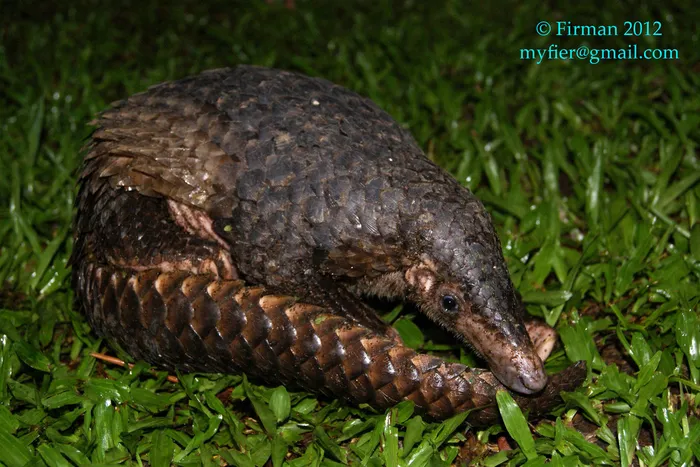
A scaled, ant- and termite-eating mammal threatened by illegal trade. Climbing and secretive behaviour make direct observation difficult.
Support this cause from outside Indonesia
If you live outside Indonesia and want to fund work on this issue, you can help pangolins through rescue and rehabilitation with World Animal Rescue Network.
Related site: PanduanHewan’s founder is also a director of World Animal Rescue Network. PanduanHewan itself does not accept donations, and this invitation is not directed at people in Indonesia. Before giving to any organisation, check how it is registered and how it reports on spending.
An Indonesian organisation working on this cause?
Officially registered organisations (a yayasan or perkumpulan with legal status on AHU, and a PUB permit where they raise money from the public) can contact us to be listed on this cause page free of charge. Every request is checked first, and a listing is not an endorsement.
Sources and references
- Permen LHK No. P.106/MENLHK/SETJEN/KUM.1/12/2018, Lampiran: jenis satwa dilindungi (Manidae, no. 84) ↗
- IUCN Red List: Sunda Pangolin Manis javanica (Challender et al., assessed 2019) ↗
- Species+ (UNEP-WCMC and CITES Secretariat) — Manis javanica, CITES listing history (API data) ↗
- Gakkum Kehutanan — Jangan biarkan kami punah, selamatkan trenggiling! (1 September 2025) ↗
- Kementerian Kehutanan — Siaran pers SP.185/HKLN/05/2026: tersangka 3 ton sisik trenggiling tujuan Kamboja ditahan (24 Mei 2026) ↗
- UU No. 1 Tahun 2026 tentang Penyesuaian Pidana (JDIH BPK) ↗
- Jin et al. (2021), Evidence for the medicinal value of Squama Manitis (pangolin scale): a systematic review, Integrative Medicine Research ↗
- Diskominfo Provinsi Jawa Timur — BBKSDA Jawa Timur selamatkan trenggiling (9 Januari 2025) ↗
- UU No. 32 Tahun 2024 tentang Perubahan atas UU No. 5 Tahun 1990 (JDIH BPK) ↗
- Gakkum Kehutanan — Siaran pers: WNA Vietnam ditahan, penyelundupan 796,34 kg sisik trenggiling di Pelabuhan Merak (13 April 2026) ↗
- Kompas.com — Sisik trenggiling diselundupkan 3 ton, BKSDA: 1 kg butuh 4–6 ekor trenggiling (4 Maret 2026) ↗
- IUCN press release (27 August 2025): Lack of data and reporting gaps hamper global efforts to protect pangolins ↗
- Targeted sequencing enhances detection of pangolin trafficking hotspots and dynamics of both domestic and global trade markets (2026), PLoS Biology ↗
- Kompas.com — Sebelum sisiknya diambil, 5 ton trenggiling direbus (11 Agustus 2015) ↗
- ANTARA — Tim Gakkum KLHK gagalkan 1.180 kilogram sisik trenggiling di Sumut (26 November 2024) ↗
- detikSumut — Oknum polisi penjual 1,1 ton sisik trenggiling di Asahan divonis 9 tahun (15 Desember 2025) ↗
- Kementerian Kehutanan — Siaran pers SP.132/HUMAS/PP/HMS.3/7/2025: tersangka baru perdagangan sisik trenggiling (21 Juli 2025) ↗
- Gakkum Kehutanan — Sindikat perdagangan sisik trenggiling transnasional diseret ke meja hijau (6 Oktober 2025) ↗
- Gakkum Kehutanan — Perdagangan satwa liar dilindungi di Magelang digagalkan (17 Januari 2026) ↗
- Wang et al. (2016), Pangolin armor: overlapping, structure, and mechanical properties of the keratinous scales, Acta Biomaterialia (abstract) ↗
- China's Legal Protection System for Pangolins: Past, Present, and Future (2025), Animals ↗
- UU No. 1 Tahun 2023 tentang KUHP (JDIH BPK) ↗
- UU No. 41 Tahun 2014 tentang Perubahan atas UU No. 18 Tahun 2009 (Peternakan dan Kesehatan Hewan), JDIH BPK ↗
- IUCN SSC Pangolin Specialist Group — Sunda pangolin species profile ↗
- Chains of Commerce: a comprehensive review of animal welfare impacts in the international wildlife trade (2025), Animals ↗
- Multi-omics reveals functional recovery of the gut microbiome in rescued Sunda pangolins (2026), iScience ↗
- Lam et al. (2020), Identifying SARS-CoV-2-related coronaviruses in Malayan pangolins, Nature (abstract) ↗
- Serological evidence of sarbecovirus exposure along Sunda pangolin trafficking pathways (2024), BMC Biology ↗
- Systematic review and integrated data analysis reveal diverse pangolin-associated microbes with infection potential (2023), Nature Communications (abstract) ↗
- Multiple etiological agents associated with the deaths of trafficked pangolins (2026), Zoological Research (abstract) ↗
- Kementerian Kehutanan — Siaran pers SP.534/HKLN/09/2026: rescue satwa liar terdampak karhutla (17 September 2026) ↗
- Kompas.id — Pemadaman karhutla di Kalbar tersisa di Kayong Utara dan Ketapang (1 Oktober 2026) ↗
- Prokalteng — Diduga terdampak karhutla, trenggiling lemah ditemukan di rumah warga Palangka Raya (18 September 2026) ↗
- CNN Indonesia — Induk orang utan hingga trenggiling dievakuasi dari karhutla Kotim (28 September 2026) ↗
- Permen LHK No. 17 Tahun 2024 tentang Penyelamatan Jenis Satwa (JDIH BPK) ↗
- IUCN (2019), Guidelines for the management of confiscated, live organisms ↗
- ANTARA Kalteng — BKSDA Sampit lepas liarkan trenggiling temuan dari TPK Bagendang (5 Oktober 2025) ↗
- Kementerian Lingkungan Hidup/BPLH — Melawan perdagangan satwa liar demi masa depan Indonesia (5 Agustus 2026) ↗
- Gakkum Kehutanan — Tersangka perdagangan ilegal trenggiling di Jawa Tengah diserahkan ke kejaksaan (10 November 2025) ↗
- Kementerian Kehutanan — Siaran pers SP.108/HKLN/04/2026: Gakkum gagalkan perdagangan sisik trenggiling di Medan (8 April 2026) ↗
- Pengaduan Gakkum Kehutanan (aplikasi pengaduan resmi Ditjen Penegakan Hukum Kehutanan) ↗
- Polri — Call Center 110 ↗
Checked 2026-10-01. Facts, figures and rules can change; check the date on the original source. Report errors through the corrections page. Send a correction