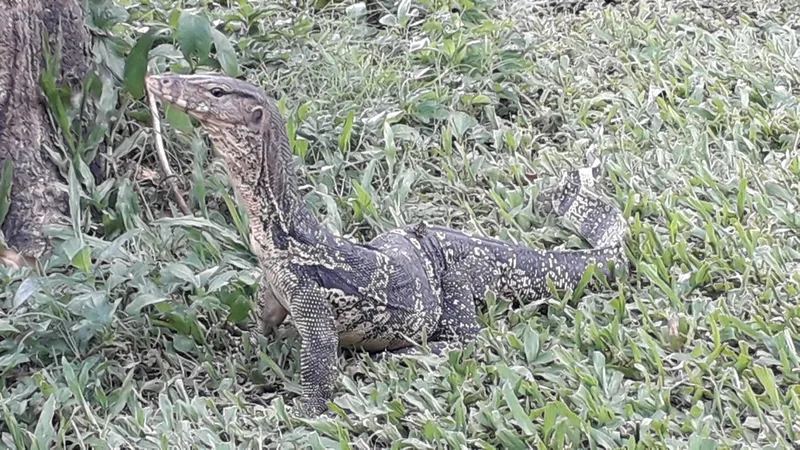
Recognising a water monitor
The Asian water monitor is a large lizard with a dark body, paler markings, long tail and strong limbs. Pattern can change with age and vary among populations. It is not a Komodo dragon: both belong to Varanus, but they are different species with different ranges and habitat contexts.
Following water across landscapes
Sarawak’s forestry department records water monitors in coastal mangroves, riverine forest, wetlands and human-used land. Their association with water helps explain sightings along drains and urban edges. Records in disturbed places are no reason to treat natural swamps and mangroves as unimportant.
Predator and scavenger
Water monitors take varied prey, including fish, frogs, crabs and other small animals, and also consume carrion when available. A monitor near waste is therefore not simply a “garbage eater.” Easily available human food can alter its movements and increase unwanted encounters.
Safer encounters
Do not approach, touch, feed or block a monitor’s escape route. A cornered animal may defend itself. If one enters a building or crowded area, keep people and pets back and seek help from local wildlife authorities. Singapore’s official guidance likewise advises the public not to handle monitors themselves.
Pressures and limits of sighting data
Research in southern Sumatra documented water-monitor harvesting for skins and examined how ecological flexibility affected persistence. Historic findings from one area cannot serve as a current harvest figure or status for all Indonesia. Photographic records are not a census either; local assessment needs surveys, habitat context and up-to-date trade data.
Sources & references
- Sarawak Forest Department — Varanus salvator ↗
- Singapore Animal & Veterinary Service — Monitor lizards ↗
- Shine et al. — Commercial harvesting of giant lizards in southern Sumatra ↗
- Animal Diversity Web — Varanus salvator ↗
- GBIF — accepted Varanus salvator taxon ↗
References can change. Check dates and context in the original source.