Quick answer
IUCN status: Least ConcernJavan spitting cobra at a glance
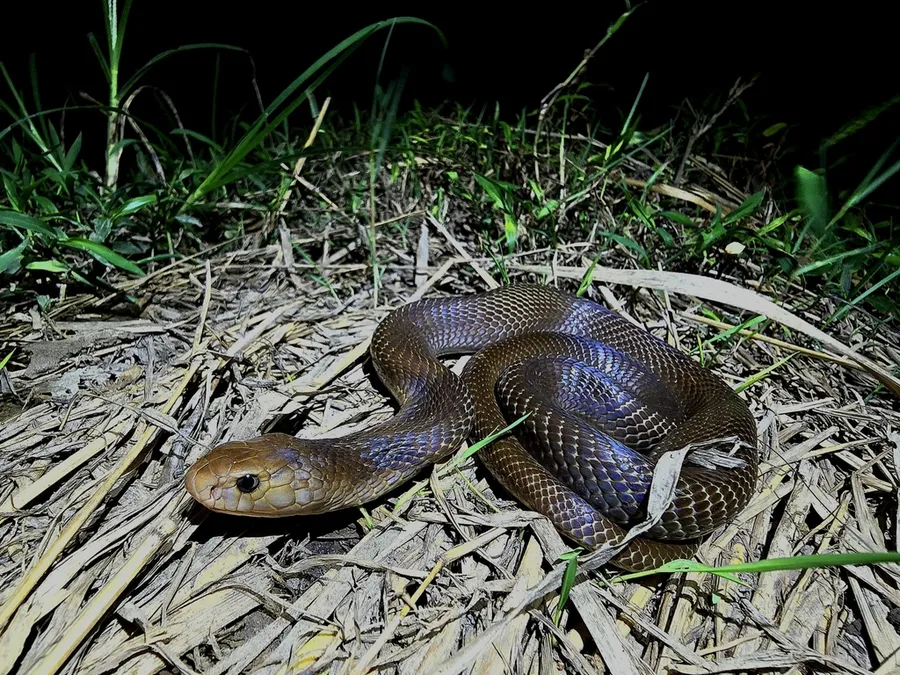
The Javan spitting cobra (Naja sputatrix) is a reptile in the family Elapidae. Range in Indonesia: Java, Bali and Nusa Tenggara (Lombok to Alor). It is endemic to Indonesia, living naturally only in Java, Bali and Nusa Tenggara (Lombok to Alor). Diet: rats, lizards, frogs, birds and other snakes; a carnivore. IUCN Red List status: Least Concern.
| Scientific name | Naja sputatrix |
|---|---|
| Indonesian name | Ular kobra Jawa |
| Group | Reptiles |
| Family | Elapidae |
| Range in Indonesia | Java, Bali and Nusa Tenggara (Lombok to Alor) |
| Linked habitats | Savannas, Urban Habitats |
| Diet | Rats, lizards, frogs, birds and other snakes |
| Range in Indonesia | Java, Bali, Lombok, Sumbawa, Flores, Komodo and Alor |
| Key feature | Spoon-shaped hood; can spray venom |
| Length | Average 130 cm, up to 180 cm |
| Other names | Indonesian cobra; ular sendok (spoon snake) |
| Risk to people | Bite can kill; venom spray injures eyes |
| IUCN status | Least Concern · IUCN Red List (via GBIF) · checked 1 October 2026 |
| Diet type | Carnivore (meat-eater) — generalist predator: small mammals, birds, frogs, lizards and other snakes · Wildlife Preservation Canada |
| Reproduction | Laying eggs (oviparous) · Reptile Database |
| Venom or poison | Venomous · WHO Regional Office for South-East Asia (2016), Guidelines for the management of snakebites, 2nd ed |
| Active | Cathemeral (active irregularly by day and night) · Auffenberg, W. (1980) The herpetofauna of Komodo, with notes on adjacent areas. Bulletin of the Florida State Museum, Biological Sciences 25(2): 39-156 |
| Endemic to Indonesia | Yes — Java, Bali and Nusa Tenggara (Lombok to Alor) · Reptile Database |
In this guide (12)
What is the Javan spitting cobra?
The Javan spitting cobra (Naja sputatrix) is a venomous cobra of the family Elapidae that can spray its venom, and Indonesians widely call it ular sendok, the spoon snake. The name comes from the way it rears up and flattens its neck into a spoon-like hood when threatened. According to LIPI researcher Amir Hamidy, it averages 1.3 metres and can reach 1.8 metres. The name sputatrix comes from the Latin for spitter. It differs from the Sumatran spitting cobra (Naja sumatrana) of Sumatra and Borneo. It also differs from the king cobra, which belongs to another genus (Ophiophagus) and grows much longer.
Evidence: Mongabay Indonesia — Ular Kobra Masuk Rumah Warga, Fenomena Apa? (2019) ↗ · The Reptile Database — Naja sputatrix ↗ · Mongabay Indonesia — Urusan King Kobra dan Kobra, Amir Hamidy Pakarnya (2020) ↗
Where does the Javan spitting cobra live?
The Javan spitting cobra lives in Java, Bali and Nusa Tenggara, including Lombok, Sumbawa, Flores, Komodo, Rinca, Alor and Lembata. According to Amir Hamidy, its habitat is open forest edges, savanna, rice fields and yards. It is also common in residential areas. In Greater Jakarta, a 2015–2019 study found that 204 of 656 snake reports (31.1%) were Javan spitting cobras, the most of the 37 species reported. The researchers suggest that plentiful prey around homes supports it. Records from Sulawesi are considered doubtful, as the last one dates from 1936.
Evidence: The Reptile Database — Naja sputatrix ↗ · Mongabay Indonesia — Ular Kobra Masuk Rumah Warga, Fenomena Apa? (2019) ↗ · Media Konservasi — Khoerunisa, Kusrini & Mardiastuti (2021), Diversity of snake rescued from residential areas in Greater Jakarta Metropolitan Area ↗
What does the Javan spitting cobra eat?
The Javan spitting cobra eats rats, lizards, frogs and other snakes. A study of snakes in Greater Jakarta's residential areas describes it as a generalist, opportunistic predator of small mammals, frogs, lizards, birds and snakes, including other cobras. The study suggests that abundant prey around homes may explain why the cobra is so often found there. A book by Riza Marlon, quoted by Mongabay, says it is active by day and night, on the ground and sometimes in trees. Cobras subdue prey by biting and injecting venom through their fangs, and the venom paralyses the prey's nerves and muscles within minutes.
Evidence: Mongabay Indonesia — Ular Kobra Masuk Rumah Warga, Fenomena Apa? (2019) ↗ · Media Konservasi — Khoerunisa, Kusrini & Mardiastuti (2021), Diversity of snake rescued from residential areas in Greater Jakarta Metropolitan Area ↗
How does the Javan spitting cobra breed?
The Javan spitting cobra lays eggs; according to Amir Hamidy of LIPI, a female lays 10–20 eggs at a time. The eggs are laid in holes in the ground or under damp leaf litter and hatch after three to four months. As with almost all snakes, the mother leaves the eggs to hatch alone, and the young disperse at once. Hatching happens at the start of the rainy season, so young cobras often appear around homes then. In December 2019, dozens of young cobras were reported entering homes in Bogor, Depok, Bekasi, Purwakarta, East Jakarta, Klaten and Yogyakarta. Even hatchlings have venom glands and are dangerous to people.
Evidence: Mongabay Indonesia — Ular Kobra Masuk Rumah Warga, Fenomena Apa? (2019) ↗ · Mongabay Indonesia — Urusan King Kobra dan Kobra, Amir Hamidy Pakarnya (2020) ↗
Is the Javan spitting cobra dangerous?
Yes, the Javan spitting cobra is highly dangerous: its bite can kill and it can spray venom towards the eyes. WHO lists it as Category 1, the highest medical importance, in Java and the Lesser Sunda Islands. Spitting cobras squeeze venom from the tips of their fangs as a fine spray aimed at an attacker's eyes, and the spray can injure the eyes. Mongabay cites a spitting range of up to two metres. Proteomic analysis shows the venom is dominated by three-finger toxins, mainly cytotoxins and short-chain neurotoxins, plus phospholipase A2. If bitten or sprayed, seek medical care at a health facility immediately.
Evidence: WHO Regional Office for South-East Asia — Guidelines for the management of snakebites, 2nd edition (2016) ↗ · PubMed — Tan, Wong & Tan (2017), Venomics of Naja sputatrix, the Javan spitting cobra ↗ · Mongabay Indonesia — Ular Kobra Masuk Rumah Warga, Fenomena Apa? (2019) ↗
What should you do if you meet a Javan spitting cobra?
If you meet a Javan spitting cobra, back away slowly and do not approach, catch, handle or kill it; call trained officers such as Damkar, the fire and rescue service. A Greater Jakarta study records fire departments in Bogor, Jakarta, Depok, Tangerang and Bekasi responding to snake reports in residential areas. Give the snake room to leave; WHO notes that snakes prefer to avoid large animals such as people. Make homes less attractive to snakes by not leaving food scraps that draw rats, clearing junk piles and removing heaps of dead leaves. WHO also notes that no known chemical repels snakes effectively while being safe for children and pets.
Evidence: Media Konservasi — Khoerunisa, Kusrini & Mardiastuti (2021), Diversity of snake rescued from residential areas in Greater Jakarta Metropolitan Area ↗ · WHO Regional Office for South-East Asia — Guidelines for the management of snakebites, 2nd edition (2016) ↗ · Mongabay Indonesia — Ular Kobra Masuk Rumah Warga, Fenomena Apa? (2019) ↗
Explore related habitats
These habitat relationships are supported by species sources in this guide. This is not a complete range map.
Scientific classification of the Javan spitting cobra
| Kingdom | Animalia |
|---|---|
| Phylum | Chordata |
| Class | Reptilia |
| Order | Squamata |
| Family | Elapidae |
| Genus | Naja |
| Species | Naja sputatrix |
Source: GBIF Backbone Taxonomy, adjusted to the ranks commonly used in school biology (for example class Reptilia).
Common questions about the Javan spitting cobra
What is the scientific name of the Javan spitting cobra?
The scientific name of the Javan spitting cobra is Naja sputatrix, in the family Elapidae. In Indonesian it is called Ular kobra Jawa.
What kind of animal is the Javan spitting cobra?
The Javan spitting cobra is a reptile in the family Elapidae. By diet it is a carnivore (meat-eater): a generalist predator: small mammals, birds, frogs, lizards and other snakes. It is also endemic to Indonesia.
Where does the Javan spitting cobra live in Indonesia?
In Indonesia, this guide records the Javan spitting cobra in: Java, Bali and Nusa Tenggara (Lombok to Alor).
The Javan spitting cobra is endemic to Indonesia and lives naturally only in Java, Bali and Nusa Tenggara (Lombok to Alor). Source: Reptile Database.
Source-supported habitats: Savannas, Urban Habitats.
What does the Javan spitting cobra eat?
Diet of the Javan spitting cobra: rats, lizards, frogs, birds and other snakes. That makes it a carnivore (meat-eater). Source: Wildlife Preservation Canada.
How does the Javan spitting cobra reproduce?
The Javan spitting cobra reproduces by laying eggs (oviparous). Source: Reptile Database.
Is the Javan spitting cobra venomous?
Yes. The Javan spitting cobra is venomous. Besides biting, this cobra can spray venom towards the eyes. Source: WHO Regional Office for South-East Asia (2016), Guidelines for the management of snakebites, 2nd ed.
Do not catch, handle or disturb wild animals. If bitten, stung or exposed to its toxins, go to the nearest health facility straight away.
Is the Javan spitting cobra nocturnal?
The cited source records the Javan spitting cobra as cathemeral (active irregularly by day and night). Source: Auffenberg, W. (1980) The herpetofauna of Komodo, with notes on adjacent areas. Bulletin of the Florida State Museum, Biological Sciences 25(2): 39-156.
See also the list of nocturnal and diurnal animals in Indonesia.
What are the main features of the Javan spitting cobra?
Key features of the Javan spitting cobra, from this guide’s sources: Key feature: spoon-shaped hood; can spray venom; Length: average 130 cm, up to 180 cm.
Is the Javan spitting cobra dangerous to people?
Bite can kill; venom spray injures eyes.
Do not approach, catch or handle wild animals. If you are injured or bitten, get medical care at a health facility straight away.
What is the scientific classification of the Javan spitting cobra?
Scientific classification of the Javan spitting cobra: kingdom Animalia, phylum Chordata, class Reptilia, order Squamata, family Elapidae, genus Naja, species Naja sputatrix.
Source: GBIF Backbone Taxonomy, adjusted to the ranks commonly used in school biology.
Is the Javan spitting cobra endangered?
No, according to the global IUCN assessment. On the IUCN Red List, the Javan spitting cobra is listed as Least Concern: it does not qualify for a threatened category or for Near Threatened in the global assessment. Source: IUCN Red List (via GBIF), checked 1 October 2026.
This global category is separate from legal protection in Indonesia. To check whether the Javan spitting cobra is a protected species, consult the current national list of protected species or contact the local BKSDA (natural resources conservation office).
Compare with similar animals
Sources & references
- The Reptile Database — Naja sputatrix ↗
- Mongabay Indonesia — Ular Kobra Masuk Rumah Warga, Fenomena Apa? (2019) ↗
- Mongabay Indonesia — Urusan King Kobra dan Kobra, Amir Hamidy Pakarnya (2020) ↗
- Media Konservasi — Khoerunisa, Kusrini & Mardiastuti (2021), Diversity of snake rescued from residential areas in Greater Jakarta Metropolitan Area ↗
- PubMed — Tan, Wong & Tan (2017), Venomics of Naja sputatrix, the Javan spitting cobra ↗
- WHO Regional Office for South-East Asia — Guidelines for the management of snakebites, 2nd edition (2016) ↗
- Wildlife Preservation Canada ↗
- Auffenberg, W. (1980) The herpetofauna of Komodo, with notes on adjacent areas. Bulletin of the Florida State Museum, Biological Sciences 25(2): 39-156 ↗
- WHO Regional Office for South-East Asia (2016), Guidelines for the management of snakebites, 2nd ed ↗
- GBIF Backbone Taxonomy (GBIF) ↗
- IUCN Red List of Threatened Species, version 2026-1, via GBIF (CC BY 4.0) ↗
References can change. Check dates and context in the original source. How we use sources and data →
Further reading
Cobra: facts, threats and conservation ↗ — World Animal Rescue Network. A broader overview that covers this animal.
Related site: PanduanHewan’s founder is also a director of World Animal Rescue Network.
Cite this page
Credit PanduanHewan when referring to this page. Check the original evidence sources before reusing a claim.
PanduanHewan. Javan spitting cobra (Naja sputatrix). Last substantive update: 1 October 2026. https://panduanhewan.org/en/species/javan-spitting-cobra/