Quick answer
IUCN status: Least ConcernMalayan krait at a glance
The Malayan krait (Bungarus candidus) is a reptile in the family Elapidae. Its IUCN Red List category is Least Concern.
| Scientific name | Bungarus candidus |
|---|---|
| Indonesian name | Ular weling |
| Group | Reptiles |
| Family | Elapidae |
| Range in Indonesia | Sumatra, Java and Bali |
| Linked habitats | Urban Habitats |
| Diet | Other snakes, lizards, amphibians and small mammals |
| Range in Indonesia | Sumatra, Java and Bali |
| Key feature | Black and white bands on back; plain white belly |
| Active period | Night (nocturnal) |
| Other names | Ular weling; blue krait |
| Risk to people | Potent neurotoxic venom; bites may be painless |
| IUCN status | Least Concern · IUCN Red List (via GBIF) · checked 25 September 2026 |
In this guide (10)
What is the Malayan krait?
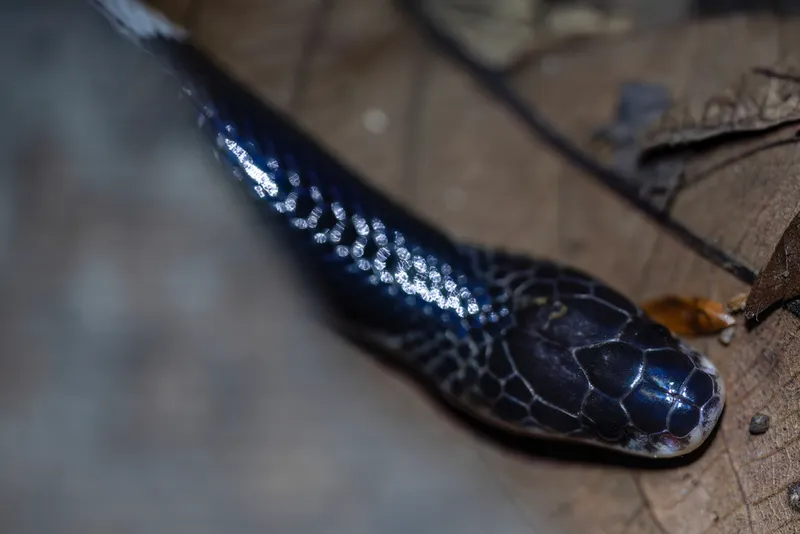
The Malayan krait (Bungarus candidus), known in Indonesia as ular weling, is a venomous krait with black and white bands and a plain white belly. WHO guidance describes black saddle-shaped markings on the back and pure white belly scales. It can be confused with the banded krait, and with juvenile Lycodon subcinctus or with Lycodon stormi, which also have alternating black and white bands. An all-black form once described as Bungarus javanicus is now considered a melanistic form of this species. The name candidus comes from the Latin for shining, a reference to its smooth, glossy scales.
Evidence: WHO Regional Office for South-East Asia — Guidelines for the management of snakebites, 2nd edition (2016) ↗ · The Reptile Database — Bungarus candidus ↗ · Acta Medica Indonesiana — Adiwinata & Nelwan (2015), Snakebite in Indonesia ↗
Where does the Malayan krait live, and when is it active?
In Indonesia, the Malayan krait is recorded from Sumatra, Java and Bali; records from Sulawesi are considered doubtful, as the last dates from 1887. It often lives close to people: in Greater Jakarta it appeared 24 times in snake reports from homes between 2015 and 2019. A radio-tracking study on a university campus in Thailand found that over half of krait locations were in human settlements and 37.1% were associated with buildings. By day, kraits sheltered in burrows or under buildings, emerging after sunset between 19:00 and 22:30. Activity was higher in the wet season and lowest in the hot season.
Evidence: The Reptile Database — Bungarus candidus ↗ · Media Konservasi — Khoerunisa, Kusrini & Mardiastuti (2021), Diversity of snake rescued from residential areas in Greater Jakarta Metropolitan Area ↗ · Scientific Reports — Hodges et al. (2022), Malayan kraits (Bungarus candidus) show affinity to anthropogenic structures in a human dominated landscape ↗
What does the Malayan krait eat?
The Malayan krait eats other snakes, lizards, amphibians and small mammals, hunting mainly at night. In a Thai radio-tracking study, two kraits were seen eating snakes in built-up areas: one in a concrete gutter near student housing and one in the atrium of an office building. Another record from the same campus shows a krait eating an ornate flying snake (Chrysopelea ornata) in a building hallway, about 25 minutes after sunrise. The researchers suggest that kraits enter settlements in pursuit of prey, which raises the chance of meeting people.
Evidence: Journal of Threatened Taxa — Hodges, D'souza & Jintapirom (2020), Diurnal observation of a Malayan Krait feeding inside a building in Thailand ↗ · Scientific Reports — Hodges et al. (2022), Malayan kraits (Bungarus candidus) show affinity to anthropogenic structures in a human dominated landscape ↗
What is the difference between the Malayan krait and the banded krait?
The easiest way to tell them apart is the belly: the banded krait's bands ring the whole body, while the Malayan krait's belly is plain white. According to the Indonesian Herpetological Society, the Malayan krait is round-bodied and the banded krait triangular. Banded kraits are usually black and yellow, sometimes black and white; Malayan kraits are black and white. WHO adds that the banded krait has a blunt tail tip; it can reach 2.25 metres. Both are nocturnal and have neurotoxic venom. WHO records deaths from Malayan krait bites in Java but no known banded krait bites in Indonesia. As they are easily confused, treat both as dangerous.
Evidence: Perhimpunan Herpetologi Indonesia — Ular Welang (Bungarus fasciatus) (salinan arsip Wayback Machine, April 2026) ↗ · WHO Regional Office for South-East Asia — Guidelines for the management of snakebites, 2nd edition (2016) ↗ · Scientific Reports — Biakzuala et al. (2023), Molecular phylogeny reveals distinct evolutionary lineages of the banded krait ↗
Is the Malayan krait dangerous?
Yes, the Malayan krait is very dangerous: its potent neurotoxic venom can cause progressive muscle paralysis leading to respiratory failure. WHO lists it as Category 1, the highest medical importance, from Sumatra and Java east to Bali, and records deaths from its bites in Java. Krait bites can be painless and often happen at night; some victims are bitten while asleep. WHO explains that this can happen when a krait enters a home to hunt and a person sleeping on the floor rolls onto it. If a bite is suspected, seek medical care at a health facility immediately.
Evidence: WHO Regional Office for South-East Asia — Guidelines for the management of snakebites, 2nd edition (2016) ↗ · PLOS ONE — Rusmili et al. (2019), Variations in neurotoxicity and proteome profile of Malayan krait (Bungarus candidus) venoms ↗ · Scientific Reports — Hodges et al. (2022), Malayan kraits (Bungarus candidus) show affinity to anthropogenic structures in a human dominated landscape ↗
What should you do if you meet a Malayan krait?
If you meet a Malayan krait, keep your distance and do not approach, catch, handle or kill it; call trained officers such as Damkar, the fire and rescue service. In Greater Jakarta, fire departments are among the groups that remove snakes from homes, and kraits are among the venomous snakes most often relocated. To reduce the risk of bites, WHO advises against sleeping unprotected on the floor and recommends a mosquito net tucked in well under the mattress. Use a light when walking at night, check your home regularly, seal gaps where snakes can hide, and store food in rodent-proof containers.
Evidence: Media Konservasi — Khoerunisa, Kusrini & Mardiastuti (2021), Diversity of snake rescued from residential areas in Greater Jakarta Metropolitan Area ↗ · WHO Regional Office for South-East Asia — Guidelines for the management of snakebites, 2nd edition (2016) ↗
Explore related habitats
These habitat relationships are supported by species sources in this guide. This is not a complete range map.
Common questions about the Malayan krait
What is the scientific name of the Malayan krait?
The scientific name of the Malayan krait is Bungarus candidus, in the family Elapidae. In Indonesian it is called Ular weling.
Where can the Malayan krait be found in Indonesia?
In Indonesia, this guide records the Malayan krait in: Sumatra, Java and Bali.
Source-supported habitats: Urban Habitats.
What does the Malayan krait eat?
Diet of the Malayan krait: other snakes, lizards, amphibians and small mammals.
What is the conservation status of the Malayan krait?
On the IUCN Red List, the Malayan krait is listed as Least Concern: it does not currently qualify for a threatened category in the global assessment. Source: IUCN Red List (via GBIF), checked 25 September 2026.
This global category is separate from legal protection in Indonesia. To check whether the Malayan krait is a protected species, consult the current national list of protected species or contact the local BKSDA (natural resources conservation office).
Sources & references
- The Reptile Database — Bungarus candidus ↗
- PLOS ONE — Rusmili et al. (2019), Variations in neurotoxicity and proteome profile of Malayan krait (Bungarus candidus) venoms ↗
- Scientific Reports — Hodges et al. (2022), Malayan kraits (Bungarus candidus) show affinity to anthropogenic structures in a human dominated landscape ↗
- Journal of Threatened Taxa — Hodges, D'souza & Jintapirom (2020), Diurnal observation of a Malayan Krait feeding inside a building in Thailand ↗
- WHO Regional Office for South-East Asia — Guidelines for the management of snakebites, 2nd edition (2016) ↗
- Acta Medica Indonesiana — Adiwinata & Nelwan (2015), Snakebite in Indonesia ↗
- Perhimpunan Herpetologi Indonesia — Ular Welang (Bungarus fasciatus) (salinan arsip Wayback Machine, April 2026) ↗
- Media Konservasi — Khoerunisa, Kusrini & Mardiastuti (2021), Diversity of snake rescued from residential areas in Greater Jakarta Metropolitan Area ↗
- Scientific Reports — Biakzuala et al. (2023), Molecular phylogeny reveals distinct evolutionary lineages of the banded krait ↗
- IUCN Red List of Threatened Species, version 2026-1, via GBIF (CC BY 4.0) ↗
References can change. Check dates and context in the original source.
Cite this page
PanduanHewan. (2026, 25 September). Malayan krait (Bungarus candidus). PanduanHewan.org. https://panduanhewan.org/en/species/malayan-krait/