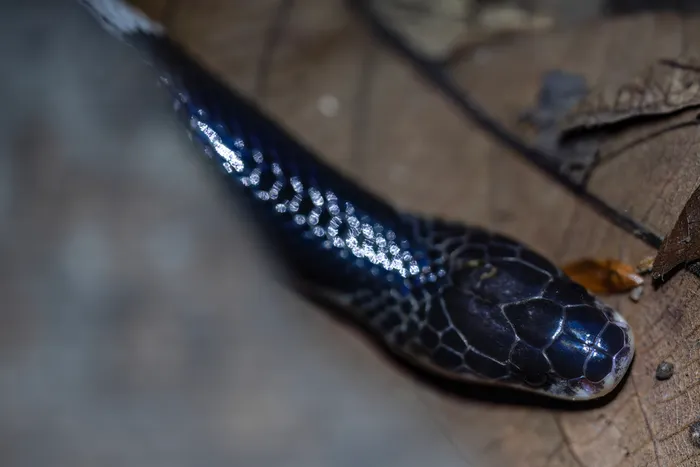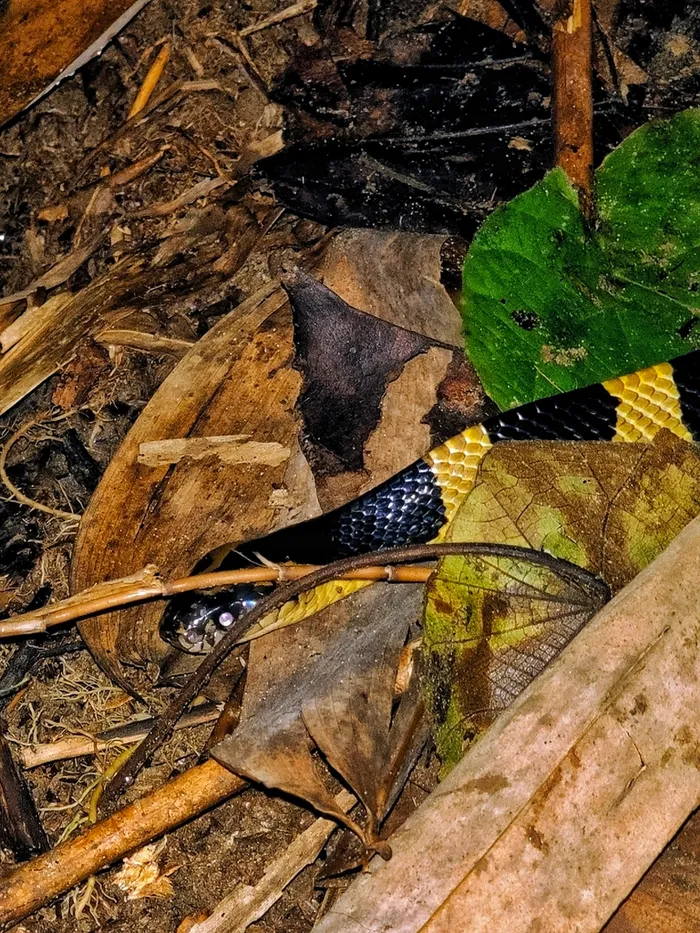
Bungarus fasciatus
The banded krait (Bungarus fasciatus) is a neurotoxic krait with full black-and-yellow rings, found in Sumatra, Java, Borneo and Bali.
PANDUANHEWAN · INDONESIA
How do the Banded krait (Bungarus fasciatus) and Malayan krait (Bungarus candidus) differ? Classification, features, range, diet, size, IUCN status and legal protection, from cited sources.
The banded krait (Bungarus fasciatus) and the Malayan krait (Bungarus candidus) are different species in the same genus, Bungarus. Range in Indonesia — the banded krait: Sumatra, Java, Borneo and Bali; the Malayan krait: Sumatra, Java and Bali.
The banded krait (Bungarus fasciatus) is a neurotoxic krait with full black-and-yellow rings, found in Sumatra, Java, Borneo and Bali.
The Malayan krait (Bungarus candidus) is a highly venomous black-and-white banded krait of Sumatra, Java and Bali that is active at night.
| Aspect | Banded krait | Malayan krait |
|---|---|---|
| Scientific name | Bungarus fasciatus | Bungarus candidus |
| Indonesian name | Ular welang | Ular weling |
| Class | Reptilia | Reptilia |
| Order | Squamata | Squamata |
| Family | Elapidae | Elapidae |
| Range in Indonesia | Sumatra, Java, Borneo and Bali | Sumatra, Java and Bali |
| Endemic to Indonesia | No | No |
| Key features | Bands ring the belly; triangular body cross-section | Black and white bands on back; plain white belly |
| Size | Up to 225 cm | — |
| Diet | Other snakes, lizards and small mammals | Other snakes, lizards, amphibians and small mammals |
| Diet type | carnivore (meat-eater) | carnivore (meat-eater) |
| Reproduction | laying eggs (oviparous) | laying eggs (oviparous) |
| IUCN status | Least Concern | Least Concern |
Every cell comes from the sourced data on each animal’s page; an empty cell means the data is not yet available, not that it is absent.
Telling animals apart never replaces keeping your distance. Do not approach, catch or handle wild animals; if bitten, go to a health facility immediately.
Search by name, habitat or island in the animal directory.