Quick answer
IUCN status: Least ConcernMalayan pit viper at a glance
The Malayan pit viper (Calloselasma rhodostoma) is a reptile in the family Viperidae. Its IUCN Red List category is Least Concern.
| Scientific name | Calloselasma rhodostoma |
|---|---|
| Indonesian name | Ular tanah |
| Group | Reptiles |
| Family | Viperidae |
| Range in Indonesia | Java, Karimunjawa and Kangean |
| Linked habitats | Tropical Rainforests, Urban Habitats |
| Diet | Rodents and other small mammals, frogs, lizards and birds |
| Range in Indonesia | Java, Karimunjawa and Kangean |
| Key feature | Triangular head; dark triangular blotches along each side |
| Length | Females about 100 cm, males about 75 cm |
| Other names | Ular tanah, ular biludak |
| Risk to people | Haemotoxic venom; damages tissue and causes bleeding |
| IUCN status | Least Concern · IUCN Red List (via GBIF) · checked 25 September 2026 |
In this guide (10)
What is the Malayan pit viper?
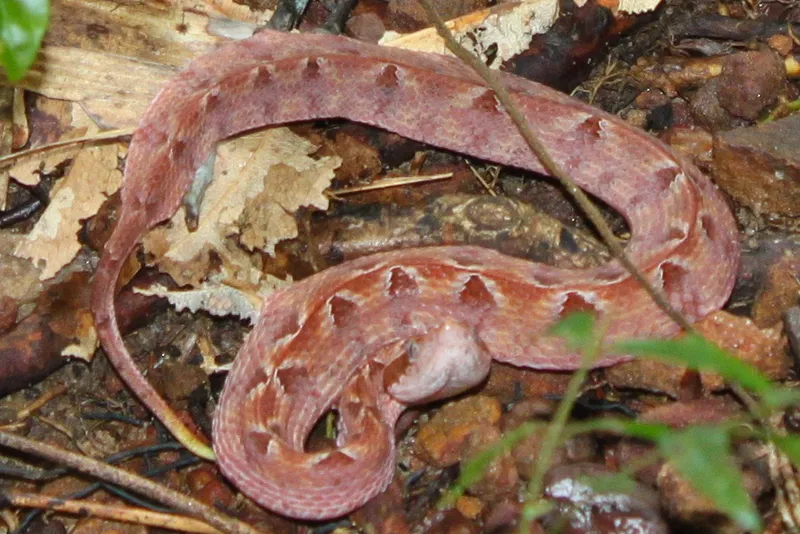
The Malayan pit viper (Calloselasma rhodostoma), called ular tanah in Indonesia, is a stout, venomous viper with a triangular head and the only member of its genus. As a pit viper, it has a heat-sensing organ between the nostril and the eye. According to MyBIS, its back is reddish-brown or purplish-brown with a row of dark brown triangular blotches on each side, whitish upper lips, a dark stripe behind the eye and a pointed, slightly upturned snout. Unlike most vipers, its back scales are smooth. Females grow to about 100 cm and males to about 75 cm. It is also known as ular biludak.
Evidence: MyBIS (Malaysia Biodiversity Information System) — Calloselasma rhodostoma ↗ · Toxins — Tan et al. (2023), De novo venom gland transcriptome of Calloselasma rhodostoma, the Malayan pit viper ↗ · Acta Medica Indonesiana — Adiwinata & Nelwan (2015), Snakebite in Indonesia ↗
Where does the Malayan pit viper live?
In Indonesia, the Malayan pit viper is recorded from Java and the Karimunjawa and Kangean islands. A study by Kadafi, Hamidy and Kurniawan (2018) examined museum specimens from West, Central and East Java, Karimunjawa and Kangean. There are reports from Kalimantan, but their status is uncertain; a 2023 study suggests snakes there may have been introduced for pest control in plantations. It lives in lowland forest, plantations, scrub and rocky areas. Around people, the Indonesian Herpetological Society notes it can be found in damp places such as woodpiles, rubbish heaps and under houses.
Evidence: Journal of Experimental Life Science — Kadafi, Hamidy & Kurniawan (2018), Morphological characters of the Malayan pit viper and distribution status in Indonesia ↗ · Toxins — Tan et al. (2023), De novo venom gland transcriptome of Calloselasma rhodostoma, the Malayan pit viper ↗ · Perhimpunan Herpetologi Indonesia — Ular Viper Tanah (Calloselasma rhodostoma) (salinan arsip Wayback Machine, April 2026) ↗
What does the Malayan pit viper eat?
The Malayan pit viper eats small mammals such as rats, as well as frogs, lizards and birds. It is an ambush hunter: it lies still among dead leaves, where its colour and pattern camouflage it, and strikes at passing prey. MyBIS says its prey probably includes any small animal that comes within striking range. The heat-sensing pit between nostril and eye lets pit vipers sense the body heat of prey and judge its size and position. As its Indonesian name, ground snake, suggests, it lives on the ground, and it is active at night.
Evidence: MyBIS (Malaysia Biodiversity Information System) — Calloselasma rhodostoma ↗ · Perhimpunan Herpetologi Indonesia — Ular Viper Tanah (Calloselasma rhodostoma) (salinan arsip Wayback Machine, April 2026) ↗
How does the Malayan pit viper breed?
The Malayan pit viper lays eggs, and the female guards them until they hatch. In a study by York and Burghardt (1988), a female laid 27 eggs and stayed coiled on top of them until hatching. She did not regulate the eggs' temperature but changed how much of the clutch was exposed as humidity changed. When prodded while brooding, she made jerking body movements that may help to deter predators. Observations in a Thai forest also recorded a female coiled around her eggs for the whole incubation period. The Reptile Database notes that the eggshells of this species are very thin.
Evidence: The Herpetological Journal — York & Burghardt (1988), Brooding in the Malayan pit viper, Calloselasma rhodostoma ↗ · MyBIS (Malaysia Biodiversity Information System) — Calloselasma rhodostoma ↗ · The Reptile Database — Calloselasma rhodostoma ↗
Is the Malayan pit viper dangerous?
Yes, the Malayan pit viper is dangerous: its venom is haemotoxic and a bite can be fatal. WHO lists it as Category 1, the highest medical importance, in Java. A bite can damage tissue around the wound and disrupt blood clotting, causing bleeding such as nosebleeds and blood in the urine. In Thailand, it causes 38% of snakebites where the species is known, according to WHO. The Indonesian Herpetological Society notes that it tends to stay put and will bite people who come close. If bitten, seek medical care at a health facility immediately.
Evidence: WHO Regional Office for South-East Asia — Guidelines for the management of snakebites, 2nd edition (2016) ↗ · Toxins — Tan et al. (2023), De novo venom gland transcriptome of Calloselasma rhodostoma, the Malayan pit viper ↗ · Perhimpunan Herpetologi Indonesia — Ular Viper Tanah (Calloselasma rhodostoma) (salinan arsip Wayback Machine, April 2026) ↗
What should you do if you meet a Malayan pit viper?
If you see a Malayan pit viper, do not approach, touch, catch or kill it; back away slowly and call trained officers such as Damkar, the fire and rescue service. In Greater Jakarta, fire departments respond to snake reports in homes. Because it lies still and camouflaged in leaf litter, watch your step in gardens, scrub and leaf piles. WHO notes that most snakebites happen when a snake is trodden on, in the dark or in undergrowth, by someone barefoot or in sandals. Wear closed footwear and use a light at night. The main threat to the species is the loss of forest to farmland and settlements.
Evidence: WHO Regional Office for South-East Asia — Guidelines for the management of snakebites, 2nd edition (2016) ↗ · Perhimpunan Herpetologi Indonesia — Ular Viper Tanah (Calloselasma rhodostoma) (salinan arsip Wayback Machine, April 2026) ↗ · Media Konservasi — Khoerunisa, Kusrini & Mardiastuti (2021), Diversity of snake rescued from residential areas in Greater Jakarta Metropolitan Area ↗
Explore related habitats
These habitat relationships are supported by species sources in this guide. This is not a complete range map.
Common questions about the Malayan pit viper
What is the scientific name of the Malayan pit viper?
The scientific name of the Malayan pit viper is Calloselasma rhodostoma, in the family Viperidae. In Indonesian it is called Ular tanah.
Where can the Malayan pit viper be found in Indonesia?
In Indonesia, this guide records the Malayan pit viper in: Java, Karimunjawa and Kangean.
Source-supported habitats: Tropical Rainforests, Urban Habitats.
What does the Malayan pit viper eat?
Diet of the Malayan pit viper: rodents and other small mammals, frogs, lizards and birds.
What is the conservation status of the Malayan pit viper?
On the IUCN Red List, the Malayan pit viper is listed as Least Concern: it does not currently qualify for a threatened category in the global assessment. Source: IUCN Red List (via GBIF), checked 25 September 2026.
This global category is separate from legal protection in Indonesia. To check whether the Malayan pit viper is a protected species, consult the current national list of protected species or contact the local BKSDA (natural resources conservation office).
Sources & references
- The Reptile Database — Calloselasma rhodostoma ↗
- MyBIS (Malaysia Biodiversity Information System) — Calloselasma rhodostoma ↗
- Perhimpunan Herpetologi Indonesia — Ular Viper Tanah (Calloselasma rhodostoma) (salinan arsip Wayback Machine, April 2026) ↗
- Journal of Experimental Life Science — Kadafi, Hamidy & Kurniawan (2018), Morphological characters of the Malayan pit viper and distribution status in Indonesia ↗
- Toxins — Tan et al. (2023), De novo venom gland transcriptome of Calloselasma rhodostoma, the Malayan pit viper ↗
- The Herpetological Journal — York & Burghardt (1988), Brooding in the Malayan pit viper, Calloselasma rhodostoma ↗
- WHO Regional Office for South-East Asia — Guidelines for the management of snakebites, 2nd edition (2016) ↗
- Acta Medica Indonesiana — Adiwinata & Nelwan (2015), Snakebite in Indonesia ↗
- Media Konservasi — Khoerunisa, Kusrini & Mardiastuti (2021), Diversity of snake rescued from residential areas in Greater Jakarta Metropolitan Area ↗
- IUCN Red List of Threatened Species, version 2026-1, via GBIF (CC BY 4.0) ↗
References can change. Check dates and context in the original source.
Cite this page
PanduanHewan. (2026, 25 September). Malayan pit viper (Calloselasma rhodostoma). PanduanHewan.org. https://panduanhewan.org/en/species/malayan-pit-viper/