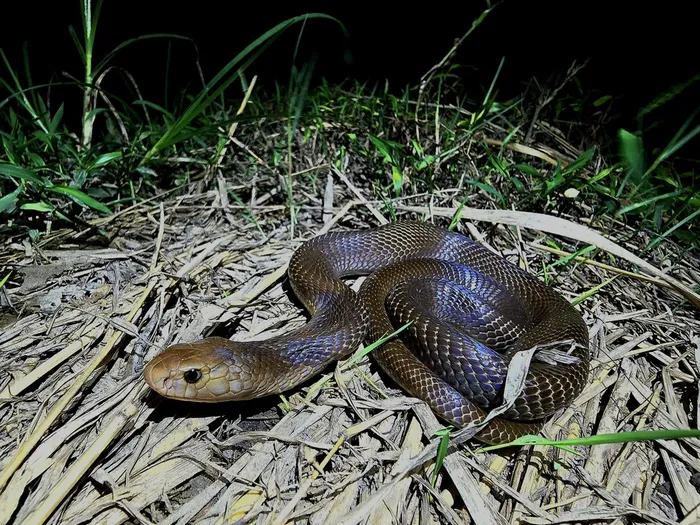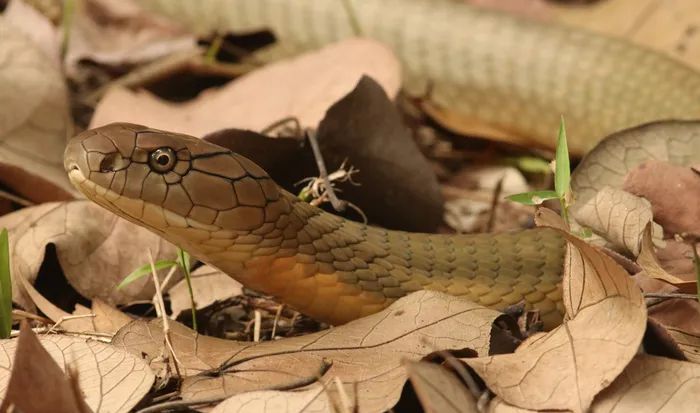
Ophiophagus bungarus
The Sunda king cobra (Ophiophagus bungarus) is a venomous snake-eater of Sumatra, Java, Borneo and Bali, separated from O. hannah in 2024.
PANDUANHEWAN · INDONESIA
How do the Sunda king cobra (Ophiophagus bungarus) and Javan spitting cobra (Naja sputatrix) differ? Classification, features, range, diet, size, IUCN status and legal protection, from cited sources.
The Sunda king cobra (Ophiophagus bungarus) and the Javan spitting cobra (Naja sputatrix) share the family Elapidae but belong to different genera: Ophiophagus and Naja. Range in Indonesia — the Sunda king cobra: Sumatra, Java, Borneo, Bali and nearby islands; the Javan spitting cobra: Java, Bali and Nusa Tenggara (Lombok to Alor).
The Sunda king cobra (Ophiophagus bungarus) is a venomous snake-eater of Sumatra, Java, Borneo and Bali, separated from O. hannah in 2024.
The Javan spitting cobra (Naja sputatrix) is a venomous spitting cobra of Java, Bali and Nusa Tenggara that often turns up around homes.
| Aspect | Sunda king cobra | Javan spitting cobra |
|---|---|---|
| Scientific name | Ophiophagus bungarus | Naja sputatrix |
| Indonesian name | King kobra | Ular kobra Jawa |
| Class | Reptilia | Reptilia |
| Order | Squamata | Squamata |
| Family | Elapidae | Elapidae |
| Range in Indonesia | Sumatra, Java, Borneo, Bali and nearby islands | Java, Bali and Nusa Tenggara (Lombok to Alor) |
| Endemic to Indonesia | No | Yes |
| Key features | Adults mostly plain brown; juveniles with 57–87 pale bands | Spoon-shaped hood; can spray venom |
| Size | — | Average 130 cm, up to 180 cm |
| Diet | Mainly other snakes, including rat snakes, pythons and cobras | Rats, lizards, frogs, birds and other snakes |
| Diet type | carnivore (meat-eater) | carnivore (meat-eater) |
| Reproduction | laying eggs (oviparous) | laying eggs (oviparous) |
| IUCN status | — | Least Concern |
Every cell comes from the sourced data on each animal’s page; an empty cell means the data is not yet available, not that it is absent.
Telling animals apart never replaces keeping your distance. Do not approach, catch or handle wild animals; if bitten, go to a health facility immediately.
Search by name, habitat or island in the animal directory.