Quick answer
IUCN status: Least ConcernSooty-headed bulbul at a glance
The Sooty-headed bulbul (Pycnonotus aurigaster) is a bird in the family Pycnonotidae. Its IUCN Red List category is Least Concern.
| Scientific name | Pycnonotus aurigaster |
|---|---|
| Indonesian name | Kutilang |
| Group | Birds |
| Family | Pycnonotidae |
| Range in Indonesia | Java and Bali (native); introduced to Sumatra, Borneo and Sulawesi |
| Linked habitats | Urban Habitats |
| Diet | Soft fruit and small insects |
| Range in Indonesia | Native to Java and Bali; introduced elsewhere |
| Key feature | Black head and crest, white rump, orange-red vent |
| Other names | Cucak kutilang, cangkurileung (Sundanese), ketilang, genthilang (Javanese) |
| Length | About 19–21 cm |
| IUCN status | Least Concern · IUCN Red List (via GBIF) · checked 25 September 2026 |
In this guide (10)
What is the sooty-headed bulbul?
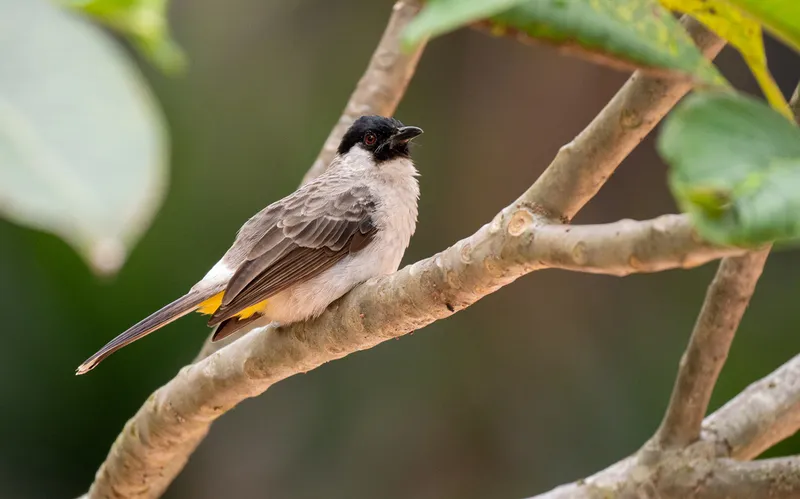
The sooty-headed bulbul, known in Indonesia as kutilang, is perhaps the country's best-known bulbul, helped by a children's song named after it. The Bird Society of Singapore gives its length as 19–21 cm. It has a black head, chin and nape with a short crest, brown upperparts, a white rump, white underparts and an orange-red vent. Juveniles have a browner head. Indonesia's conservation directorate (Ditjen KSDAE) gives its official Indonesian name as cucak kutilang and notes about nine recognised subspecies.
Evidence: Bird Society of Singapore, Birds of Singapore — Sooty-headed Bulbul ↗ · Ditjen KSDAE (Balai TN Batang Gadis) — Burung Kutilang (Pycnonotus aurigaster) Cucak Terpopuler ↗
Where does the sooty-headed bulbul live?
The sooty-headed bulbul is native to Java and Bali. According to Ditjen KSDAE, the populations on Sumatra, Borneo and Sulawesi come from birds brought by people. Outside Indonesia it ranges across southern China and mainland Southeast Asia. It uses a wide range of habitats, from open woodland, forest edge, scrub, secondary growth and roadsides to yards, gardens and city parks, from the lowlands up to about 1,500 m. BirdLife also lists urban areas, farmland and degraded former forest as suitable habitat.
Evidence: Ditjen KSDAE (Balai TN Batang Gadis) — Burung Kutilang (Pycnonotus aurigaster) Cucak Terpopuler ↗ · Bird Society of Singapore, Birds of Singapore — Sooty-headed Bulbul ↗ · BirdLife International DataZone — Sooty-headed Bulbul Pycnonotus aurigaster species factsheet ↗
What does the sooty-headed bulbul eat?
Like other bulbuls, the sooty-headed bulbul feeds mainly on soft fruit, though it also eats a variety of small insects. According to Ditjen KSDAE, it is often seen in groups, either with its own kind or with other bulbuls. It is still easy to find in many areas, especially on Java, including in yards, gardens and city parks. BirdLife also describes the species as still common on Java, and lists rural gardens and farmland among its suitable habitats.
Evidence: Ditjen KSDAE (Balai TN Batang Gadis) — Burung Kutilang (Pycnonotus aurigaster) Cucak Terpopuler ↗ · BirdLife International DataZone — Sooty-headed Bulbul Pycnonotus aurigaster species factsheet ↗
How does the sooty-headed bulbul breed?
The sooty-headed bulbul builds a cup-shaped nest woven from grass, leaf stalks or fine twigs. According to Ditjen KSDAE, the female lays two or three eggs per clutch. The eggs are pinkish with fine purple and grey spots.
It is a noisy, restless bird. Its song is loud but sweet, with rapidly repeated "cuk-cuk" and "cang-kur" notes. Its Sundanese name, cangkurileung, and Javanese names, ketilang or genthilang, are widely used locally.
Evidence: Ditjen KSDAE (Balai TN Batang Gadis) — Burung Kutilang (Pycnonotus aurigaster) Cucak Terpopuler ↗
Is the sooty-headed bulbul affected by the songbird trade?
Yes: it is still listed as Least Concern, but BirdLife's 2024 assessment says its population is suspected to be declining because of heavy trapping pressure. A TRAFFIC survey of Jakarta's three largest bird markets in July 2014 counted 476 sooty-headed bulbuls in 32 shops. A TRAFFIC survey of five markets in Surabaya, Yogyakarta and Malang in June 2015 counted 345. In that survey it was among the 20 most numerous species out of 22,911 birds counted.
Evidence: BirdLife International DataZone — Sooty-headed Bulbul Pycnonotus aurigaster species factsheet ↗ · TRAFFIC — In the Market for Extinction: An inventory of Jakarta's bird markets (Chng et al., 2015) ↗ · TRAFFIC — In the Market for Extinction: Eastern and Central Java (Chng & Eaton, 2016) ↗
How can the sooty-headed bulbul be protected?
The simplest way to protect the sooty-headed bulbul is to leave it free. Do not catch adults, take chicks from nests, or buy wild-caught birds. According to Ditjen KSDAE, its numbers are falling because of habitat damage as well as capture and trade, so yards and city parks with trees are worth keeping. Some regions have acted. Mongabay Indonesia reports that a 2011 Aceh governor's instruction barred hunting this bird and nine other species, or taking them out of Aceh, because wild numbers had fallen.
Evidence: Ditjen KSDAE (Balai TN Batang Gadis) — Burung Kutilang (Pycnonotus aurigaster) Cucak Terpopuler ↗ · Mongabay Indonesia — Diburu, Nasib Murai Batu Makin Tak Menentu (2021) ↗
Explore related habitats
These habitat relationships are supported by species sources in this guide. This is not a complete range map.
Common questions about the Sooty-headed bulbul
What is the scientific name of the Sooty-headed bulbul?
The scientific name of the Sooty-headed bulbul is Pycnonotus aurigaster, in the family Pycnonotidae. In Indonesian it is called Kutilang.
Where can the Sooty-headed bulbul be found in Indonesia?
In Indonesia, this guide records the Sooty-headed bulbul in: Java and Bali (native); introduced to Sumatra, Borneo and Sulawesi.
Source-supported habitats: Urban Habitats.
What does the Sooty-headed bulbul eat?
Diet of the Sooty-headed bulbul: soft fruit and small insects.
What is the conservation status of the Sooty-headed bulbul?
On the IUCN Red List, the Sooty-headed bulbul is listed as Least Concern: it does not currently qualify for a threatened category in the global assessment. Source: IUCN Red List (via GBIF), checked 25 September 2026.
This global category is separate from legal protection in Indonesia. To check whether the Sooty-headed bulbul is a protected species, consult the current national list of protected species or contact the local BKSDA (natural resources conservation office).
Sources & references
- BirdLife International DataZone — Sooty-headed Bulbul Pycnonotus aurigaster species factsheet ↗
- Ditjen KSDAE (Balai TN Batang Gadis) — Burung Kutilang (Pycnonotus aurigaster) Cucak Terpopuler ↗
- Bird Society of Singapore, Birds of Singapore — Sooty-headed Bulbul ↗
- TRAFFIC — In the Market for Extinction: An inventory of Jakarta's bird markets (Chng et al., 2015) ↗
- TRAFFIC — In the Market for Extinction: Eastern and Central Java (Chng & Eaton, 2016) ↗
- Mongabay Indonesia — Diburu, Nasib Murai Batu Makin Tak Menentu (2021) ↗
- IUCN Red List of Threatened Species, version 2026-1, via GBIF (CC BY 4.0) ↗
References can change. Check dates and context in the original source.
Cite this page
PanduanHewan. (2026, 25 September). Sooty-headed bulbul (Pycnonotus aurigaster). PanduanHewan.org. https://panduanhewan.org/en/species/sooty-headed-bulbul/