Quick answer
IUCN status: Critically EndangeredStraw-headed bulbul at a glance
The Straw-headed bulbul (Pycnonotus zeylanicus) is a bird in the family Pycnonotidae. Its IUCN Red List category is Critically Endangered.
| Scientific name | Pycnonotus zeylanicus |
|---|---|
| Indonesian name | Cucak rawa |
| Group | Birds |
| Family | Pycnonotidae |
| Range in Indonesia | Borneo (remnant populations in remote areas) and possibly Sumatra; extinct on Java |
| Linked habitats | Freshwater Wetlands, Tropical Rainforests |
| Diet | Mainly fruit: berries, figs and palm fruits |
| Range in Indonesia | Remnants in remote Borneo; extinct on Java |
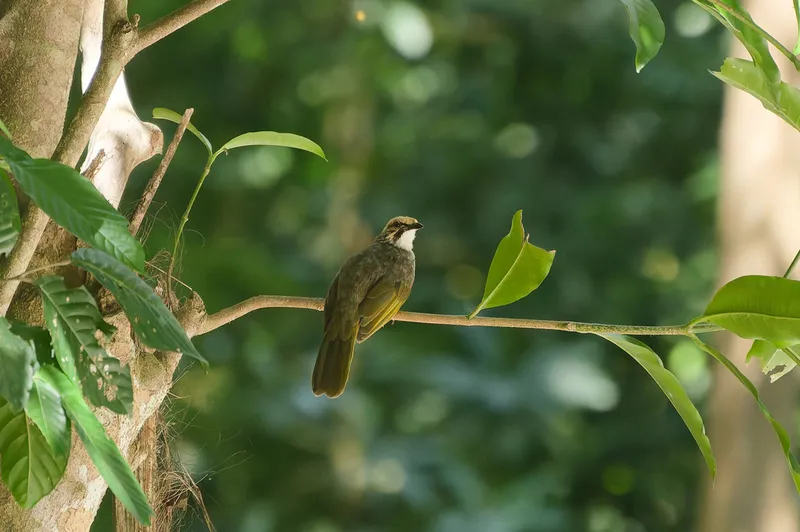
| Key feature | Straw-yellow crown and cheeks, black moustachial stripe |
| IUCN status | Critically Endangered since 2018 |
| International trade | Moved to CITES Appendix I at CoP19 (2022) |
| IUCN status | Critically Endangered · IUCN Red List (via GBIF) · checked 25 September 2026 |
In this guide (10)
What is the straw-headed bulbul?
The straw-headed bulbul is a large member of the bulbul family, Pycnonotidae, about 29 cm long, with a golden, straw-coloured crown and cheeks. BirdLife describes blackish eye and moustachial stripes, a white throat and fine whitish streaks on the upperparts and breast. Juveniles have a duller, browner head. The Bird Society of Singapore adds that the wings and tail have olive-green edges and the iris is red. TRAFFIC once found a yellow-vented bulbul with a dyed crown being sold as this species in Jakarta.
Evidence: BirdLife International DataZone — Straw-headed Bulbul Pycnonotus zeylanicus species factsheet ↗ · Bird Society of Singapore, Birds of Singapore — Straw-headed Bulbul ↗ · TRAFFIC — In the Market for Extinction: An inventory of Jakarta's bird markets (Chng et al., 2015) ↗
Where does the straw-headed bulbul live?
The straw-headed bulbul lives along rivers, streams and marshes in the lowlands, mainly in secondary and disturbed forest. According to BirdLife, it once ranged from southern Myanmar and Thailand through Peninsular Malaysia and Singapore to Sumatra, Java and Borneo. It is now considered extinct in Thailand and probably in Myanmar, Java, Nias and Sipora. In Kalimantan, the survivors are confined to areas furthest from people. An IUCN and TRAFFIC analysis says the largest stable population is now in Singapore.
Evidence: BirdLife International DataZone — Straw-headed Bulbul Pycnonotus zeylanicus species factsheet ↗ · IUCN/TRAFFIC — Analyses of the proposals to amend the CITES Appendices at CoP19 (2022) ↗
What does the straw-headed bulbul eat?
The straw-headed bulbul feeds mainly on fruit. The Bird Society of Singapore records it eating berries, figs and exotic palm fruits, and it also forages on the ground. It is usually seen in pairs or small family groups. BirdLife gives group sizes of up to five birds, while the Bird Society of Singapore says three to six. BirdLife also describes its habitat as successional vegetation beside water, where seasonal flooding stops climax forest from forming.
Evidence: Bird Society of Singapore, Birds of Singapore — Straw-headed Bulbul ↗ · BirdLife International DataZone — Straw-headed Bulbul Pycnonotus zeylanicus species factsheet ↗
How does the straw-headed bulbul behave?
The straw-headed bulbul is sedentary and lives in pairs or family groups. Its song is loud, rich and melodious. According to the Bird Society of Singapore, the full song usually heard is a duet or a group chorus. BirdLife advises listening for it in marshes and along forested rivers.
Its behaviour makes it easy to catch. BirdLife notes that it is not shy and roosts and nests in easily reached places, which has made it more vulnerable to trappers.
Evidence: BirdLife International DataZone — Straw-headed Bulbul Pycnonotus zeylanicus species factsheet ↗ · Bird Society of Singapore, Birds of Singapore — Straw-headed Bulbul ↗
Why has the straw-headed bulbul almost vanished from the wild?
The straw-headed bulbul has almost vanished from the wild because it is still trapped for the songbird trade. BirdLife's 2021 IUCN assessment estimates only 600–1,700 mature individuals remain, after a decline of more than 80% over three generations. Scarcity has pushed prices up from about US$20 in 1987 to over US$900 in 2018, according to an IUCN and TRAFFIC analysis. TRAFFIC market surveys in Kalimantan and Java in 2014–2015 still found 71 birds in 11 markets. Wild-caught birds are seen as better singers, so captive breeding has not reduced demand.
Evidence: BirdLife International DataZone — Straw-headed Bulbul Pycnonotus zeylanicus species factsheet ↗ · IUCN/TRAFFIC — Analyses of the proposals to amend the CITES Appendices at CoP19 (2022) ↗ · TRAFFIC — Trade is the straw breaking the Straw-headed Bulbul's back, says new paper (2017) ↗
How can the straw-headed bulbul be protected?
Protecting the straw-headed bulbul depends on ending the capture and trade of wild birds. It has been on CITES Appendix II since 1997. At CoP19 in 2022, CITES Parties agreed to move it to Appendix I after a 12-month delay, which bans international commercial trade in wild-caught birds. BirdLife recommends tighter policing of bird markets and more patrols around protected areas. People can help by not buying wild-caught birds and by reporting suspicious trapping or sales to the local conservation agency (BKSDA) or the police.
Evidence: TRAFFIC — CITES CoP19 Decisions and listings come into force (2023) ↗ · TRAFFIC — Trade is the straw breaking the Straw-headed Bulbul's back, says new paper (2017) ↗ · BirdLife International DataZone — Straw-headed Bulbul Pycnonotus zeylanicus species factsheet ↗
Explore related habitats
These habitat relationships are supported by species sources in this guide. This is not a complete range map.
Common questions about the Straw-headed bulbul
What is the scientific name of the Straw-headed bulbul?
The scientific name of the Straw-headed bulbul is Pycnonotus zeylanicus, in the family Pycnonotidae. In Indonesian it is called Cucak rawa.
Where can the Straw-headed bulbul be found in Indonesia?
In Indonesia, this guide records the Straw-headed bulbul in: Borneo (remnant populations in remote areas) and possibly Sumatra; extinct on Java.
Source-supported habitats: Freshwater Wetlands, Tropical Rainforests.
What does the Straw-headed bulbul eat?
Diet of the Straw-headed bulbul: mainly fruit: berries, figs and palm fruits.
What is the conservation status of the Straw-headed bulbul?
On the IUCN Red List, the Straw-headed bulbul is listed as Critically Endangered: it is considered to face an extremely high risk of extinction in the wild. Source: IUCN Red List (via GBIF), checked 25 September 2026.
This global category is separate from legal protection in Indonesia. To check whether the Straw-headed bulbul is a protected species, consult the current national list of protected species or contact the local BKSDA (natural resources conservation office).
Sources & references
- BirdLife International DataZone — Straw-headed Bulbul Pycnonotus zeylanicus species factsheet ↗
- IUCN/TRAFFIC — Analyses of the proposals to amend the CITES Appendices at CoP19 (2022) ↗
- TRAFFIC — Trade is the straw breaking the Straw-headed Bulbul's back, says new paper (2017) ↗
- TRAFFIC — CITES CoP19 Decisions and listings come into force (2023) ↗
- Bird Society of Singapore, Birds of Singapore — Straw-headed Bulbul ↗
- TRAFFIC — In the Market for Extinction: An inventory of Jakarta's bird markets (Chng et al., 2015) ↗
- IUCN Red List of Threatened Species, version 2026-1, via GBIF (CC BY 4.0) ↗
References can change. Check dates and context in the original source.
Cite this page
PanduanHewan. (2026, 25 September). Straw-headed bulbul (Pycnonotus zeylanicus). PanduanHewan.org. https://panduanhewan.org/en/species/straw-headed-bulbul/