Quick answer
IUCN status: Least ConcernCommon hill myna at a glance
The common hill myna (Gracula religiosa) is a bird in the family Sturnidae. Range in Indonesia: Sumatra, Borneo, Java and Bali, including Enggano Island (now hard to find in the wild on Java and Bali). Diet: mainly fruit, especially figs; also nectar and insects. IUCN Red List status: Least Concern. It is a legally protected species in Indonesia (Regulation P.106/2018).
| Scientific name | Gracula religiosa |
|---|---|
| Indonesian name | Beo |
| Group | Birds |
| Family | Sturnidae |
| Range in Indonesia | Sumatra, Borneo, Java and Bali, including Enggano Island (now hard to find in the wild on Java and Bali) |
| Linked habitats | Tropical Rainforests |
| Diet | Mainly fruit, especially figs; also nectar and insects |
| Range in Indonesia | Sumatra, Borneo, Java, Bali and Enggano |
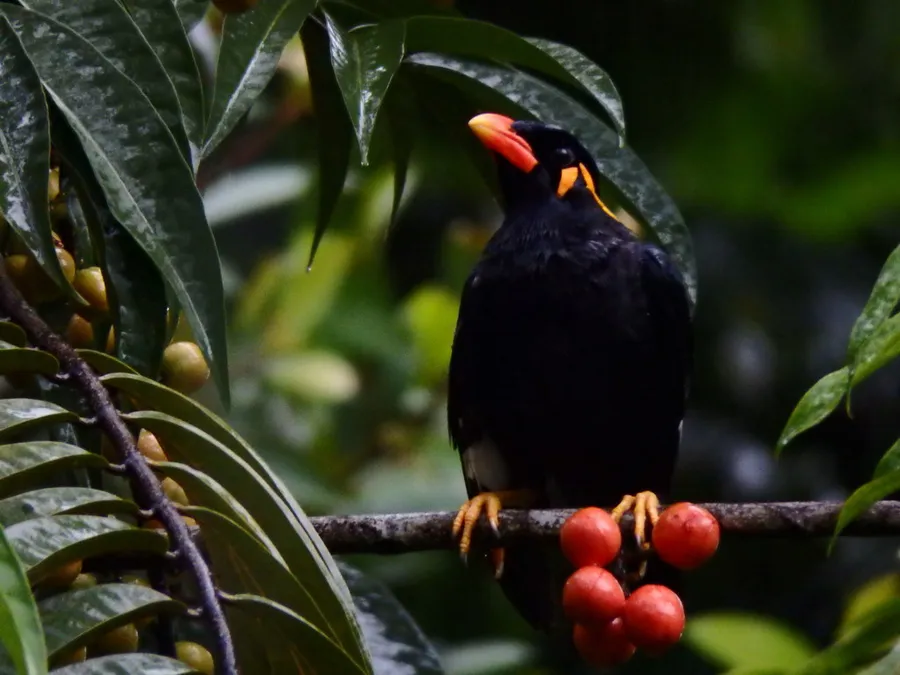
| Key feature | Glossy black, yellow wattles, orange bill |
| Other names | Tiong emas, beo |
| International trade | CITES Appendix II since 1997 |
| IUCN status | Least Concern · IUCN Red List (via GBIF) · checked 1 October 2026 |
| Legal protection in Indonesia | Protected · Regulation P.106/2018 · annex no. 662 |
| Broods per year | 2–3 broods a year, each of about two eggs · Animal Diversity Web — Gracula religiosa (hill myna) |
| Reproduction | Laying eggs (oviparous) · Vigie-Nature École (MNHN) |
| Active | Diurnal (active by day) · EltonTraits 1.0 (Wilman et al. 2014, Ecology 95:2027), BirdFuncDat.txt |
In this guide (12)
What is the common hill myna?
The common hill myna, called beo or tiong emas in Indonesia, is a 27–31 cm member of the starling family, Sturnidae, according to the Bird Society of Singapore. It is glossy black with a purple and green sheen, yellow wattles on the cheeks and nape, a bright orange bill and yellow legs. White wing patches show clearly in flight. According to BirdLife, several forms once lumped in Gracula religiosa are now treated as separate species, including G. robusta of Nias and G. venerata of Nusa Tenggara. Indonesia's Regulation P.106/2018 also lists them separately.
Evidence: Bird Society of Singapore, Birds of Singapore — Common Hill Myna ↗ · BirdLife International DataZone — Common Hill Myna Gracula religiosa species factsheet ↗ · JDIH Kementerian Kehutanan — Permen LHK P.106/MENLHK/SETJEN/KUM.1/12/2018 tentang Jenis Tumbuhan dan Satwa yang Dilindungi (PDF, dengan lampiran) ↗
Where does the common hill myna live?
The common hill myna lives in moist and semi-evergreen forest from the lowlands up into the hills and mountains. BirdLife maps its range from eastern India and southern China to Borneo and the Greater Sundas, including Enggano Island. Animal Diversity Web says it prefers areas of high rainfall and humidity and is common at forest edges and clearings. Mongabay Indonesia, writing with Burung Indonesia, reports that it is common in the lowland forests of Sumatra and Borneo, but now hard to find in the wild on Java and Bali.
Evidence: BirdLife International DataZone — Common Hill Myna Gracula religiosa species factsheet ↗ · Animal Diversity Web (University of Michigan) — Gracula religiosa (hill myna) ↗ · Mongabay Indonesia — Tiong Emas, Si Peniru Suara Manusia yang Ulung (2016) ↗
What does the common hill myna eat?
The common hill myna feeds mainly on fruit, and figs are what it eats most often. According to Animal Diversity Web, it also takes berries and seeds from many trees and shrubs, as well as nectar, insects and lizards. Most insects are picked from trees, but it has been seen catching flying termites in the air. It lives almost entirely in the trees. The Bird Society of Singapore notes that it is usually seen in pairs or small groups, especially at fruiting trees.
Evidence: Animal Diversity Web (University of Michigan) — Gracula religiosa (hill myna) ↗ · Bird Society of Singapore, Birds of Singapore — Common Hill Myna ↗
Why can the common hill myna mimic human speech?
The hill myna's talent for mimicry comes from its syrinx, the bird's voice organ. According to Mongabay Indonesia, one of the cartilage ridges in the syrinx wall works much like human vocal cords. In the wild, each bird has three to 13 call types, and hill mynas do not copy other bird species. Their ability to imitate human speech appears in captivity.
Hill mynas nest in tree holes at the forest edge, mostly from April to July. According to Animal Diversity Web, the female usually lays two blue eggs with brown spots.
Evidence: Mongabay Indonesia — Tiong Emas, Si Peniru Suara Manusia yang Ulung (2016) ↗ · Animal Diversity Web (University of Michigan) — Gracula religiosa (hill myna) ↗
Why is the common hill myna so heavily hunted?
The hill myna is hunted because its mimicry makes it one of the most popular pet birds in Asia. According to BirdLife, more than 170,000 wild-caught hill mynas were exported from range states in 1994–2003. Trade combined with forest loss has caused major declines in Indonesia, China, Peninsular Malaysia and Thailand, driven mainly by domestic demand. A TRAFFIC survey of five markets in Surabaya, Yogyakarta and Malang in June 2015 still found 197 hill mynas for sale, at an average of about US$188 each.
Evidence: BirdLife International DataZone — Common Hill Myna Gracula religiosa species factsheet ↗ · TRAFFIC — In the Market for Extinction: Eastern and Central Java (Chng & Eaton, 2016) ↗
How can the common hill myna be protected?
The common hill myna is protected in Indonesia: Gracula religiosa is listed as tiong emas in the annex of Environment and Forestry Ministerial Regulation P.106/MENLHK/SETJEN/KUM.1/12/2018. Internationally, it was added to CITES Appendix III in 1992 at Thailand's request and moved to Appendix II in 1997. People can help by not catching, buying or trading hill mynas, and by reporting sales in markets or on social media to the local conservation agency (BKSDA) or the police. Protecting lowland and hill forest with large, hollow trees also matters, because hill mynas nest in tree holes.
Evidence: JDIH Kementerian Kehutanan — Permen LHK P.106/MENLHK/SETJEN/KUM.1/12/2018 tentang Jenis Tumbuhan dan Satwa yang Dilindungi (PDF, dengan lampiran) ↗ · BirdLife International DataZone — Common Hill Myna Gracula religiosa species factsheet ↗ · Animal Diversity Web (University of Michigan) — Gracula religiosa (hill myna) ↗
Explore related habitats
These habitat relationships are supported by species sources in this guide. This is not a complete range map.
Scientific classification of the Common hill myna
| Kingdom | Animalia |
|---|---|
| Phylum | Chordata |
| Class | Aves |
| Order | Passeriformes |
| Family | Sturnidae |
| Genus | Gracula |
| Species | Gracula religiosa |
Source: GBIF Backbone Taxonomy, adjusted to the ranks commonly used in school biology (for example class Reptilia).
Common questions about the common hill myna
What is the scientific name of the common hill myna?
The scientific name of the common hill myna is Gracula religiosa, in the family Sturnidae. In Indonesian it is called Beo.
Where does the common hill myna live in Indonesia?
In Indonesia, this guide records the common hill myna in: Sumatra, Borneo, Java and Bali, including Enggano Island (now hard to find in the wild on Java and Bali).
Source-supported habitats: Tropical Rainforests.
What does the common hill myna eat?
Diet of the common hill myna: mainly fruit, especially figs; also nectar and insects.
How does the common hill myna reproduce?
The common hill myna reproduces by laying eggs (oviparous). Source: Vigie-Nature École (MNHN).
Is the common hill myna nocturnal?
The cited source records the common hill myna as diurnal (active by day). Source: EltonTraits 1.0 (Wilman et al. 2014, Ecology 95:2027), BirdFuncDat.txt.
See also the list of nocturnal and diurnal animals in Indonesia.
What are the main features of the common hill myna?
Key features of the common hill myna, from this guide’s sources: Key feature: glossy black, yellow wattles, orange bill.
What is the scientific classification of the common hill myna?
Scientific classification of the common hill myna: kingdom Animalia, phylum Chordata, class Aves, order Passeriformes, family Sturnidae, genus Gracula, species Gracula religiosa.
Source: GBIF Backbone Taxonomy, adjusted to the ranks commonly used in school biology.
Is the common hill myna endangered?
No, according to the global IUCN assessment. On the IUCN Red List, the common hill myna is listed as Least Concern: it does not qualify for a threatened category or for Near Threatened in the global assessment. Source: IUCN Red List (via GBIF), checked 1 October 2026.
This global category is separate from national legal protection. Is the common hill myna protected in Indonesia?
Is the common hill myna protected in Indonesia?
Yes. The common hill myna (Gracula religiosa) is a protected species in Indonesia under Environment and Forestry Ministerial Regulation No. P.106/MENLHK/SETJEN/KUM.1/12/2018 on protected plant and animal species (annex, entry 662).
Article 21(2) of Law No. 5 of 1990, as amended by Law No. 32 of 2024, prohibits anyone from hunting, catching, injuring, killing, storing, owning, keeping, transporting or trading a protected animal, alive or dead, including its body parts, eggs and nests.
If you see this animal being traded, kept or injured, contact the local BKSDA office.
Can the common hill myna be kept as a pet?
No. Because the common hill myna is a protected species, catching, owning, keeping, transporting or trading it without a permit is prohibited by law. Trading without a permit through electronic media is also prohibited.
If you see this animal for sale or being kept, report it to the local BKSDA office.
Compare with similar animals
Sources & references
- BirdLife International DataZone — Common Hill Myna Gracula religiosa species factsheet ↗
- Animal Diversity Web (University of Michigan) — Gracula religiosa (hill myna) ↗
- Mongabay Indonesia — Tiong Emas, Si Peniru Suara Manusia yang Ulung (2016) ↗
- Bird Society of Singapore, Birds of Singapore — Common Hill Myna ↗
- JDIH Kementerian Kehutanan — Permen LHK P.106/MENLHK/SETJEN/KUM.1/12/2018 tentang Jenis Tumbuhan dan Satwa yang Dilindungi (PDF, dengan lampiran) ↗
- TRAFFIC — In the Market for Extinction: Eastern and Central Java (Chng & Eaton, 2016) ↗
- Vigie-Nature École (MNHN) ↗
- EltonTraits 1.0 (Wilman et al. 2014, Ecology 95:2027), BirdFuncDat.txt ↗
- GBIF Backbone Taxonomy (GBIF) ↗
- IUCN Red List of Threatened Species, version 2026-1, via GBIF (CC BY 4.0) ↗
References can change. Check dates and context in the original source. How we use sources and data →
Related causes and news
Cite this page
Credit PanduanHewan when referring to this page. Check the original evidence sources before reusing a claim.
PanduanHewan. Common hill myna (Gracula religiosa). Last substantive update: 1 October 2026. https://panduanhewan.org/en/species/common-hill-myna/