Quick answer
IUCN status: Least ConcernGreater bird-of-paradise at a glance
The greater bird-of-paradise (Paradisaea apoda) is a bird in the family Paradisaeidae. Range in Indonesia: Aru Islands (Maluku) and the southern lowlands of Papua. Diet: fruit and arthropods such as insects; a omnivore. IUCN Red List status: Least Concern. It is a legally protected species in Indonesia (Regulation P.106/2018).
| Scientific name | Paradisaea apoda |
|---|---|
| Indonesian name | Cenderawasih besar |
| Group | Birds |
| Family | Paradisaeidae |
| Range in Indonesia | Aru Islands (Maluku) and the southern lowlands of Papua |
| Linked habitats | Tropical Rainforests |
| Diet | Fruit and arthropods such as insects |
| Range in Indonesia | Aru Islands and the southern lowlands of Papua |
| Key feature | Males have long yellow plumes and two tail wires |
| Other names | Cenderawasih kuning besar, cendrawasih besar |
| IUCN status | Least Concern (BirdLife assessment, 2024) |
| IUCN status | Least Concern · IUCN Red List (via GBIF) · checked 1 October 2026 |
| Legal protection in Indonesia | Protected · Regulation P.106/2018 · annex no. 448 |
| Diet type | Omnivore (eats plants and animals) — fruit and arthropods (e.g. insects) · Australian Museum |
| Reproduction | Laying eggs (oviparous) · Vigie-Nature École (MNHN) |
| Active | Diurnal (active by day) · EltonTraits 1.0 (Wilman et al. 2014, Ecology 95:2027), BirdFuncDat.txt |
In this guide (12)
What is the greater bird-of-paradise?
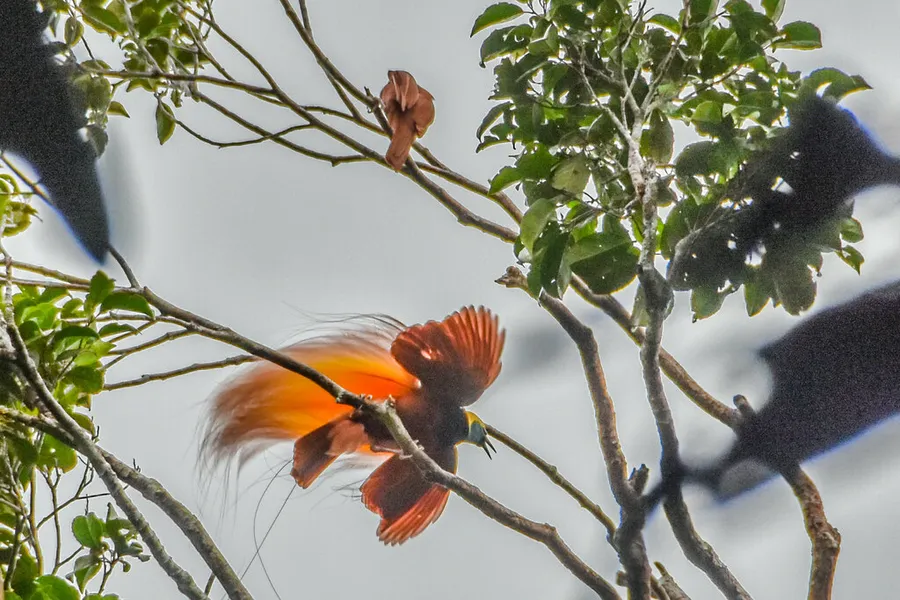
The greater bird-of-paradise (Paradisaea apoda) is a bird-of-paradise whose males carry long yellow flank plumes and two wire-like central tail feathers. According to the Australian Museum, males average 43 cm excluding the tail wires, and females about 35 cm. Males have a yellow head and an iridescent green throat, with a brown back, wings and underparts. Females are brown all over.
In Indonesian it is also called cenderawasih kuning besar. It resembles the lesser bird-of-paradise (Paradisaea minor), but its back is brown rather than yellow, and it is the larger of the two.
Evidence: Australian Museum — Greater Bird of Paradise ↗ · Al-Kauniyah: Jurnal Biologi — Pohon Bermain Burung Cenderawasih Kuning Besar (Paradisaea apoda) di Hutan Kampung Katan, Kabupaten Mappi (2023) ↗
Where does the greater bird-of-paradise live?
The greater bird-of-paradise lives in the Aru Islands, Maluku, and the southern lowlands of New Guinea, from around Timika east to the Fly and Strickland rivers in Papua New Guinea. Its habitat is lowland and hill forest up to about 950 m. A study in the village forest of Katan, Mappi Regency, recorded the birds using particular display trees. Mongabay Indonesia, citing researchers from Pattimura University, reports that within Maluku it occurs only in the Aru Islands. Key habitat there lies on Kobror and Baun islands in Central Aru, which have tall natural forest and mangrove-fringed coasts.
Evidence: Australian Museum — Greater Bird of Paradise ↗ · Mongabay Indonesia — Tidak Hanya di Papua, Habitat Cendrawasih Juga Ada di Pulau Kobror, Aru (2023) ↗ · Al-Kauniyah: Jurnal Biologi — Pohon Bermain Burung Cenderawasih Kuning Besar (Paradisaea apoda) di Hutan Kampung Katan, Kabupaten Mappi (2023) ↗
What does the greater bird-of-paradise eat?
The greater bird-of-paradise eats fruit and arthropods, including insects. Mongabay Indonesia, citing research in the Aru Islands, says it takes a range of small to medium-sized fruits and some insects. Much of its activity takes place in large forest trees such as wild canarium (Canarium vulgare), wild nutmeg (Myristica fatua) and tawang (Pometia pinnata), which can reach 30 m. It uses these trees for perching, feeding, nesting and mating. The bird is sensitive to disturbance and may leave an area if it is bothered by the noise of human activity.
Evidence: Australian Museum — Greater Bird of Paradise ↗ · Mongabay Indonesia — Tidak Hanya di Papua, Habitat Cendrawasih Juga Ada di Pulau Kobror, Aru (2023) ↗
How does the greater bird-of-paradise display and breed?
The greater bird-of-paradise breeds at leks, where several males display together on traditional perches to attract females. The Australian Museum records up to 15 adult males at one lek, plus younger males still in female-like plumage. Displaying males throw their plumes over their backs, hop along the branch and then hang facing downwards with plumes spread. Females build and attend nests alone. Breeding has been recorded at least in March–May and August–December. A study in a production forest in Papua saw young males watch adult males and then imitate their dance, suggesting a learning process.
Evidence: Australian Museum — Greater Bird of Paradise ↗ · Jurnal Pengelolaan Sumberdaya Alam dan Lingkungan (IPB) — Pramunandya 2024, The Display Behavior of Sub-Adult Greater Bird-of-Paradise (Paradisaea apoda) ↗
Why is the greater bird-of-paradise called the ‘footless’ bird?
The scientific name apoda means ‘footless’ because the first trade skins taken to Europe had their legs removed. The Australian Museum explains that these skins were prepared without legs, which is why Linnaeus gave the species this name in 1758. Trade is still a pressure today. BirdLife reports that the species appears at high prevalence in wildlife-trade datasets, including for handicrafts and the pet trade. In the Aru Islands, a resident interviewed by Mongabay Indonesia said the population on Trangan Island had declined because of hunting for sale and illegal logging.
Evidence: Australian Museum — Greater Bird of Paradise ↗ · BirdLife International DataZone — Greater Bird-of-paradise Paradisaea apoda species factsheet ↗ · Mongabay Indonesia — Tidak Hanya di Papua, Habitat Cendrawasih Juga Ada di Pulau Kobror, Aru (2023) ↗
How can the greater bird-of-paradise be protected?
The greater bird-of-paradise is listed as a protected species, as cendrawasih besar, in the annex to Indonesian Ministerial Regulation P.106/MENLHK/SETJEN/KUM.1/12/2018. BirdLife assessed it as Least Concern in 2024, but its population is suspected to be declining as forest cover shrinks. The best help is to protect lowland forest, including the trees used for leks. Do not buy live birds, mounted specimens or ornaments made from its plumes. When watching displays in the wild, keep your distance and stay quiet. In the Aru Islands, Kobror and Baun are designated as part of a wildlife reserve in the regency’s spatial plan.
Evidence: JDIH Kementerian Kehutanan — Permen LHK P.106/MENLHK/SETJEN/KUM.1/12/2018 tentang Jenis Tumbuhan dan Satwa yang Dilindungi (PDF, dengan lampiran) ↗ · BirdLife International DataZone — Greater Bird-of-paradise Paradisaea apoda species factsheet ↗ · Mongabay Indonesia — Tidak Hanya di Papua, Habitat Cendrawasih Juga Ada di Pulau Kobror, Aru (2023) ↗
Explore related habitats
These habitat relationships are supported by species sources in this guide. This is not a complete range map.
Scientific classification of the Greater bird-of-paradise
| Kingdom | Animalia |
|---|---|
| Phylum | Chordata |
| Class | Aves |
| Order | Passeriformes |
| Family | Paradisaeidae |
| Genus | Paradisaea |
| Species | Paradisaea apoda |
Source: GBIF Backbone Taxonomy, adjusted to the ranks commonly used in school biology (for example class Reptilia).
Common questions about the greater bird-of-paradise
What is the scientific name of the greater bird-of-paradise?
The scientific name of the greater bird-of-paradise is Paradisaea apoda, in the family Paradisaeidae. In Indonesian it is called Cenderawasih besar.
What kind of animal is the greater bird-of-paradise?
The greater bird-of-paradise is a bird in the family Paradisaeidae. By diet it is a omnivore (eats plants and animals): a fruit and arthropods (e.g. insects).
Where does the greater bird-of-paradise live in Indonesia?
In Indonesia, this guide records the greater bird-of-paradise in: Aru Islands (Maluku) and the southern lowlands of Papua.
Source-supported habitats: Tropical Rainforests.
What does the greater bird-of-paradise eat?
Diet of the greater bird-of-paradise: fruit and arthropods such as insects. That makes it a omnivore (eats plants and animals). Source: Australian Museum.
How does the greater bird-of-paradise reproduce?
The greater bird-of-paradise reproduces by laying eggs (oviparous). Source: Vigie-Nature École (MNHN).
Is the greater bird-of-paradise nocturnal?
The cited source records the greater bird-of-paradise as diurnal (active by day). Source: EltonTraits 1.0 (Wilman et al. 2014, Ecology 95:2027), BirdFuncDat.txt.
See also the list of nocturnal and diurnal animals in Indonesia.
What are the main features of the greater bird-of-paradise?
Key features of the greater bird-of-paradise, from this guide’s sources: Key feature: males have long yellow plumes and two tail wires.
What is the scientific classification of the greater bird-of-paradise?
Scientific classification of the greater bird-of-paradise: kingdom Animalia, phylum Chordata, class Aves, order Passeriformes, family Paradisaeidae, genus Paradisaea, species Paradisaea apoda.
Source: GBIF Backbone Taxonomy, adjusted to the ranks commonly used in school biology.
Is the greater bird-of-paradise endangered?
No, according to the global IUCN assessment. On the IUCN Red List, the greater bird-of-paradise is listed as Least Concern: it does not qualify for a threatened category or for Near Threatened in the global assessment. Source: IUCN Red List (via GBIF), checked 1 October 2026.
This global category is separate from national legal protection. Is the greater bird-of-paradise protected in Indonesia?
Is the greater bird-of-paradise protected in Indonesia?
Yes. The greater bird-of-paradise (Paradisaea apoda) is a protected species in Indonesia under Environment and Forestry Ministerial Regulation No. P.106/MENLHK/SETJEN/KUM.1/12/2018 on protected plant and animal species (annex, entry 448).
Article 21(2) of Law No. 5 of 1990, as amended by Law No. 32 of 2024, prohibits anyone from hunting, catching, injuring, killing, storing, owning, keeping, transporting or trading a protected animal, alive or dead, including its body parts, eggs and nests.
If you see this animal being traded, kept or injured, contact the local BKSDA office.
Can the greater bird-of-paradise be kept as a pet?
No. Because the greater bird-of-paradise is a protected species, catching, owning, keeping, transporting or trading it without a permit is prohibited by law. Trading without a permit through electronic media is also prohibited.
If you see this animal for sale or being kept, report it to the local BKSDA office.
Compare with similar animals
Sources & references
- BirdLife International DataZone — Greater Bird-of-paradise Paradisaea apoda species factsheet ↗
- Australian Museum — Greater Bird of Paradise ↗
- Mongabay Indonesia — Tidak Hanya di Papua, Habitat Cendrawasih Juga Ada di Pulau Kobror, Aru (2023) ↗
- Jurnal Pengelolaan Sumberdaya Alam dan Lingkungan (IPB) — Pramunandya 2024, The Display Behavior of Sub-Adult Greater Bird-of-Paradise (Paradisaea apoda) ↗
- Al-Kauniyah: Jurnal Biologi — Pohon Bermain Burung Cenderawasih Kuning Besar (Paradisaea apoda) di Hutan Kampung Katan, Kabupaten Mappi (2023) ↗
- JDIH Kementerian Kehutanan — Permen LHK P.106/MENLHK/SETJEN/KUM.1/12/2018 tentang Jenis Tumbuhan dan Satwa yang Dilindungi (PDF, dengan lampiran) ↗
- Vigie-Nature École (MNHN) ↗
- EltonTraits 1.0 (Wilman et al. 2014, Ecology 95:2027), BirdFuncDat.txt ↗
- GBIF Backbone Taxonomy (GBIF) ↗
- IUCN Red List of Threatened Species, version 2026-1, via GBIF (CC BY 4.0) ↗
References can change. Check dates and context in the original source. How we use sources and data →
National parks where it is recorded
According to the official national park profiles from the KSDAE directorate. The animal may also live elsewhere.
Further reading
Greater bird-of-paradise: facts, threats and conservation ↗ — World Animal Rescue Network.
Related site: PanduanHewan’s founder is also a director of World Animal Rescue Network.
Cite this page
Credit PanduanHewan when referring to this page. Check the original evidence sources before reusing a claim.
PanduanHewan. Greater bird-of-paradise (Paradisaea apoda). Last substantive update: 1 October 2026. https://panduanhewan.org/en/species/greater-bird-of-paradise/