Quick answer
IUCN status: Least ConcernWhite-rumped shama at a glance
The White-rumped shama (Copsychus malabaricus) is a bird in the family Muscicapidae. Its IUCN Red List category is Least Concern.
| Scientific name | Copsychus malabaricus |
|---|---|
| Indonesian name | Murai batu |
| Group | Birds |
| Family | Muscicapidae |
| Range in Indonesia | Sumatra and nearby islands, Borneo and Java (now very rare in the wild on Java) |
| Linked habitats | Tropical Rainforests, Mangroves |
| Diet | Ground-dwelling arthropods, plus worms and berries |
| Range in Indonesia | Sumatra, nearby islands and Borneo; rare on Java |
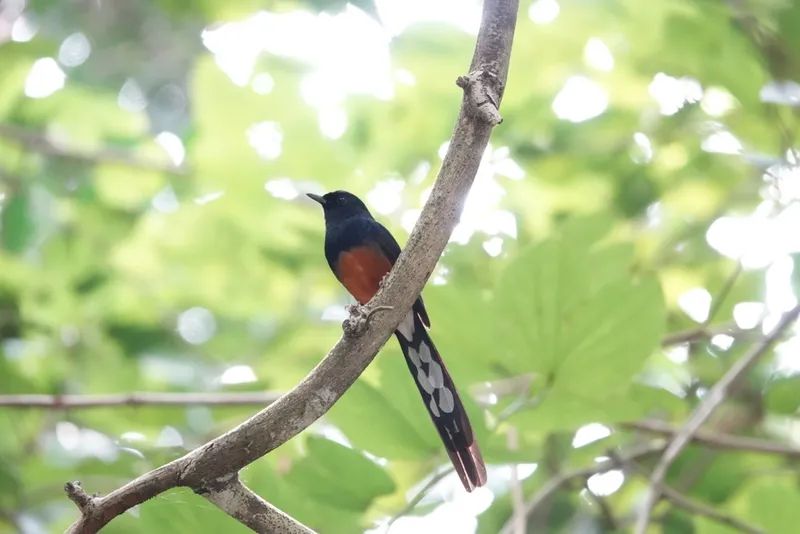
| Key feature | Glossy black, orange belly, white rump, long tail |
| Other names | Kucica hutan; Kittacincla malabarica |
| International trade | CITES Appendix II since CoP19 (2022) |
| IUCN status | Least Concern · IUCN Red List (via GBIF) · checked 25 September 2026 |
In this guide (10)
What is the white-rumped shama?
The white-rumped shama is a songbird of the Old World flycatcher family, Muscicapidae, famed for its rich song and long tail. Males are glossy blue-black above, with orange-rufous underparts, a bright white rump and white outer tail feathers. Females are a duller dark grey. The Bird Society of Singapore gives its length as 21.5–28 cm. It is often confused with the oriental magpie-robin, which has white underparts and no white rump.
BirdLife and CITES use the name Copsychus malabaricus; some other lists use Kittacincla malabarica. A 2022 genomic study by Wu and colleagues showed that the shama is really several distinct lineages.
Evidence: Bird Society of Singapore, Birds of Singapore — White-rumped Shama ↗ · IUCN/TRAFFIC — Analyses of the proposals to amend the CITES Appendices at CoP19 (2022) ↗ · Wu et al. (2022), Molecular Biology and Evolution — Genomes From Historic DNA Unveil Massive Hidden Extinction and Terminal Endangerment in a Tropical Asian Songbird Radiation (PMC) ↗
Where does the white-rumped shama live?
The white-rumped shama lives in lowland forest across South and Southeast Asia, including Sumatra, Borneo and Java. BirdLife lists its habitats as lowland rainforest, swamp forest, secondary jungle, overgrown plantations, mangroves and forest clearings, usually up to 500–600 m. It prefers undergrowth and shady ravines. In Aceh, Mongabay Indonesia has reported shamas in the Leuser and Ulu Masen forests and on Weh, Simeulue and the Banyak Islands.
On Java, an IUCN and TRAFFIC analysis says the shama was already rare in the 1980s and was thought to have been trapped out of the wild before 1997.
Evidence: BirdLife International DataZone — White-rumped Shama Copsychus malabaricus species factsheet ↗ · Mongabay Indonesia — Diburu, Nasib Murai Batu Makin Tak Menentu (2021) ↗ · IUCN/TRAFFIC — Analyses of the proposals to amend the CITES Appendices at CoP19 (2022) ↗
What does the white-rumped shama eat?
The white-rumped shama feeds mainly on arthropods, such as insects, and also takes worms and berries. According to BirdLife, it forages on the ground and in the lower layers of the forest. The Bird Society of Singapore notes that it feeds mostly among leaf litter and spends much of its time moving through dense thickets. A resident of Gayo Lues quoted by Mongabay Indonesia said shamas once came into gardens to eat insects and caterpillars, but are now rarely seen because of hunting.
Evidence: BirdLife International DataZone — White-rumped Shama Copsychus malabaricus species factsheet ↗ · Bird Society of Singapore, Birds of Singapore — White-rumped Shama ↗ · Mongabay Indonesia — Diburu, Nasib Murai Batu Makin Tak Menentu (2021) ↗
How does the white-rumped shama breed?
The white-rumped shama nests in cavities, such as tree holes or nest boxes. In a nest-box study in Guangxi, southern China, Zhang and colleagues (2024) found that shamas chose nests in trees close to the forest edge. The most common clutch was five eggs. Eggs were incubated for about 12 days, and chicks were fed in the nest for about 11 days. Males and females both fed the young.
Its song is a series of flute-like notes and loud whistles, often mimicking other birds. BirdLife says research on its breeding behaviour is still urgently needed.
Evidence: Zhang et al. (2024), Animals — Comparison of Reproductive Strategies between Two Sympatric Copsychus Passerines (PMC) ↗ · Hawaiʻi Birding Trails (State of Hawaiʻi) — White-rumped shama ↗ · BirdLife International DataZone — White-rumped Shama Copsychus malabaricus species factsheet ↗
Why is the white-rumped shama so heavily trapped for the songbird trade?
The white-rumped shama is trapped because its song is highly prized in songbird contests, especially in Indonesia. According to BirdLife, a 2018 survey of more than 3,000 households in Java's six provinces estimated that about 3.4 million shamas are kept on Java alone. An IUCN and TRAFFIC analysis recorded 432 seizures involving more than 15,000 birds in five Southeast Asian countries in 2008–2018, with cross-border smuggling mainly from Malaysia into Indonesia.
Wu and colleagues (2022) found that over 40% of the group's phylogenetic diversity is already extinct in the wild or nearly so, including forms from Java and Kangean Island.
Evidence: BirdLife International DataZone — White-rumped Shama Copsychus malabaricus species factsheet ↗ · IUCN/TRAFFIC — Analyses of the proposals to amend the CITES Appendices at CoP19 (2022) ↗ · Wu et al. (2022), Molecular Biology and Evolution — Genomes From Historic DNA Unveil Massive Hidden Extinction and Terminal Endangerment in a Tropical Asian Songbird Radiation (PMC) ↗
How can the white-rumped shama be protected?
The most important step is to stop trapping from the wild and smuggling. At CoP19 in 2022, the shama was listed in CITES Appendix II, so international trade now requires permits. People can help by not buying wild-caught birds, not setting traps or decoy birds in forests, and reporting suspected smuggling to the local conservation agency (BKSDA) or the police. Protecting lowland forest matters too: Mongabay Indonesia reports that songbird trappers still target areas such as Kerinci Seblat National Park.
Evidence: TRAFFIC — Asian songbirds ↗ · TRAFFIC — In the Market for Extinction: An inventory of Jakarta's bird markets (Chng et al., 2015) ↗ · Mongabay Indonesia — Nasib Sang 'Biduan' Hutan Makin Suram (2023) ↗
Explore related habitats
These habitat relationships are supported by species sources in this guide. This is not a complete range map.
Common questions about the White-rumped shama
What is the scientific name of the White-rumped shama?
The scientific name of the White-rumped shama is Copsychus malabaricus, in the family Muscicapidae. In Indonesian it is called Murai batu.
Where can the White-rumped shama be found in Indonesia?
In Indonesia, this guide records the White-rumped shama in: Sumatra and nearby islands, Borneo and Java (now very rare in the wild on Java).
Source-supported habitats: Tropical Rainforests, Mangroves.
What does the White-rumped shama eat?
Diet of the White-rumped shama: ground-dwelling arthropods, plus worms and berries.
What is the conservation status of the White-rumped shama?
On the IUCN Red List, the White-rumped shama is listed as Least Concern: it does not currently qualify for a threatened category in the global assessment. Source: IUCN Red List (via GBIF), checked 25 September 2026.
This global category is separate from legal protection in Indonesia. To check whether the White-rumped shama is a protected species, consult the current national list of protected species or contact the local BKSDA (natural resources conservation office).
Sources & references
- BirdLife International DataZone — White-rumped Shama Copsychus malabaricus species factsheet ↗
- Wu et al. (2022), Molecular Biology and Evolution — Genomes From Historic DNA Unveil Massive Hidden Extinction and Terminal Endangerment in a Tropical Asian Songbird Radiation (PMC) ↗
- IUCN/TRAFFIC — Analyses of the proposals to amend the CITES Appendices at CoP19 (2022) ↗
- TRAFFIC — Asian songbirds ↗
- Mongabay Indonesia — Diburu, Nasib Murai Batu Makin Tak Menentu (2021) ↗
- Mongabay Indonesia — Nasib Sang 'Biduan' Hutan Makin Suram (2023) ↗
- Bird Society of Singapore, Birds of Singapore — White-rumped Shama ↗
- Hawaiʻi Birding Trails (State of Hawaiʻi) — White-rumped shama ↗
- Zhang et al. (2024), Animals — Comparison of Reproductive Strategies between Two Sympatric Copsychus Passerines (PMC) ↗
- TRAFFIC — In the Market for Extinction: An inventory of Jakarta's bird markets (Chng et al., 2015) ↗
- IUCN Red List of Threatened Species, version 2026-1, via GBIF (CC BY 4.0) ↗
References can change. Check dates and context in the original source.
Cite this page
PanduanHewan. (2026, 25 September). White-rumped shama (Copsychus malabaricus). PanduanHewan.org. https://panduanhewan.org/en/species/white-rumped-shama/