Quick answer
IUCN status: Least ConcernOriental magpie-robin at a glance
The oriental magpie-robin (Copsychus saularis) is a bird in the family Muscicapidae. Range in Indonesia: Sumatra, Java, Bali and Borneo (now rare in the wild on Java and Bali). Diet: mainly ground insects; also worms, snails, small lizards; a carnivore. IUCN Red List status: Least Concern.
| Scientific name | Copsychus saularis |
|---|---|
| Indonesian name | Kacer |
| Group | Birds |
| Family | Muscicapidae |
| Range in Indonesia | Sumatra, Java, Bali and Borneo (now rare in the wild on Java and Bali) |
| Linked habitats | Urban Habitats, Mangroves |
| Diet | Mainly ground insects; also worms, snails, small lizards |
| Range in Indonesia | Sumatra, Java, Bali and Borneo |
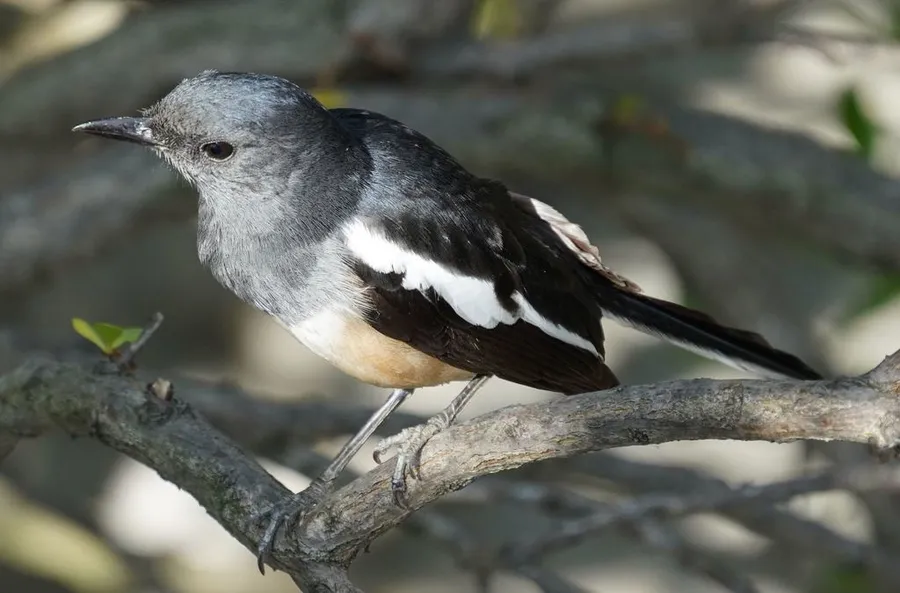
| Key feature | Black-and-white male with a broad white wing stripe |
| Other names | Kucica kampung, kacer |
| Length | About 19–21 cm |
| IUCN status | Least Concern · IUCN Red List (via GBIF) · checked 1 October 2026 |
| Diet type | Carnivore (meat-eater) — mainly ground insects, also earthworms, snails and small lizards · Oiseaux-Birds |
| Reproduction | Laying eggs (oviparous) · Vigie-Nature École (MNHN) |
| Active | Diurnal (active by day) · EltonTraits 1.0 (Wilman et al. 2014, Ecology 95:2027), BirdFuncDat.txt |
In this guide (12)
What is the oriental magpie-robin?
The oriental magpie-robin, called kacer or kucica kampung in Indonesia, is a 19–21 cm songbird of the family Muscicapidae. According to the Bird Society of Singapore, the male has a glossy black head, upperparts and upper breast, white from the lower breast to the vent, and a broad white wing stripe. In females the black is replaced by grey. It differs from the white-rumped shama in having white, not orange, underparts and no white rump. BirdLife now treats Copsychus mindanensis, once lumped with it, as a separate species.
Evidence: Bird Society of Singapore, Birds of Singapore — Oriental Magpie-Robin ↗ · BirdLife International DataZone — Oriental Magpie-robin Copsychus saularis species factsheet ↗
Where does the oriental magpie-robin live?
The oriental magpie-robin lives at forest edges and in secondary growth, gardens, parks, plantations and mangroves, often close to people. In Indonesia, TRAFFIC lists it from Sumatra, Java, Bali and Borneo. On Java and Bali, however, wild birds are now very scarce. BirdLife reports that during a citizen-science count in January 2020 it was found in just 9 of the 7,935 two-by-two-kilometre squares visited across Java and Bali. The subspecies amoenus is thought to survive only in shaded, well-guarded resort grounds on Bali.
Evidence: Bird Society of Singapore, Birds of Singapore — Oriental Magpie-Robin ↗ · TRAFFIC — In the Market for Extinction: An inventory of Jakarta's bird markets (Chng et al., 2015) ↗ · BirdLife International DataZone — Oriental Magpie-robin Copsychus saularis species factsheet ↗
What does the oriental magpie-robin eat?
The oriental magpie-robin feeds mainly on insects caught on the ground. According to the Oiseaux-Birds species card, which draws on the Handbook of the Birds of the World, it also eats earthworms, snails, small lizards, some plant matter and flower nectar. The Bird Society of Singapore describes it foraging mostly on the ground, hopping in an upright stance with its tail pumped over its back. It also feeds in trees at times.
Evidence: Oiseaux-Birds (N. Bouglouan) — Oriental Magpie-Robin species card ↗ · Bird Society of Singapore, Birds of Singapore — Oriental Magpie-Robin ↗
How does the oriental magpie-robin breed?
The oriental magpie-robin nests in cavities such as tree holes, gaps in walls or nest boxes. In a study in Guangxi, southern China, Zhang and colleagues (2024) found that magpie-robins used nest boxes on poles near houses more often than shamas did. The most common clutch was five eggs, with an average of 4.7. Eggs were incubated for about 12 days, and chicks were fed in the nest for about 13 days. Both parents fed the young.
Why is the oriental magpie-robin becoming rare in the wild?
The oriental magpie-robin is becoming rare because it is trapped in huge numbers for the songbird trade. According to TRAFFIC, it was once common on Java, but uncontrolled trapping made it scarce. BirdLife cites a 2018 survey estimating that about 2.5 million are kept on Java. Supply now often comes from Malaysia: TRAFFIC recorded 26,950 birds seized in 44 cases involving Malaysia in 2015–2020, 64% of them bound for Indonesia. In Aceh, a resident quoted by Mongabay Indonesia said the bird was easy to see near villages in the 1990s but is now disappearing.
Evidence: TRAFFIC — Smuggled for its Song: The Trade in Malaysia's Oriental Magpie-robins (2021) ↗ · BirdLife International DataZone — Oriental Magpie-robin Copsychus saularis species factsheet ↗ · Mongabay Indonesia — Diburu, Nasib Murai Batu Makin Tak Menentu (2021) ↗
How can the oriental magpie-robin be protected?
The oriental magpie-robin can be protected by curbing trapping and smuggling. Singapore offers a lesson: according to the Oriental Bird Club, wild birds there were trapped to near-extinction in the 1980s and had to be restored through a reintroduction programme. TRAFFIC calls for Malaysia and Indonesia to work together to break smuggling networks. People can help by not buying wild-caught or smuggled birds, not catching wild magpie-robins, and reporting suspected smuggling to the local conservation agency (BKSDA) or the police. Wild birds nesting around homes are best left alone.
Evidence: Oriental Bird Club — Trouble ahead for heavily smuggled Oriental Magpie-robin (2021) ↗ · TRAFFIC — Smuggled for its Song: The Trade in Malaysia's Oriental Magpie-robins (2021) ↗ · Zhang et al. (2024), Animals — Comparison of Reproductive Strategies between Two Sympatric Copsychus Passerines (PMC) ↗
Explore related habitats
These habitat relationships are supported by species sources in this guide. This is not a complete range map.
Scientific classification of the Oriental magpie-robin
| Kingdom | Animalia |
|---|---|
| Phylum | Chordata |
| Class | Aves |
| Order | Passeriformes |
| Family | Muscicapidae |
| Genus | Copsychus |
| Species | Copsychus saularis |
Source: GBIF Backbone Taxonomy, adjusted to the ranks commonly used in school biology (for example class Reptilia).
Common questions about the oriental magpie-robin
What is the scientific name of the oriental magpie-robin?
The scientific name of the oriental magpie-robin is Copsychus saularis, in the family Muscicapidae. In Indonesian it is called Kacer.
What kind of animal is the oriental magpie-robin?
The oriental magpie-robin is a bird in the family Muscicapidae. By diet it is a carnivore (meat-eater): a mainly ground insects, also earthworms, snails and small lizards.
Where does the oriental magpie-robin live in Indonesia?
In Indonesia, this guide records the oriental magpie-robin in: Sumatra, Java, Bali and Borneo (now rare in the wild on Java and Bali).
Source-supported habitats: Urban Habitats, Mangroves.
What does the oriental magpie-robin eat?
Diet of the oriental magpie-robin: mainly ground insects; also worms, snails, small lizards. That makes it a carnivore (meat-eater). Source: Oiseaux-Birds.
How does the oriental magpie-robin reproduce?
The oriental magpie-robin reproduces by laying eggs (oviparous). Source: Vigie-Nature École (MNHN).
Is the oriental magpie-robin nocturnal?
The cited source records the oriental magpie-robin as diurnal (active by day). Source: EltonTraits 1.0 (Wilman et al. 2014, Ecology 95:2027), BirdFuncDat.txt.
See also the list of nocturnal and diurnal animals in Indonesia.
What are the main features of the oriental magpie-robin?
Key features of the oriental magpie-robin, from this guide’s sources: Key feature: black-and-white male with a broad white wing stripe; Length: about 19–21 cm.
What is the scientific classification of the oriental magpie-robin?
Scientific classification of the oriental magpie-robin: kingdom Animalia, phylum Chordata, class Aves, order Passeriformes, family Muscicapidae, genus Copsychus, species Copsychus saularis.
Source: GBIF Backbone Taxonomy, adjusted to the ranks commonly used in school biology.
Is the oriental magpie-robin endangered?
No, according to the global IUCN assessment. On the IUCN Red List, the oriental magpie-robin is listed as Least Concern: it does not qualify for a threatened category or for Near Threatened in the global assessment. Source: IUCN Red List (via GBIF), checked 1 October 2026.
This global category is separate from legal protection in Indonesia. To check whether the oriental magpie-robin is a protected species, consult the current national list of protected species or contact the local BKSDA (natural resources conservation office).
Sources & references
- BirdLife International DataZone — Oriental Magpie-robin Copsychus saularis species factsheet ↗
- TRAFFIC — Smuggled for its Song: The Trade in Malaysia's Oriental Magpie-robins (2021) ↗
- Oriental Bird Club — Trouble ahead for heavily smuggled Oriental Magpie-robin (2021) ↗
- Bird Society of Singapore, Birds of Singapore — Oriental Magpie-Robin ↗
- Oiseaux-Birds (N. Bouglouan) — Oriental Magpie-Robin species card ↗
- Zhang et al. (2024), Animals — Comparison of Reproductive Strategies between Two Sympatric Copsychus Passerines (PMC) ↗
- TRAFFIC — In the Market for Extinction: An inventory of Jakarta's bird markets (Chng et al., 2015) ↗
- Mongabay Indonesia — Diburu, Nasib Murai Batu Makin Tak Menentu (2021) ↗
- Vigie-Nature École (MNHN) ↗
- EltonTraits 1.0 (Wilman et al. 2014, Ecology 95:2027), BirdFuncDat.txt ↗
- GBIF Backbone Taxonomy (GBIF) ↗
- IUCN Red List of Threatened Species, version 2026-1, via GBIF (CC BY 4.0) ↗
References can change. Check dates and context in the original source. How we use sources and data →
Related causes and news
Cite this page
Credit PanduanHewan when referring to this page. Check the original evidence sources before reusing a claim.
PanduanHewan. Oriental magpie-robin (Copsychus saularis). Last substantive update: 1 October 2026. https://panduanhewan.org/en/species/oriental-magpie-robin/