Quick answer
IUCN status: Least ConcernBarn owl at a glance
The Barn owl (Tyto alba) is a bird in the family Tytonidae. Its IUCN Red List category is Least Concern.
| Scientific name | Tyto alba |
|---|---|
| Indonesian name | Serak Jawa |
| Group | Birds |
| Family | Tytonidae |
| Range in Indonesia | Widespread in Indonesia, including Sumatra and Java |
| Linked habitats | Urban Habitats, Freshwater Wetlands |
| Diet | Mainly rats; also small birds, insects and bats |
| Range in Indonesia | Widespread, including Javan rice fields and Sumatran oil palm |
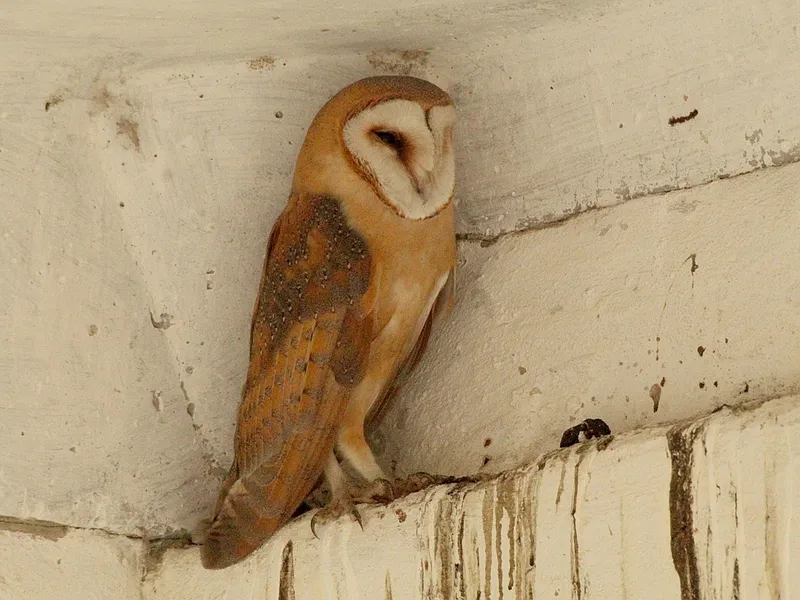
| Key feature | White heart-shaped face; active at night |
| Other names | Eastern barn owl, Tyto alba javanica, Tyto javanica (IOC) |
| IUCN status | Least Concern (BirdLife assessment, 2025) |
| IUCN status | Least Concern · IUCN Red List (via GBIF) · checked 25 September 2026 |
In this guide (10)
What is the barn owl?
The barn owl is an owl of the family Tytonidae, with a white, heart-shaped face edged in brown, a rounded head without ear tufts, and long legs. Its upperparts are light greyish-brown with spots; its underparts are whitish. According to Animal Diversity Web, females are usually slightly larger: 34–40 cm and about 570 g, against 32–38 cm and about 470 g for males.
BirdLife International and the IUCN Red List include Indonesian birds in Tyto alba, and Indonesian agencies often call them Tyto alba javanica. The IOC World Bird List, however, treats South Asian, Southeast Asian and Australasian birds as a separate species, the eastern barn owl (Tyto javanica).
Evidence: Animal Diversity Web — Tyto alba (barn owl) ↗ · BIOMA (Universitas Diponegoro) — Hadi 2008, Pola Aktivitas Harian Pasangan Burung Serak Jawa (Tyto alba) (PDF) ↗ · South American Classification Committee — Proposal 908: Split Barn Owl (Tyto alba) into three species ↗
Where does the barn owl live?
The barn owl is widespread in Indonesia and usually lives in open areas close to people. BirdLife notes that it uses farmland, oil palm plantations, rice paddies and settlements, but does not normally live inside forest. In Sumatra it lives in oil palm plantations, including in Riau. Barn owls do not build their own nests. A survey of rice fields in Kendal Regency, Central Java, found 106 nests: 76.41% in building ceilings, 20.75% in trees and 2.84% in nest boxes.
Evidence: BirdLife International DataZone — Common Barn-owl Tyto alba species factsheet ↗ · Jurnal Perlindungan Tanaman Indonesia (UGM) — Astuti K. dkk. 2004, Tipe Hunian dan Jenis Mangsa Burung Serak Tyto alba javanica pada Ekosistem Persawahan ↗ · PMC — Nijman et al. 2022, Disentangling the Legal and Illegal Wildlife Trade: Insights from Indonesian Wildlife Market Surveys, Animals ↗
What does the barn owl eat?
The barn owl feeds mainly on rats. An analysis of 2,261 pellets from 106 nests in the rice fields of Kendal, Central Java, found that rats made up 86.90% of prey, led by the ricefield rat (Rattus argentiventer) at 77.08%. The rest was birds (5.49%), insects (3.98%), bats (2.07%) and other animals such as squirrels, geckos, house lizards and frogs. In oil palm plantations its main prey is the wood rat (Rattus tiomanicus). According to Animal Diversity Web, it hunts in low flight and relies on extremely acute hearing, helped by asymmetrically placed ears. Prey is usually swallowed whole.
Evidence: Jurnal Perlindungan Tanaman Indonesia (UGM) — Astuti K. dkk. 2004, Tipe Hunian dan Jenis Mangsa Burung Serak Tyto alba javanica pada Ekosistem Persawahan ↗ · IPB University Repository — Adidharma 2009, Kajian sosial ekonomi pengendalian hama tikus pohon, Rattus tiomanicus, dengan burung hantu Tyto alba pada perkebunan kelapa sawit ↗ · Animal Diversity Web — Tyto alba (barn owl) ↗
How does the barn owl behave and breed?
The barn owl is active at night and spends much of the day resting in its nest. A 14-day, round-the-clock study of a pair nesting in a university building in Semarang recorded an average of 14 hours 44 minutes of rest per day; the male hunted for about 7 hours 40 minutes and brought food to the female. In general, according to Animal Diversity Web, females lay 2–18 eggs (usually 4–7) and incubate them for 29–34 days. Chicks first fly 50–70 days after hatching. Most barn owls are short-lived: one study found a mean age at death of 20.9 months.
Evidence: BIOMA (Universitas Diponegoro) — Hadi 2008, Pola Aktivitas Harian Pasangan Burung Serak Jawa (Tyto alba) (PDF) ↗ · Animal Diversity Web — Tyto alba (barn owl) ↗
How do barn owls help farmers control rats?
Barn owls help farmers because rats are their main prey, so ‘owl houses’ (rubuha) are put up in rice fields and plantations to attract them. In oil palm plantations, biological control with Tyto alba has been developed since the 1970s. A 2009 review by Adidharma reported rat damage falling from 20% to under 5% within two years, at about 60% lower cost than poison baits. According to Nijman and colleagues (2022), one oil palm company in Riau had installed 6,210 nest boxes by 2019. In rice fields, an owl programme in Tlogoweru village, Demak, was reported to cut rat damage significantly.
Evidence: IPB University Repository — Adidharma 2009, Kajian sosial ekonomi pengendalian hama tikus pohon, Rattus tiomanicus, dengan burung hantu Tyto alba pada perkebunan kelapa sawit ↗ · PMC — Nijman et al. 2022, Disentangling the Legal and Illegal Wildlife Trade: Insights from Indonesian Wildlife Market Surveys, Animals ↗ · Balai Besar Perbenihan dan Pelindungan Tanaman Perkebunan Medan (Ditjenbun, Kementan) — Pengembangan Burung Hantu (Tyto alba javanica) dalam Pengendalian Hama Tikus (2023) ↗
What should you do if you find a barn owl?
If barn owls nest in the ceiling of a house, school or warehouse, do not chase them away, catch them or kill them, because they help keep rats down. An agriculture ministry office in Medan notes that owls are often driven away or killed because people see them as a bad omen. Nijman and colleagues (2022) found barn owls among the owls commonly sold in bird markets on Java and Bali, and many owls on sale were nestlings taken from nests, so avoid buying them. BirdLife notes that rat poisons have harmed owl populations in several countries. If you find an injured owl, contact local officers.
Evidence: Balai Besar Perbenihan dan Pelindungan Tanaman Perkebunan Medan (Ditjenbun, Kementan) — Pengembangan Burung Hantu (Tyto alba javanica) dalam Pengendalian Hama Tikus (2023) ↗ · PMC — Nijman et al. 2022, Disentangling the Legal and Illegal Wildlife Trade: Insights from Indonesian Wildlife Market Surveys, Animals ↗ · BirdLife International DataZone — Common Barn-owl Tyto alba species factsheet ↗
Explore related habitats
These habitat relationships are supported by species sources in this guide. This is not a complete range map.
Common questions about the Barn owl
What is the scientific name of the Barn owl?
The scientific name of the Barn owl is Tyto alba, in the family Tytonidae. In Indonesian it is called Serak Jawa.
Where can the Barn owl be found in Indonesia?
In Indonesia, this guide records the Barn owl in: Widespread in Indonesia, including Sumatra and Java.
Source-supported habitats: Urban Habitats, Freshwater Wetlands.
What does the Barn owl eat?
Diet of the Barn owl: mainly rats; also small birds, insects and bats.
What is the conservation status of the Barn owl?
On the IUCN Red List, the Barn owl is listed as Least Concern: it does not currently qualify for a threatened category in the global assessment. Source: IUCN Red List (via GBIF), checked 25 September 2026.
This global category is separate from legal protection in Indonesia. To check whether the Barn owl is a protected species, consult the current national list of protected species or contact the local BKSDA (natural resources conservation office).
Sources & references
- BirdLife International DataZone — Common Barn-owl Tyto alba species factsheet ↗
- Animal Diversity Web — Tyto alba (barn owl) ↗
- Jurnal Perlindungan Tanaman Indonesia (UGM) — Astuti K. dkk. 2004, Tipe Hunian dan Jenis Mangsa Burung Serak Tyto alba javanica pada Ekosistem Persawahan ↗
- IPB University Repository — Adidharma 2009, Kajian sosial ekonomi pengendalian hama tikus pohon, Rattus tiomanicus, dengan burung hantu Tyto alba pada perkebunan kelapa sawit ↗
- Balai Besar Perbenihan dan Pelindungan Tanaman Perkebunan Medan (Ditjenbun, Kementan) — Pengembangan Burung Hantu (Tyto alba javanica) dalam Pengendalian Hama Tikus (2023) ↗
- PMC — Nijman et al. 2022, Disentangling the Legal and Illegal Wildlife Trade: Insights from Indonesian Wildlife Market Surveys, Animals ↗
- South American Classification Committee — Proposal 908: Split Barn Owl (Tyto alba) into three species ↗
- BIOMA (Universitas Diponegoro) — Hadi 2008, Pola Aktivitas Harian Pasangan Burung Serak Jawa (Tyto alba) (PDF) ↗
- IUCN Red List of Threatened Species, version 2026-1, via GBIF (CC BY 4.0) ↗
References can change. Check dates and context in the original source.
Further reading
Barn owl: facts, threats and conservation ↗ — World Animal Rescue Network.
Cite this page
PanduanHewan. (2026, 25 September). Barn owl (Tyto alba). PanduanHewan.org. https://panduanhewan.org/en/species/barn-owl/