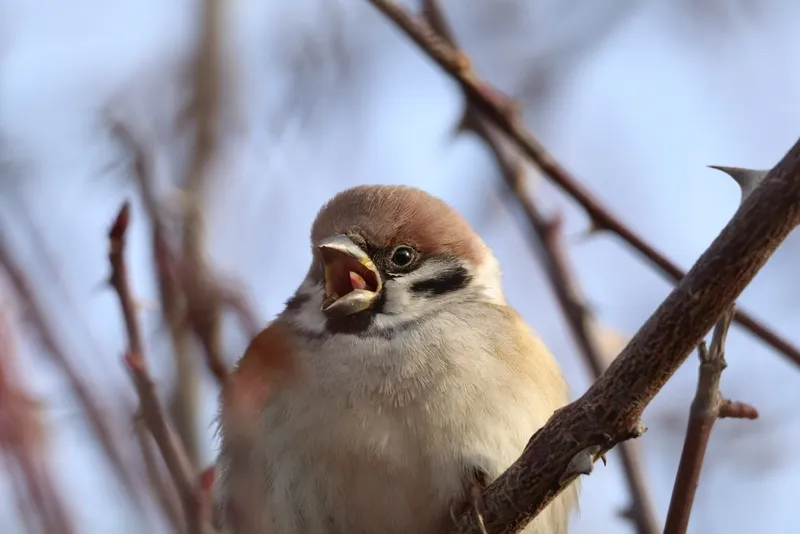
Useful field marks
The Eurasian tree sparrow shows a chestnut crown, dark throat and a clear black patch on each white cheek. Males and females look similar, while juveniles tend to be duller. Use the complete head pattern rather than brown colour alone; several small birds look alike at a distance.
Life near people
This species uses open spaces, gardens, farmland and built surroundings. It is often seen in small, noisy groups searching for food. A sighting on one street or in one yard does not mean every area offers the same food and nesting opportunities; local land cover matters.
Seeds, insects and nest sites
Cornell records seeds as an important food for tree sparrows; insects can also form part of the diet, especially when young are being raised. Nests may occupy cavities in trees or buildings. An adult near a house does not by itself prove an active nest; observe from a distance without opening cavities.
Distinguishing birds from records
Repeated photographs at popular locations can add many records of the same individuals. GBIF data show observations from several Indonesian regions, but record totals do not count unique birds or establish an upward trend. For a useful sighting, note the date, broad location and visible cheek and crown markings.
Watching without disturbance
Watch from a distance that does not change the bird’s behaviour. Do not move eggs or young or provide unsuitable food. If birds occupy a cavity, leave its entrance clear. This guide does not assign a local conservation status; any such assessment needs a source with a clear region and date.
Sources & references
- Cornell Lab — Eurasian Tree Sparrow life history ↗
- eBird — Eurasian Tree Sparrow identification ↗
- GBIF — accepted Passer montanus taxon ↗
References can change. Check dates and context in the original source.