Quick answer
IUCN status: Least ConcernSpotted dove at a glance
The spotted dove (Spilopelia chinensis) is a bird in the family Columbidae. Range in Indonesia: Parts of Indonesia; native or introduced status needs island-specific checking. Diet: mainly seeds taken on the ground; a herbivore. IUCN Red List status: Least Concern.
| Scientific name | Spilopelia chinensis |
|---|---|
| Former scientific name | Streptopelia chinensis |
| Indonesian name | Burung tekukur |
| Group | Birds |
| Family | Columbidae |
| Range in Indonesia | Parts of Indonesia; native or introduced status needs island-specific checking |
| Linked habitats | Urban Habitats |
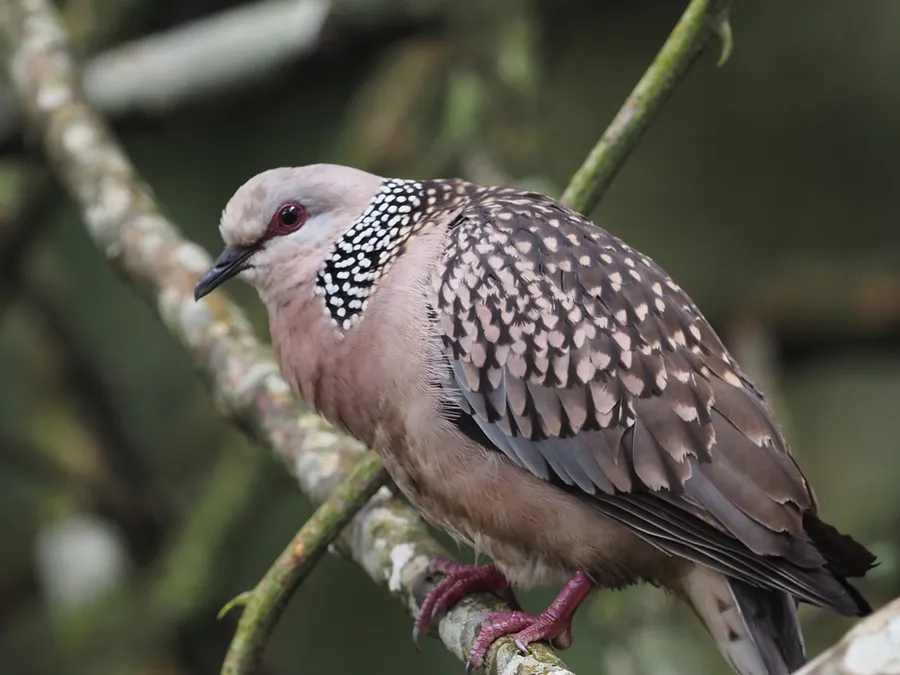
| Field mark | White spots on black nape patch |
| Food | Mainly seeds taken on the ground |
| Behaviour | Often walks and gives repeated coos |
| IUCN status | Least Concern · IUCN Red List (via GBIF) · checked 1 October 2026 |
| Diet type | Herbivore (plant-eater) — seed-eater (granivore) · BirdLife Australia — Birds in Backyards |
| Reproduction | Laying eggs (oviparous) · Vigie-Nature École (MNHN) |
| Active | Diurnal (active by day) · EltonTraits 1.0 (Wilman et al. 2014, Ecology 95:2027), BirdFuncDat.txt |
In this guide (11)
A spotted neck as a clue
The spotted dove is brown with a somewhat rosy breast, long tail and conspicuous white spots on a black patch at the back of the neck. This pattern helps separate it from zebra doves and other pigeons. Shape and voice provide useful confirmation when a photograph is unclear.
Evidence: eBird — Spotted Dove identification and habitat ↗ · NParks BiodiversitySG — Spotted Dove ecology ↗
Open land and forest edges
eBird records this species in parks, fields and open woodland. Its use of settlements explains many encounters, but it is not solely an urban bird. Ground cover, human activity and seed availability affect the chances of seeing a dove in a particular place.
Searching the ground for seeds
Singapore’s biodiversity service describes the spotted dove as a seed eater that may swallow grit to help its gizzard process food. It often walks slowly while pecking at the ground. A garden visit does not mean hand-feeding is needed; natural food and a safe space matter more.
Voice and daily life
The spotted dove gives a repeated low coo that may be heard before it is seen. A pair or single bird walking on the ground can be disturbed by a sudden approach. When recording calls or photographs, keep a reasonable distance and allow the bird to move away.
Evidence: eBird — Spotted Dove identification and habitat ↗ · NParks — birdwatching etiquette ↗
Interpreting distribution records
eBird describes both native and introduced populations in different parts of the world. A record on an island therefore does not by itself establish native status. Check the locality, date and origin information in an appropriate regional source. GBIF records aid investigation but do not alone establish a complete range or population total.
Evidence: eBird — Spotted Dove identification and habitat ↗ · GBIF — what occurrence records document ↗
Explore related habitats
These habitat relationships are supported by species sources in this guide. This is not a complete range map.
Scientific classification of the Spotted dove
| Kingdom | Animalia |
|---|---|
| Phylum | Chordata |
| Class | Aves |
| Order | Columbiformes |
| Family | Columbidae |
| Genus | Spilopelia |
| Species | Spilopelia chinensis |
Source: GBIF Backbone Taxonomy, adjusted to the ranks commonly used in school biology (for example class Reptilia).
Common questions about the spotted dove
What is the scientific name of the spotted dove?
The scientific name of the spotted dove is Spilopelia chinensis, in the family Columbidae and the order Columbiformes. In Indonesian it is called Burung tekukur. A former scientific name still often used: Streptopelia chinensis.
What kind of animal is the spotted dove?
The spotted dove is a bird in the family Columbidae. By diet it is a herbivore (plant-eater): a seed-eater (granivore).
Where does the spotted dove live in Indonesia?
In Indonesia, this guide records the spotted dove in: Parts of Indonesia; native or introduced status needs island-specific checking.
Source-supported habitats: Urban Habitats.
What does the spotted dove eat?
Diet of the spotted dove: mainly seeds taken on the ground. That makes it a herbivore (plant-eater). Source: BirdLife Australia — Birds in Backyards.
How does the spotted dove reproduce?
The spotted dove reproduces by laying eggs (oviparous). Source: Vigie-Nature École (MNHN).
Is the spotted dove nocturnal?
The cited source records the spotted dove as diurnal (active by day). Source: EltonTraits 1.0 (Wilman et al. 2014, Ecology 95:2027), BirdFuncDat.txt.
See also the list of nocturnal and diurnal animals in Indonesia.
What are the main features of the spotted dove?
Key features of the spotted dove, from this guide’s sources: Field mark: white spots on black nape patch.
What is the scientific classification of the spotted dove?
Scientific classification of the spotted dove: kingdom Animalia, phylum Chordata, class Aves, order Columbiformes, family Columbidae, genus Spilopelia, species Spilopelia chinensis.
Source: GBIF Backbone Taxonomy, adjusted to the ranks commonly used in school biology.
Is the spotted dove endangered?
No, according to the global IUCN assessment. On the IUCN Red List, the spotted dove is listed as Least Concern: it does not qualify for a threatened category or for Near Threatened in the global assessment. Source: IUCN Red List (via GBIF), checked 1 October 2026.
This global category is separate from legal protection in Indonesia. To check whether the spotted dove is a protected species, consult the current national list of protected species or contact the local BKSDA (natural resources conservation office).
Sources & references
- eBird — Spotted Dove identification and habitat ↗
- NParks BiodiversitySG — Spotted Dove ecology ↗
- NParks — birdwatching etiquette ↗
- GBIF — what occurrence records document ↗
- BirdLife Australia — Birds in Backyards ↗
- Vigie-Nature École (MNHN) ↗
- EltonTraits 1.0 (Wilman et al. 2014, Ecology 95:2027), BirdFuncDat.txt ↗
- GBIF Backbone Taxonomy (GBIF) ↗
- IUCN Red List of Threatened Species, version 2026-1, via GBIF (CC BY 4.0) ↗
References can change. Check dates and context in the original source. How we use sources and data →
Cite this page
Credit PanduanHewan when referring to this page. Check the original evidence sources before reusing a claim.
PanduanHewan. Spotted dove (Spilopelia chinensis). Last substantive update: 7 October 2026. https://panduanhewan.org/en/species/spilopelia-chinensis/