Quick answer
IUCN status: VulnerableRhinoceros hornbill at a glance
The Rhinoceros hornbill (Buceros rhinoceros) is a bird in the family Bucerotidae. Its IUCN Red List category is Vulnerable.
| Scientific name | Buceros rhinoceros |
|---|---|
| Indonesian name | Rangkong badak |
| Group | Birds |
| Family | Bucerotidae |
| Range in Indonesia | Sumatra, Java and Borneo (Kalimantan) |
| Linked habitats | Tropical Rainforests |
| Diet | Mainly figs, plus insects, lizards and other small animals |
| Range in Indonesia | Sumatra, Java and Kalimantan |
| Key feature | Upturned orange-red casque; white tail with black band |
| Other names | Enggang cula, rangkong badak |
| IUCN status | Vulnerable (BirdLife assessment, 2020) |
| Legal protection in Indonesia | Protected (Ministerial Regulation P.106/MENLHK/SETJEN/KUM.1/12/2018) |
| IUCN status | Vulnerable · IUCN Red List (via GBIF) · checked 25 September 2026 |
In this guide (10)
What is the rhinoceros hornbill?
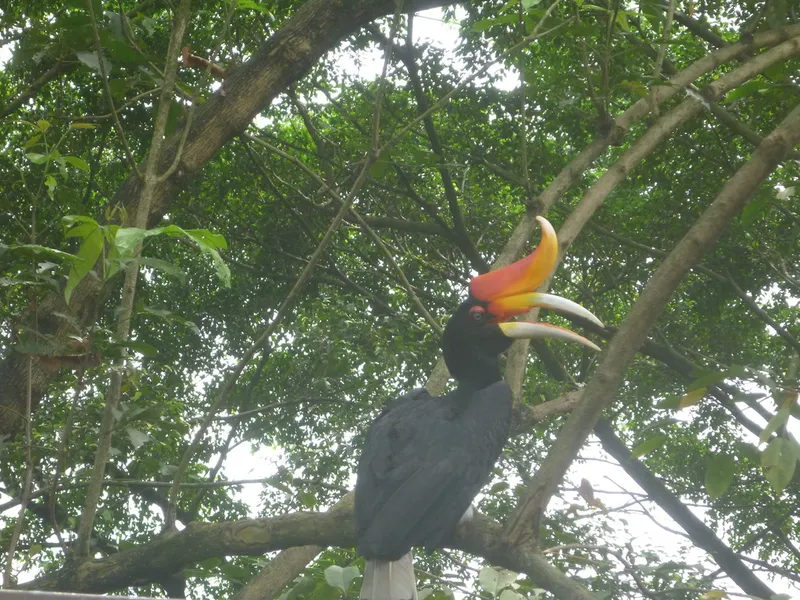
The rhinoceros hornbill (Buceros rhinoceros) is a very large hornbill with an orange-red casque that curves upwards above its bill. According to the IUCN SSC Hornbill Specialist Group, it measures 99–125 cm; males weigh 2,465–3,000 g and females 2,040–2,330 g. It is black, with white thighs, vent and tail, and a broad black tail band. Males have red eyes; females have white eyes and a smaller casque.
Three subspecies exist: B. r. rhinoceros (Sumatra and the Malay Peninsula), B. r. borneoensis (Borneo) and B. r. silvestris (Java). Unlike the similar great hornbill (Buceros bicornis), it has all-black wings and a reddish, upturned casque rather than a yellowish, straight one.
Evidence: IUCN SSC Hornbill Specialist Group — Rhinoceros Hornbill ↗ · Animal Diversity Web — Buceros rhinoceros (rhinoceros hornbill) ↗
Where does the rhinoceros hornbill live?
In Indonesia, the rhinoceros hornbill lives in the forests of Sumatra, Java and Kalimantan (Indonesian Borneo). Beyond Indonesia it occurs in Peninsular Malaysia, southern Thailand, Sabah, Sarawak and Brunei, but it is locally extinct in Singapore. Its main habitat is extensive primary lowland and hill forest, extending into tall secondary forest and swamp forest, up to about 1,400 m. It sometimes crosses plantations or disturbed land to reach fruiting trees. BirdLife International lists protected areas where it occurs, including Gunung Leuser, Bukit Barisan Selatan, Way Kambas and Berbak in Sumatra, and Bukit Baka Bukit Raya in West Kalimantan.
Evidence: BirdLife International DataZone — Rhinoceros Hornbill Buceros rhinoceros species factsheet ↗ · IUCN SSC Hornbill Specialist Group — Rhinoceros Hornbill ↗
What does the rhinoceros hornbill eat?
The rhinoceros hornbill mainly eats fruit, especially figs (Ficus), and occasionally takes small animals. Animal Diversity Web cites one study in which figs made up 76.9% of its diet. In southern Thailand, food delivered to nests was 72% figs, 24% other fruit and 4% animal prey by weight. Animal prey includes insects, lizards, tree frogs, rodents and bird eggs, taken especially to give protein to chicks. Because it regurgitates or excretes seeds away from the parent tree, it is an important seed disperser, including for trees with very large seeds.
Evidence: Animal Diversity Web — Buceros rhinoceros (rhinoceros hornbill) ↗ · IUCN SSC Hornbill Specialist Group — Rhinoceros Hornbill ↗ · BirdLife International DataZone — Rhinoceros Hornbill Buceros rhinoceros species factsheet ↗
How does the rhinoceros hornbill nest?
The rhinoceros hornbill nests in natural cavities in large trees, and the female seals herself inside. It cannot dig its own hole, so it depends on old trees; BirdLife notes nest cavities 9–15 m above the ground. The female closes the entrance with mud, droppings and fruit remains, leaving a narrow slit through which the male passes food. According to Animal Diversity Web, she lays 1–2 eggs, incubates them for 37–46 days and stays sealed in for 5–7 weeks after hatching. The young are nearly independent at about four months. Pairs are monogamous and first breed at about five years old.
Evidence: Animal Diversity Web — Buceros rhinoceros (rhinoceros hornbill) ↗ · BirdLife International DataZone — Rhinoceros Hornbill Buceros rhinoceros species factsheet ↗
Why is the rhinoceros hornbill threatened?
The rhinoceros hornbill is threatened because its lowland forest keeps disappearing and it is still hunted. BirdLife International has assessed it as Vulnerable on the IUCN Red List since 2018, and its 2020 assessment projects a 35–40% population decline over three generations, or 42 years. It is hunted for food and trade, and for its casque and tail feathers, which are used in ceremonial dress. BirdLife also notes that it may be caught as bycatch by hunters targeting helmeted hornbills, and that hunting for feathers and casques sold online in Kalimantan is likely to increase.
Evidence: BirdLife International DataZone — Rhinoceros Hornbill Buceros rhinoceros species factsheet ↗ · Animal Diversity Web — Buceros rhinoceros (rhinoceros hornbill) ↗
How can the rhinoceros hornbill be protected?
The rhinoceros hornbill benefits most when large tracts of lowland forest stay intact and hunting stops. It is listed as a protected species, under the name enggang cula, in the annex to Indonesian Ministerial Regulation P.106/MENLHK/SETJEN/KUM.1/12/2018, and its international trade is regulated under CITES Appendix II. People can help by not buying or keeping hornbills, or their feathers and casques, including those offered online. Large hollow trees near forest should be left standing, because hornbills cannot make their own nest holes. If you see hornbills being hunted or sold, report it to local forestry or conservation officers.
Evidence: JDIH Kemenko Infrastruktur — Permen LHK No. P.106/MENLHK/SETJEN/KUM.1/12/2018 tentang Jenis Tumbuhan dan Satwa yang Dilindungi (PDF) ↗ · BirdLife International DataZone — Rhinoceros Hornbill Buceros rhinoceros species factsheet ↗ · Animal Diversity Web — Buceros rhinoceros (rhinoceros hornbill) ↗
Explore related habitats
These habitat relationships are supported by species sources in this guide. This is not a complete range map.
Common questions about the Rhinoceros hornbill
What is the scientific name of the Rhinoceros hornbill?
The scientific name of the Rhinoceros hornbill is Buceros rhinoceros, in the family Bucerotidae. In Indonesian it is called Rangkong badak.
Where can the Rhinoceros hornbill be found in Indonesia?
In Indonesia, this guide records the Rhinoceros hornbill in: Sumatra, Java and Borneo (Kalimantan).
Source-supported habitats: Tropical Rainforests.
What does the Rhinoceros hornbill eat?
Diet of the Rhinoceros hornbill: mainly figs, plus insects, lizards and other small animals.
What is the conservation status of the Rhinoceros hornbill?
On the IUCN Red List, the Rhinoceros hornbill is listed as Vulnerable: it is considered to face a high risk of extinction in the wild. Source: IUCN Red List (via GBIF), checked 25 September 2026.
This global category is separate from legal protection in Indonesia. To check whether the Rhinoceros hornbill is a protected species, consult the current national list of protected species or contact the local BKSDA (natural resources conservation office).
Sources & references
- BirdLife International DataZone — Rhinoceros Hornbill Buceros rhinoceros species factsheet ↗
- Animal Diversity Web — Buceros rhinoceros (rhinoceros hornbill) ↗
- IUCN SSC Hornbill Specialist Group — Rhinoceros Hornbill ↗
- JDIH Kemenko Infrastruktur — Permen LHK No. P.106/MENLHK/SETJEN/KUM.1/12/2018 tentang Jenis Tumbuhan dan Satwa yang Dilindungi (PDF) ↗
- IUCN Red List of Threatened Species, version 2026-1, via GBIF (CC BY 4.0) ↗
References can change. Check dates and context in the original source.
Further reading
Rhinoceros hornbill: facts, threats and conservation ↗ — World Animal Rescue Network.
Cite this page
PanduanHewan. (2026, 25 September). Rhinoceros hornbill (Buceros rhinoceros). PanduanHewan.org. https://panduanhewan.org/en/species/rhinoceros-hornbill/