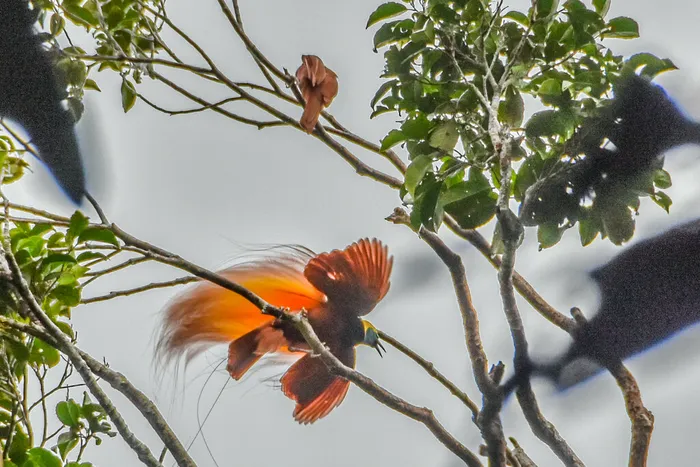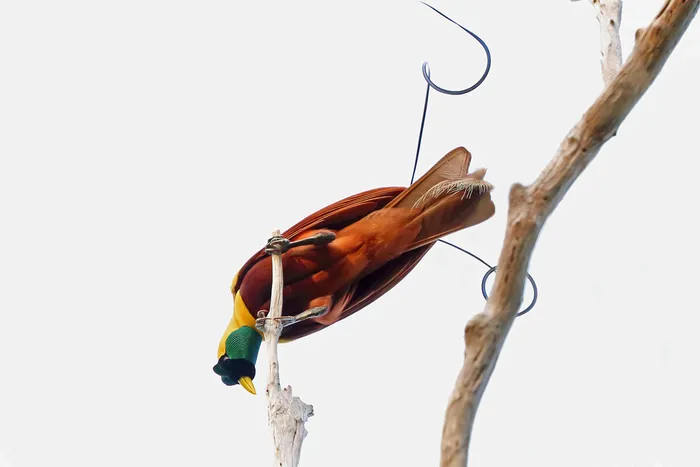
Paradisaea rubra
A forest bird of Raja Ampat whose males carry red plumes and two long tail ribbons. Its striking displays connect birdwatching with forest conservation.
PANDUANHEWAN · INDONESIA
How do the Red bird-of-paradise (Paradisaea rubra) and Greater bird-of-paradise (Paradisaea apoda) differ? Classification, features, range, diet, size, IUCN status and legal protection, from cited sources.
The red bird-of-paradise (Paradisaea rubra) and the greater bird-of-paradise (Paradisaea apoda) are different species in the same genus, Paradisaea. Range in Indonesia — the red bird-of-paradise: Raja Ampat islands, including Waigeo and Batanta; the greater bird-of-paradise: Aru Islands (Maluku) and the southern lowlands of Papua.
A forest bird of Raja Ampat whose males carry red plumes and two long tail ribbons. Its striking displays connect birdwatching with forest conservation.
The greater bird-of-paradise (Paradisaea apoda) is a yellow-plumed bird-of-paradise of the Aru Islands and the southern lowlands of New Guinea.
| Aspect | Red bird-of-paradise | Greater bird-of-paradise |
|---|---|---|
| Scientific name | Paradisaea rubra | Paradisaea apoda |
| Indonesian name | Cenderawasih merah | Cenderawasih besar |
| Class | Aves | Aves |
| Order | Passeriformes | Passeriformes |
| Family | Paradisaeidae | Paradisaeidae |
| Range in Indonesia | Raja Ampat islands, including Waigeo and Batanta | Aru Islands (Maluku) and the southern lowlands of Papua |
| Endemic to Indonesia | Yes | No |
| Key features | — | Males have long yellow plumes and two tail wires |
| Diet | Fruit and arthropods | Fruit and arthropods such as insects |
| Diet type | omnivore (eats plants and animals) | omnivore (eats plants and animals) |
| Reproduction | laying eggs (oviparous) | laying eggs (oviparous) |
| IUCN status | Near Threatened | Least Concern |
| Legal protection | Protected (Regulation P.106/2018) | Protected (Regulation P.106/2018) |
Every cell comes from the sourced data on each animal’s page; an empty cell means the data is not yet available, not that it is absent.
Search by name, habitat or island in the animal directory.