Quick answer
IUCN status: Least ConcernMalay civet at a glance
The Malay civet (Viverra tangalunga) is a mammal in the family Viverridae. Its IUCN Red List category is Least Concern.
| Scientific name | Viverra tangalunga |
|---|---|
| Indonesian name | Musang tenggalung |
| Group | Mammals |
| Family | Viverridae |
| Range in Indonesia | Sumatra, Borneo and nearby islands; introduced to Sulawesi and Maluku |
| Linked habitats | Tropical Rainforests |
| Diet | Omnivore: invertebrates, fruit, rodents, birds, reptiles |
| Range in Indonesia | Sumatra, Borneo, nearby islands; introduced to Sulawesi and Maluku |
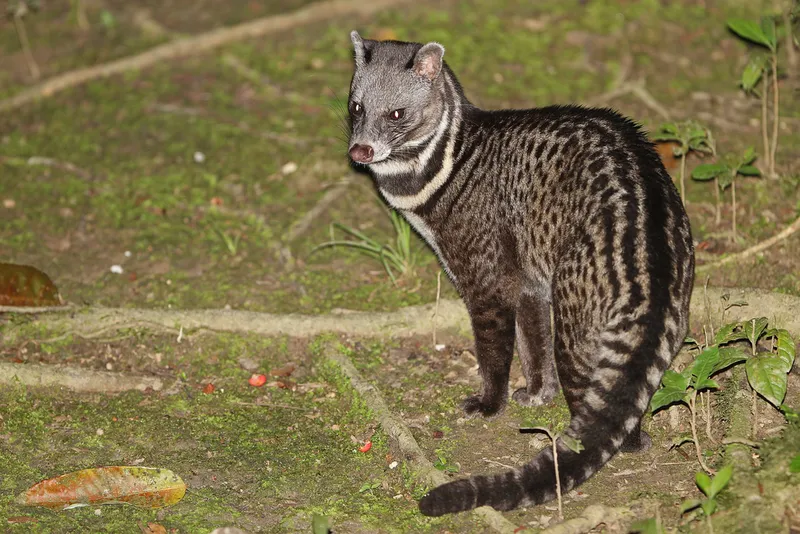
| Key feature | Black spots, banded neck collars, black-and-white ringed tail |
| Activity | Mainly nocturnal, ground-dwelling |
| Other names | Malayan civet, Oriental civet |
| IUCN status | Least Concern · IUCN Red List (via GBIF) · checked 25 September 2026 |
In this guide (10)
What is the Malay civet?
The Malay civet (Viverra tangalunga) is a ground-dwelling civet of the family Viverridae, with black spots and a black-and-white banded tail. ADW describes a tawny or greyish coat with black spots, usually three black and two white collars on the sides of the neck, and a black stripe from the shoulders to the tail. A study in Sabah gives a weight of 3–7 kg. It is not a cat. The 2016 IUCN assessment notes that the population on Belitung island is so genetically distinct that it should be managed as a separate conservation unit.
Evidence: Animal Diversity Web (University of Michigan) — Viverra tangalunga, Malay civet ↗ · Conservation Physiology (Evans et al. 2020, via PubMed Central) — Blood profiles of wild Malay civets (Viverra tangalunga) at the forest interface of oil palm agriculture ↗ · IUCN Red List (Duckworth et al. 2016) — Viverra tangalunga, Malay civet, assessment PDF (copy hosted by HoSCAP Borneo) ↗
Where does the Malay civet live?
The Malay civet is probably native to Sumatra and Borneo, and has been recorded on many other Indonesian islands, partly because people carried it there. The 2016 IUCN assessment lists records from Bangka, Belitung, Bintan, Lingga, Natuna, Karimata, Sangihe, Ambon, Buru, Seram, Halmahera, Bacan and Ternate. Populations on Sulawesi and in Maluku were introduced. There are a few records from Java, but no evidence of a native population there. On Sumatra it seems patchier, occurring mainly in the east. It uses primary and secondary forest, farmland and village edges, from sea level to 2,100 m.
Evidence: IUCN Red List (Duckworth et al. 2016) — Viverra tangalunga, Malay civet, assessment PDF (copy hosted by HoSCAP Borneo) ↗ · Animal Diversity Web (University of Michigan) — Viverra tangalunga, Malay civet ↗
What does the Malay civet eat?
The Malay civet is an omnivore that eats invertebrates, fruit and small animals. A diet study by Colón and Sugau in lowland forest in Sabah found invertebrates, fruit, rodents, shrews and their relatives, birds, snakes and lizards in its diet, with an apparent preference for centipedes and scorpions. In logged forest it ate less fruit, perhaps because less was available, and more invertebrates. ADW also lists frogs, insects and eggs. It hunts by stalking prey or pouncing from cover.
Evidence: CUNY Academic Works (Colón & Sugau) — Notes on the diet of the Malay civet (Viverra tangalunga) and other civets in logged and unlogged lowland dipterocarp rain forests in Sabah, Borneo ↗ · Animal Diversity Web (University of Michigan) — Viverra tangalunga, Malay civet ↗
How does the Malay civet behave?
Malay civets live alone, are mainly nocturnal and spend most of their time on the ground, although they can climb. By day they rest at ground level under cover. Average adult home ranges are about 110 ha in Sabah and 70 ha on Sulawesi. On Buton Island they are more active in daylight than in Sabah. Males and females meet only to mate. ADW notes litters of 1–4 young, born in dense vegetation or holes in the ground. Glands near the anus produce a strong-smelling secretion known as civet.
Evidence: IUCN Red List (Duckworth et al. 2016) — Viverra tangalunga, Malay civet, assessment PDF (copy hosted by HoSCAP Borneo) ↗ · Animal Diversity Web (University of Michigan) — Viverra tangalunga, Malay civet ↗
How is the Malay civet different from the Asian palm civet?
The Malay civet lives on the ground and has a ringed tail, while the Asian palm civet, or musang luwak (Paradoxurus hermaphroditus), lives mostly in trees and has no rings. According to ADW, the palm civet's tail is only tipped black, and it has dark stripes down the back and three rows of spots on each side. The palm civet is the animal associated with kopi luwak coffee; the sources used here for the Malay civet do not link it to kopi luwak. Both are viverrids, not cats.
Evidence: Animal Diversity Web (University of Michigan) — Viverra tangalunga, Malay civet ↗ · Animal Diversity Web (University of Michigan) — Paradoxurus hermaphroditus, Asian palm civet ↗ · IUCN Red List (Duckworth et al. 2016) — Viverra tangalunga, Malay civet, assessment PDF (copy hosted by HoSCAP Borneo) ↗
What should you do if you meet a Malay civet?
If you meet a Malay civet, leave it alone and give it space; it generally shows little aggression unless cornered. It is sometimes treated as a pest because it is blamed for taking poultry, and it is hunted or snared as a result. As a ground-dwelling animal it is exposed to snares, hunting with dogs and attacks by feral dogs. Closing poultry pens at night is a better response than setting snares or poison. IUCN lists it as Least Concern, but it still needs forest: there is no evidence it can survive in landscapes without trees.
Evidence: IUCN Red List (Duckworth et al. 2016) — Viverra tangalunga, Malay civet, assessment PDF (copy hosted by HoSCAP Borneo) ↗ · Animal Diversity Web (University of Michigan) — Viverra tangalunga, Malay civet ↗ · The Forest Forever (PT RHOI, Yayasan BOS) — Musang tenggalung (Viverra tangalunga), Hutan Kehje Sewen, Kalimantan Timur ↗
Explore related habitats
These habitat relationships are supported by species sources in this guide. This is not a complete range map.
Common questions about the Malay civet
What is the scientific name of the Malay civet?
The scientific name of the Malay civet is Viverra tangalunga, in the family Viverridae. In Indonesian it is called Musang tenggalung.
Where can the Malay civet be found in Indonesia?
In Indonesia, this guide records the Malay civet in: Sumatra, Borneo and nearby islands; introduced to Sulawesi and Maluku.
Source-supported habitats: Tropical Rainforests.
What does the Malay civet eat?
Diet of the Malay civet: omnivore: invertebrates, fruit, rodents, birds, reptiles.
What is the conservation status of the Malay civet?
On the IUCN Red List, the Malay civet is listed as Least Concern: it does not currently qualify for a threatened category in the global assessment. Source: IUCN Red List (via GBIF), checked 25 September 2026.
This global category is separate from legal protection in Indonesia. To check whether the Malay civet is a protected species, consult the current national list of protected species or contact the local BKSDA (natural resources conservation office).
Sources & references
- IUCN Red List (Duckworth et al. 2016) — Viverra tangalunga, Malay civet, assessment PDF (copy hosted by HoSCAP Borneo) ↗
- CUNY Academic Works (Colón & Sugau) — Notes on the diet of the Malay civet (Viverra tangalunga) and other civets in logged and unlogged lowland dipterocarp rain forests in Sabah, Borneo ↗
- Conservation Physiology (Evans et al. 2020, via PubMed Central) — Blood profiles of wild Malay civets (Viverra tangalunga) at the forest interface of oil palm agriculture ↗
- Animal Diversity Web (University of Michigan) — Viverra tangalunga, Malay civet ↗
- Animal Diversity Web (University of Michigan) — Paradoxurus hermaphroditus, Asian palm civet ↗
- The Forest Forever (PT RHOI, Yayasan BOS) — Musang tenggalung (Viverra tangalunga), Hutan Kehje Sewen, Kalimantan Timur ↗
- IUCN Red List of Threatened Species, version 2026-1, via GBIF (CC BY 4.0) ↗
References can change. Check dates and context in the original source.
Further reading
Civet: facts, threats and conservation ↗ — World Animal Rescue Network. A broader overview that covers this animal.
Cite this page
PanduanHewan. (2026, 25 September). Malay civet (Viverra tangalunga). PanduanHewan.org. https://panduanhewan.org/en/species/malay-civet/