Quick answer
Asian honey bee at a glance
The Asian honey bee (Apis cerana) is an invertebrate in the family Apidae.
| Scientific name | Apis cerana |
|---|---|
| Indonesian name | Lebah madu Asia |
| Group | Invertebrates |
| Family | Apidae |
| Range in Indonesia | Sumatra, Java, Bali, Nusa Tenggara, Kalimantan and Sulawesi; introduced to Papua |
| Linked habitats | Tropical Rainforests, Urban Habitats |
| Diet | Nectar and pollen from many flowering plants |
| Range in Indonesia | Sumatra, Java, Bali, Nusa Tenggara, Kalimantan, Sulawesi; introduced to Papua |
| Key feature | About 9 mm long; evenly black-striped abdomen |
| Other names | Eastern honey bee, Asiatic honey bee, lebah madu lokal |
| Risk to people | Painful sting; dangerous for people with allergies |
In this guide (10)
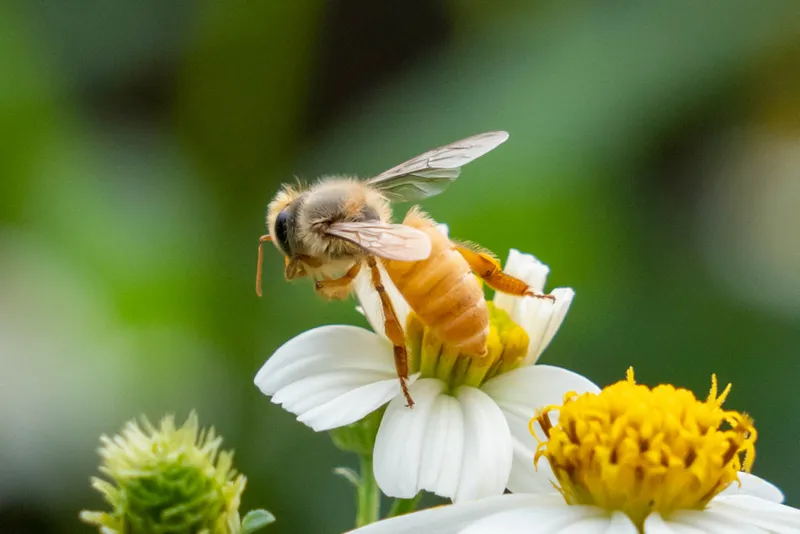
What is the Asian honey bee (Apis cerana)?
The Asian honey bee (Apis cerana) is a cavity-nesting honey bee native to Asia, used for honey and pollination for thousands of years. According to Exotic Bee ID, its body is about 9 mm long, with colour varying between races. Koetz (2013) notes its abdomen has even black stripes throughout.
It is often confused with the widely kept, generally larger European honey bee (Apis mellifera). It also differs from the giant honey bee known locally as lebah hutan (Apis dorsata), whose honey is harvested from nests in trees. Koetz says the most reliable difference from A. mellifera is an extended radial vein on the hind wing.
Evidence: Insects (MDPI) — Koetz (2013), Ecology, behaviour and control of Apis cerana with a focus on relevance to the Australian incursion ↗ · Exotic Bee ID (USDA APHIS / idtools) — Apis cerana ↗ · Mongabay Indonesia — Bijaknya petani muda Majalengka sejak kenal lebah madu (2023) ↗
Where does the Asian honey bee live?
The Asian honey bee ranges from Afghanistan to Japan and south through Indonesia, according to Koetz (2013). Indonesian populations studied come from Sumatra, Java, Bali, Lombok, Flores, Timor, Kalimantan and Sulawesi. Bees from Java were deliberately taken to Papua in the late 1970s or 1980s and then spread across New Guinea.
It nests in tree hollows, rock crevices, caves and cavities in buildings, usually low down, at an average of one to two metres. In Padang, West Sumatra, most nests were in tree hollows, at 22 nests per square kilometre. In Central Sulawesi, where it lives alongside Apis nigrocincta, nests have been found only in farmland and villages.
What does the Asian honey bee eat?
The Asian honey bee feeds on nectar and pollen from a wide range of flowering plants. Koetz (2013) notes that nectar supplies carbohydrates and pollen supplies protein for larvae and adults. A worker tends to collect only nectar or only pollen from one plant species all day, and foraging starts earlier than in European honey bees.
In Kiarapayung Biodiversity Park, Sumedang, West Java, researchers recorded 50 plant species from 24 families as its food sources. At Maribaya, West Bandung, about 68% of the pollen collected came from Mexican sunflower (Tithonia diversifolia), an invasive shrub. Dry-season food shortage is a major challenge for beekeeping.
Evidence: Insects (MDPI) — Koetz (2013), Ecology, behaviour and control of Apis cerana with a focus on relevance to the Australian incursion ↗ · Jurnal Entomologi Indonesia — Asfiya et al. (2025), Eksplorasi potensi budi daya lebah madu Apis cerana Fabricius di Taman Kehati Kiarapayung, Jawa Barat ↗ · Berita Biologi (BRIN) — Azzahra et al., Identifikasi tumbuhan berdasarkan struktur polen sebagai sumber pakan lebah madu (Apis cerana) di Maribaya, Lembang ↗
How does the Asian honey bee live and nest?
The Asian honey bee lives in colonies that build several parallel combs inside an enclosed cavity. Exotic Bee ID puts a typical colony at about 7,000 bees, smaller than a European honey bee colony, and notes that it does not use propolis to seal the nest. Koetz (2013) reports average wild colony sizes of 6,884–14,745 bees.
Whole colonies sometimes abandon their nest (absconding) when food runs short, the nest deteriorates or they are disturbed repeatedly. In defence, bees shake their abdomens, hiss, and surround attacking wasps in a ‘bee ball’ that kills them by overheating; stinging is their main defence against vertebrates.
Evidence: Exotic Bee ID (USDA APHIS / idtools) — Apis cerana ↗ · Insects (MDPI) — Koetz (2013), Ecology, behaviour and control of Apis cerana with a focus on relevance to the Australian incursion ↗
Why does the Asian honey bee matter, and how is it kept?
The Asian honey bee matters as a pollinator of wild plants and crops, and as a honey source for villagers. Koetz (2013) reports that its pollination increases fruit and seed set in many crops, and that it is more disease-resistant and needs less management than the European honey bee in many poorer parts of Asia.
In Majalengka, West Java, young beekeepers keep A. cerana in boxes in their yards; Mongabay Indonesia reports that each colony yields 1–2 kg of honey a month, depending on the flowering season. At the National Beekeeping Centre (Pusbahnas) in Parungpanjang, Bogor, a food-plant study for this local bee found kapok the densest.
Evidence: Insects (MDPI) — Koetz (2013), Ecology, behaviour and control of Apis cerana with a focus on relevance to the Australian incursion ↗ · Mongabay Indonesia — Bijaknya petani muda Majalengka sejak kenal lebah madu (2023) ↗ · Jurnal Nusa Sylva (Universitas Nusa Bangsa) — Mulyono et al. (2018), Kajian ketersediaan pakan lebah madu lokal (Apis cerana Fabr.) ↗
What should you do if you meet Asian honey bees?
If you meet Asian honey bees, stay calm and do not swat at them, as this can provoke a sting. Do not disturb their nests. CDC advises moving away quickly if attacked by several bees, because a stinging bee releases a chemical that can attract others. Most stings cause only pain or itching, redness and slight swelling.
Seek medical care at a health facility promptly if signs of an allergic reaction appear, such as hives, swelling of the face, lips or throat, difficulty breathing or swallowing, dizziness or fainting, or nausea and vomiting. A BRIN researcher quoted by Mongabay names habitat loss and pesticides as the main threats to bees.
Evidence: CDC NIOSH — Insects and Scorpions at Work ↗ · RSUD Kabupaten Buleleng — Alergi sengatan lebah ↗ · Mongabay Indonesia — Bijaknya petani muda Majalengka sejak kenal lebah madu (2023) ↗
Explore related habitats
These habitat relationships are supported by species sources in this guide. This is not a complete range map.
Common questions about the Asian honey bee
What is the scientific name of the Asian honey bee?
The scientific name of the Asian honey bee is Apis cerana, in the family Apidae. In Indonesian it is called Lebah madu Asia.
Where can the Asian honey bee be found in Indonesia?
In Indonesia, this guide records the Asian honey bee in: Sumatra, Java, Bali, Nusa Tenggara, Kalimantan and Sulawesi; introduced to Papua.
Source-supported habitats: Tropical Rainforests, Urban Habitats.
What does the Asian honey bee eat?
Diet of the Asian honey bee: nectar and pollen from many flowering plants.
Sources & references
- Insects (MDPI) — Koetz (2013), Ecology, behaviour and control of Apis cerana with a focus on relevance to the Australian incursion ↗
- Exotic Bee ID (USDA APHIS / idtools) — Apis cerana ↗
- Jurnal Entomologi Indonesia — Asfiya et al. (2025), Eksplorasi potensi budi daya lebah madu Apis cerana Fabricius di Taman Kehati Kiarapayung, Jawa Barat ↗
- Berita Biologi (BRIN) — Azzahra et al., Identifikasi tumbuhan berdasarkan struktur polen sebagai sumber pakan lebah madu (Apis cerana) di Maribaya, Lembang ↗
- Jurnal Nusa Sylva (Universitas Nusa Bangsa) — Mulyono et al. (2018), Kajian ketersediaan pakan lebah madu lokal (Apis cerana Fabr.) ↗
- Mongabay Indonesia — Bijaknya petani muda Majalengka sejak kenal lebah madu (2023) ↗
- CDC NIOSH — Insects and Scorpions at Work ↗
- RSUD Kabupaten Buleleng — Alergi sengatan lebah ↗
References can change. Check dates and context in the original source.
Cite this page
PanduanHewan. (2026, 25 September). Asian honey bee (Apis cerana). PanduanHewan.org. https://panduanhewan.org/en/species/asian-honey-bee/