Quick answer
IUCN status: VulnerableCoconut crab at a glance
The coconut crab (Birgus latro) is an invertebrate in the family Coenobitidae. Range in Indonesia: Small islands off Borneo, Sulawesi, Maluku and Papua. Diet: pandanus fruit, coconut flesh, carrion and other crabs; a omnivore. IUCN Red List status: Vulnerable. It is a legally protected species in Indonesia (Regulation P.106/2018).
| Scientific name | Birgus latro |
|---|---|
| Indonesian name | Ketam kenari |
| Group | Invertebrates |
| Family | Coenobitidae |
| Range in Indonesia | Small islands off Borneo, Sulawesi, Maluku and Papua |
| Diet | Pandanus fruit, coconut flesh, carrion and other crabs |
| Range in Indonesia | Small islands of Borneo, Sulawesi, Maluku and Papua |
| Key feature | Very strong claws, breathes with lungs, up to 4 kg |
| Other names | Robber crab, kepiting kenari, ketam kelapa |
| IUCN status | Vulnerable · IUCN Red List (via GBIF) · checked 1 October 2026 |
| Legal protection in Indonesia | Protected · Regulation P.106/2018 · annex no. 779 |
| Diet type | Omnivore (eats plants and animals) — omnivorous scavenger: pandanus fruit, coconut meat, carrion including other crabs, and moulted crustacean shells · Animal Diversity Web |
| Reproduction | Laying eggs (oviparous) · Animal Diversity Web |
| Venom or poison | Not venomous, but can cause poisoning if eaten · SeaLifeBase: Birgus latro species summary |
| Active | Nocturnal (active at night) · Animal Diversity Web |
In this guide (11)
What is the coconut crab?
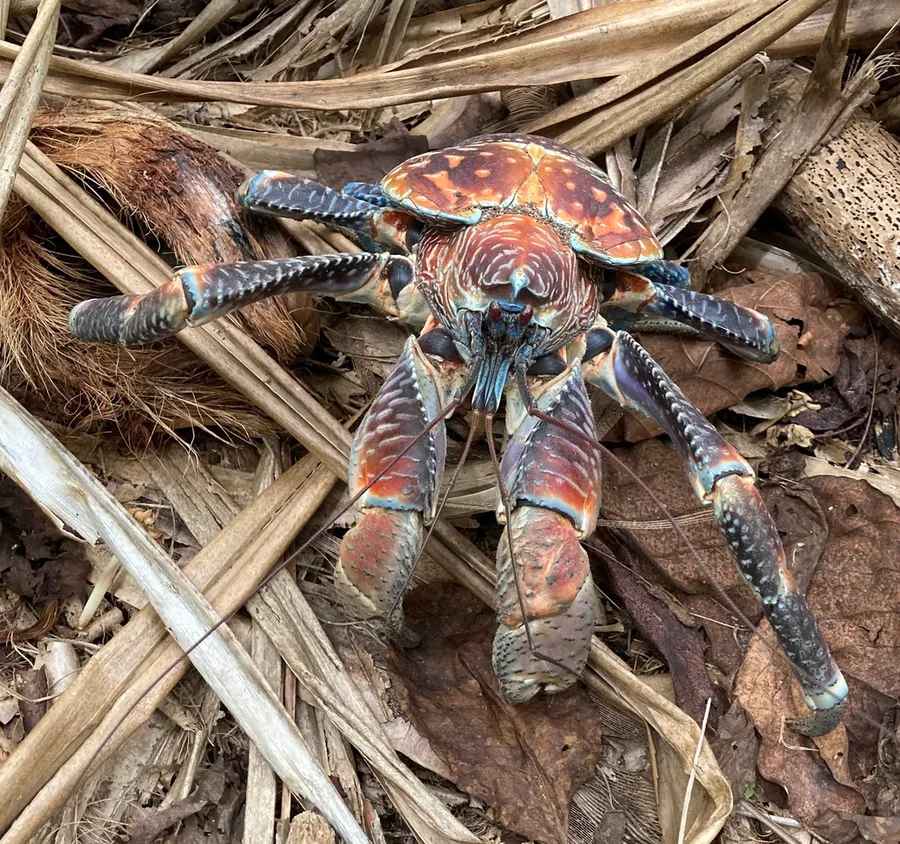
The coconut crab (Birgus latro) is the largest land-living arthropod in the world, and is in fact a giant hermit crab of the family Coenobitidae. According to Animal Diversity Web (ADW), it can weigh up to 4 kg and span about 1 m from leg tip to leg tip. Males are larger than females.
Young crabs shelter in snail shells like other hermit crabs. Adults harden their abdomen and no longer need a shell. Colour varies: most are deep blue, but some are reddish or purple. Its gills are vestigial, so it breathes with lungs inside its body cavity. SeaLifeBase gives a maximum reported age of 40 years.
Evidence: Animal Diversity Web — Birgus latro, coconut crab ↗ · SeaLifeBase — Birgus latro, coconut crab ↗
Where does the coconut crab live?
The coconut crab lives on land on oceanic islands, atolls and coasts across the Indo-Pacific, from Tanzania and Mozambique to the Pitcairn Islands, according to SeaLifeBase. It can be found up to about 6 km from the sea.
In Indonesia it occurs patchily on islands around Borneo, Sulawesi, Maluku and Papua. Mongabay Indonesia reports it on Maratua Island (East Kalimantan), Kadatua (Southeast Sulawesi) and small North Maluku islands such as Kayoa, Gebe, Pisang and Talimau. By day it hides in burrows in sand, loose soil or rock crevices to stay moist.
Evidence: SeaLifeBase — Birgus latro, coconut crab ↗ · Mongabay Indonesia (2024) — Terancam Penangkapan Ilegal, Populasi Kepiting Kenari di Maluku Utara Makin Terbatas ↗ · Mongabay Indonesia (2016) — Begini Penampakan Ketam Kenari, Kepiting Terbesar di Dunia ↗
What does the coconut crab eat?
The coconut crab is an omnivorous scavenger that eats a lot of carrion and fruit, according to ADW. Its food includes pandanus fruit, a main food in many places, coconut flesh, dead animals, other crabs, and the shed shells of moulting crustaceans.
As its name suggests, it can open coconuts. ADW describes several methods: piercing a soft 'eye' with its claws, hammering the nut until it splits, or carrying it up a tree and dropping it. Large food items are often taken back to the burrow to be eaten and stored. The crab also climbs trees to forage.
Evidence: Animal Diversity Web — Birgus latro, coconut crab ↗ · SeaLifeBase — Birgus latro, coconut crab ↗
How does the coconut crab breed?
Coconut crabs mate on land, but their young develop at sea. According to ADW, the female carries 50,000–138,000 eggs under her abdomen, then walks into shallow water and releases them at high tide.
The larvae drift as plankton for several weeks. The young then move into an empty snail shell, come ashore and turn into juvenile crabs. Growth is very slow: ADW says coconut crabs mature at about five years and reach full size only after 40–60 years. Khairun University researcher Supyan notes that small crabs caught in North Maluku already carry eggs, which he suspects is a response to hunting pressure.
Evidence: Animal Diversity Web — Birgus latro, coconut crab ↗ · Mongabay Indonesia (2024) — Terancam Penangkapan Ilegal, Populasi Kepiting Kenari di Maluku Utara Makin Terbatas ↗
Why is the coconut crab threatened?
The coconut crab is threatened mainly by hunting for food and the restaurant trade, along with habitat damage. It has been listed as Vulnerable on the IUCN Red List since a 2018 assessment.
Mongabay Indonesia reports that dozens to hundreds of coconut crabs are supplied to restaurants in Ternate every month. Researcher Supyan puts the price at Rp250,000–350,000 each in Ternate restaurants and up to Rp750,000 in Jakarta. In 2009, crabs of 4 kg could still be found; now even 3 kg crabs are hard to find. Slow growth and ease of capture make it easy to overharvest. The Maluku conservation office (BKSDA) admits enforcement is limited by staff shortages.
Evidence: Mongabay Indonesia (2024) — Kepiting Kenari, Satwa Dilindungi yang Terus Diburu di Maluku Utara ↗ · Mongabay Indonesia (2024) — Terancam Penangkapan Ilegal, Populasi Kepiting Kenari di Maluku Utara Makin Terbatas ↗ · SeaLifeBase — Birgus latro, coconut crab ↗
How can the coconut crab be protected?
The coconut crab is legally protected: the annex to Regulation P.106/2018 lists it as entry 779. According to Mongabay Indonesia, in 2017 the environment ministry also issued a decree allowing limited, conditional use as a game animal in North Maluku.
The simplest way to help is not to order, buy or eat wild-caught coconut crabs, even on holiday. SeaLifeBase also notes that the crab can be poisonous to eat. If you see one in the wild, leave it alone; its claws are very strong. Report capture or sale to the local BKSDA. Protecting coastal forest and pandanus on small islands also protects its food and cover.
Evidence: JDIH Kementerian Kehutanan — Lampiran Permen LHK P.106/MENLHK/SETJEN/KUM.1/12/2018 tentang Jenis Tumbuhan dan Satwa yang Dilindungi ↗ · Mongabay Indonesia (2024) — Terancam Penangkapan Ilegal, Populasi Kepiting Kenari di Maluku Utara Makin Terbatas ↗ · SeaLifeBase — Birgus latro, coconut crab ↗
Scientific classification of the Coconut crab
| Kingdom | Animalia |
|---|---|
| Phylum | Arthropoda |
| Class | Malacostraca |
| Order | Decapoda |
| Family | Coenobitidae |
| Genus | Birgus |
| Species | Birgus latro |
Source: GBIF Backbone Taxonomy, adjusted to the ranks commonly used in school biology (for example class Reptilia).
Common questions about the coconut crab
What is the scientific name of the coconut crab?
The scientific name of the coconut crab is Birgus latro, in the family Coenobitidae. In Indonesian it is called Ketam kenari.
What kind of animal is the coconut crab?
The coconut crab is an invertebrate in the family Coenobitidae. By diet it is a omnivore (eats plants and animals): a omnivorous scavenger: pandanus fruit, coconut meat, carrion including other crabs, and moulted crustacean shells.
Where does the coconut crab live in Indonesia?
In Indonesia, this guide records the coconut crab in: Small islands off Borneo, Sulawesi, Maluku and Papua.
What does the coconut crab eat?
Diet of the coconut crab: pandanus fruit, coconut flesh, carrion and other crabs. That makes it a omnivore (eats plants and animals). Source: Animal Diversity Web.
How does the coconut crab reproduce?
The coconut crab reproduces by laying eggs (oviparous). The female carries tens of thousands of eggs under her abdomen, then releases them into shallow sea water at high tide, where they hatch at once and the larvae drift as plankton. Source: Animal Diversity Web.
Is the coconut crab poisonous?
Only if eaten. Not venomous, but eating it has caused fatal poisonings (thought to come from toxic fruit it eats); its claws are also very strong. Source: SeaLifeBase: Birgus latro species summary.
Do not catch, handle or disturb wild animals. If bitten, stung or exposed to its toxins, go to the nearest health facility straight away.
Is the coconut crab nocturnal?
Yes. The coconut crab is nocturnal (active at night). Sometimes also active by day; on islands with many people it is active only at night. Source: Animal Diversity Web.
See also the list of nocturnal and diurnal animals in Indonesia.
What are the main features of the coconut crab?
Key features of the coconut crab, from this guide’s sources: Key feature: very strong claws, breathes with lungs, up to 4 kg.
What is the scientific classification of the coconut crab?
Scientific classification of the coconut crab: kingdom Animalia, phylum Arthropoda, class Malacostraca, order Decapoda, family Coenobitidae, genus Birgus, species Birgus latro.
Source: GBIF Backbone Taxonomy, adjusted to the ranks commonly used in school biology.
Is the coconut crab endangered?
Yes. On the IUCN Red List, the coconut crab is listed as Vulnerable: it is considered to face a high risk of extinction in the wild. Source: IUCN Red List (via GBIF), checked 1 October 2026.
This global category is separate from national legal protection. Is the coconut crab protected in Indonesia?
Is the coconut crab protected in Indonesia?
Yes. The coconut crab (Birgus latro) is a protected species in Indonesia under Environment and Forestry Ministerial Regulation No. P.106/MENLHK/SETJEN/KUM.1/12/2018 on protected plant and animal species (annex, entry 779).
Article 21(2) of Law No. 5 of 1990, as amended by Law No. 32 of 2024, prohibits anyone from hunting, catching, injuring, killing, storing, owning, keeping, transporting or trading a protected animal, alive or dead, including its body parts, eggs and nests.
If you see this animal being traded, kept or injured, contact the local BKSDA office.
Can the coconut crab be kept as a pet?
No. Because the coconut crab is a protected species, catching, owning, keeping, transporting or trading it without a permit is prohibited by law. Trading without a permit through electronic media is also prohibited.
If you see this animal for sale or being kept, report it to the local BKSDA office.
Sources & references
- Animal Diversity Web — Birgus latro, coconut crab ↗
- SeaLifeBase — Birgus latro, coconut crab ↗
- Mongabay Indonesia (2024) — Kepiting Kenari, Satwa Dilindungi yang Terus Diburu di Maluku Utara ↗
- Mongabay Indonesia (2024) — Terancam Penangkapan Ilegal, Populasi Kepiting Kenari di Maluku Utara Makin Terbatas ↗
- Mongabay Indonesia (2016) — Begini Penampakan Ketam Kenari, Kepiting Terbesar di Dunia ↗
- JDIH Kementerian Kehutanan — Lampiran Permen LHK P.106/MENLHK/SETJEN/KUM.1/12/2018 tentang Jenis Tumbuhan dan Satwa yang Dilindungi ↗
- GBIF Backbone Taxonomy (GBIF) ↗
- IUCN Red List of Threatened Species, version 2026-1, via GBIF (CC BY 4.0) ↗
References can change. Check dates and context in the original source.
Cite this page
PanduanHewan. (2026, 1 October). Coconut crab (Birgus latro). PanduanHewan.org. https://panduanhewan.org/en/species/coconut-crab/