Quick answer
IUCN status: Least ConcernSunda scops owl at a glance
The Sunda scops owl (Otus lempiji) is a bird in the family Strigidae. Range in Indonesia: Sumatra, Java, Kalimantan (Borneo) and Bali. Diet: insects, lizards, frogs, rodents and small birds; a carnivore. IUCN Red List status: Least Concern.
| Scientific name | Otus lempiji |
|---|---|
| Indonesian name | Celepuk reban |
| Group | Birds |
| Family | Strigidae |
| Range in Indonesia | Sumatra, Java, Kalimantan (Borneo) and Bali |
| Linked habitats | Tropical Rainforests, Urban Habitats |
| Diet | Insects, lizards, frogs, rodents and small birds |
| Range in Indonesia | Sumatra, Java, Kalimantan and Bali |
| Key feature | Short ear tufts and a pale brown collar |
| Other names | Celepuk reban, manuk guwek (Javanese) |
| IUCN status | Least Concern (2024 assessment) |
| IUCN status | Least Concern · IUCN Red List (via GBIF) · checked 1 October 2026 |
| Diet type | Carnivore (meat-eater) — insects and other small animals · AVONET bird trait database (Tobias et al. 2022) |
| Reproduction | Laying eggs (oviparous) · Vigie-Nature École (MNHN) |
| Active | Nocturnal (active at night) · Vocal Individuality of Sunda Scops-Owl (Otus lempiji) in Peninsular Malaysia - Journal of Raptor Research 50(4), BioOne (abstract) |
In this guide (12)
What is the Sunda scops owl?
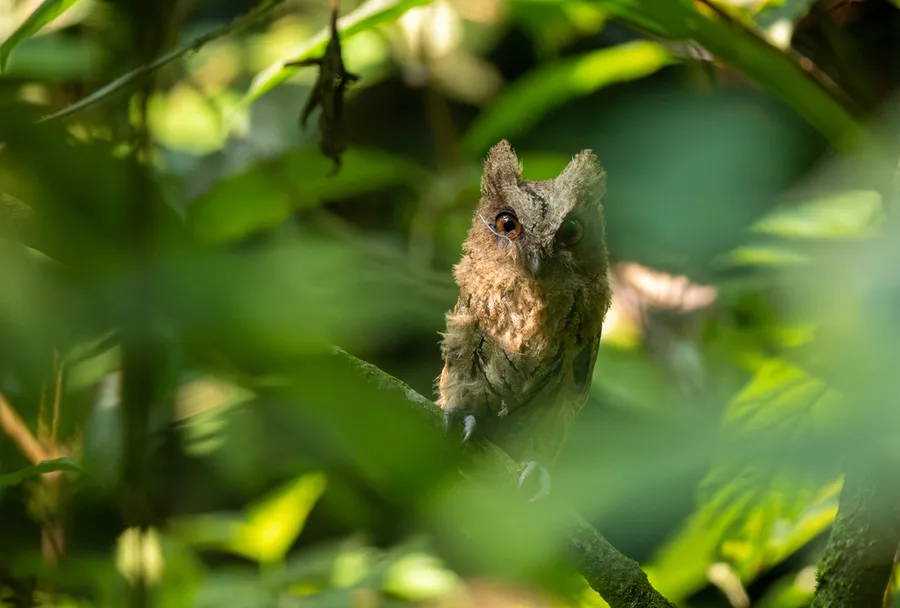
The Sunda scops owl (Otus lempiji) is a small owl of the family Strigidae with short ear tufts and a pale brown collar. NParks Singapore gives its length as about 21 cm. Its underparts are brown with faint black streaks, and its eyes are dark.
It was once lumped with several relatives as a single species, Otus bakkamoena, but BirdLife International now treats it as a separate species. It can be told apart from the brown hawk-owl (Ninox scutulata), which is larger at about 30 cm, has a rounded head without ear tufts, and has yellow eyes.
Evidence: National Parks Board Singapore (NParks) — In the Lonely 'Owl' ↗ · BirdLife International (DataZone) — Sunda Scops-owl Otus lempiji species factsheet ↗
Where does the Sunda scops owl live?
The Sunda scops owl lives on Sumatra, Java, Kalimantan and Bali, and also in Peninsular Malaysia, Singapore and Brunei. BirdLife International lists lowland and montane forest, plantations, rural gardens and urban areas among its habitats, from sea level to about 2,000 m.
In Mount Merapi National Park it is found on the slopes up to 1,600 m and is fairly easy to find near villages. Even so, BirdLife rates it as moderately dependent on tree cover, and tree cover within its range has been shrinking.
Evidence: BirdLife International (DataZone) — Sunda Scops-owl Otus lempiji species factsheet ↗ · The Owl Pages — Sunda Scops Owl (Otus lempiji) ↗ · Balai Taman Nasional Gunung Merapi — Celepuk Reban ↗
What does the Sunda scops owl eat?
The Sunda scops owl eats insects and small animals. NParks Singapore lists cockroaches, beetles, lizards and rodents. At Mount Merapi its prey includes moths, grasshoppers, frogs and small birds. It usually perches on a low tree or shrub, then drops onto its prey.
In a bait-choice test by IPB University researchers (2013), Sunda scops owls ate more rat than beetle larvae, lizard, fish or cricket. The test was run to judge whether owls could serve as natural enemies of tree rats in oil palm plantations.
Evidence: National Parks Board Singapore (NParks) — In the Lonely 'Owl' ↗ · Balai Taman Nasional Gunung Merapi — Celepuk Reban ↗ · IPB University Repository — Aswari & Priyambodo (2013), Preferensi Burung Hantu Celepuk Reban (Otus lempiji Horsfield) terhadap Umpan ↗
How does the Sunda scops owl behave and breed?
The Sunda scops owl is active at night and is heard more often than seen. At Mount Merapi, pairs often call back and forth in duets. A study in Selangor, Malaysia, found that each owl's territorial call is distinct: 97.1% of recordings were matched to the right individual.
It nests in tree holes, between coconut fronds or in bamboo clumps. According to Mount Merapi National Park, it usually breeds in the rainy season, and the female lays two to three eggs per clutch.
Evidence: Balai Taman Nasional Gunung Merapi — Celepuk Reban ↗ · Journal of Raptor Research (BioOne) — Yee et al. (2016), Vocal Individuality of Sunda Scops-Owl (Otus lempiji) in Peninsular Malaysia ↗
Why are Sunda scops owls sold in bird markets?
Sunda scops owls are sold because owls have become popular pets on Java and Bali since the late 2000s. Inside Science reports that TRAFFIC monitoring in 2016 found this species particularly popular with bird keepers. Surveys of 20 bird markets on Java and Bali in 2012–2016 estimated that at least 12,000 scops owls (genus Otus) are sold each year.
The researchers say most of these owls are taken from the wild. About half of the roughly 2,000 owls they saw were downy chicks taken from nests, and most were expected to die within weeks. BirdLife considers the population to be declining, although the species is still listed as Least Concern.
Evidence: Mongabay — Harry Potter may have sparked illegal owl trade in Indonesia (2017) ↗ · Inside Science (American Institute of Physics) — 'Burung Harry Potter' Owls Found in Indonesian Markets ↗ · BirdLife International (DataZone) — Sunda Scops-owl Otus lempiji species factsheet ↗
What should you do if you find a Sunda scops owl?
If you see a Sunda scops owl in a tree or garden, watch from a distance and leave it alone. The species often lives near houses. NParks Singapore warns that disturbing nocturnal animals can disrupt their natural behaviour, so avoid approaching or harassing the bird.
Do not take chicks from nests or buy wild-caught owls; researchers consider this trade unsustainable. If you find an injured or threatened wild animal, report it to the local nature conservation agency (BKSDA), as the Bali BKSDA urges the public to do.
Evidence: National Parks Board Singapore (NParks) — In the Lonely 'Owl' ↗ · Mongabay — Harry Potter may have sparked illegal owl trade in Indonesia (2017) ↗ · Balai KSDA Bali — Evakuasi elang ular bido di Desa Pemuteran dan pelepasliaran burung hasil sitaan (2026) ↗
Explore related habitats
These habitat relationships are supported by species sources in this guide. This is not a complete range map.
Scientific classification of the Sunda scops owl
| Kingdom | Animalia |
|---|---|
| Phylum | Chordata |
| Class | Aves |
| Order | Strigiformes |
| Family | Strigidae |
| Genus | Otus |
| Species | Otus lempiji |
Source: GBIF Backbone Taxonomy, adjusted to the ranks commonly used in school biology (for example class Reptilia).
Common questions about the Sunda scops owl
What is the scientific name of the Sunda scops owl?
The scientific name of the Sunda scops owl is Otus lempiji, in the family Strigidae. In Indonesian it is called Celepuk reban.
What kind of animal is the Sunda scops owl?
The Sunda scops owl is a bird in the family Strigidae. By diet it is a carnivore (meat-eater): a insects and other small animals.
Where does the Sunda scops owl live in Indonesia?
In Indonesia, this guide records the Sunda scops owl in: Sumatra, Java, Kalimantan (Borneo) and Bali.
Source-supported habitats: Tropical Rainforests, Urban Habitats.
What does the Sunda scops owl eat?
Diet of the Sunda scops owl: insects, lizards, frogs, rodents and small birds. That makes it a carnivore (meat-eater). Source: AVONET bird trait database (Tobias et al. 2022).
How does the Sunda scops owl reproduce?
The Sunda scops owl reproduces by laying eggs (oviparous). Source: Vigie-Nature École (MNHN).
Is the Sunda scops owl nocturnal?
The cited source records the Sunda scops owl as nocturnal (active at night). Source: Vocal Individuality of Sunda Scops-Owl (Otus lempiji) in Peninsular Malaysia - Journal of Raptor Research 50(4), BioOne (abstract).
See also the list of nocturnal and diurnal animals in Indonesia.
What are the main features of the Sunda scops owl?
Key features of the Sunda scops owl, from this guide’s sources: Key feature: short ear tufts and a pale brown collar.
What is the scientific classification of the Sunda scops owl?
Scientific classification of the Sunda scops owl: kingdom Animalia, phylum Chordata, class Aves, order Strigiformes, family Strigidae, genus Otus, species Otus lempiji.
Source: GBIF Backbone Taxonomy, adjusted to the ranks commonly used in school biology.
Is the Sunda scops owl endangered?
No, according to the global IUCN assessment. On the IUCN Red List, the Sunda scops owl is listed as Least Concern: it does not qualify for a threatened category or for Near Threatened in the global assessment. Source: IUCN Red List (via GBIF), checked 1 October 2026.
This global category is separate from legal protection in Indonesia. To check whether the Sunda scops owl is a protected species, consult the current national list of protected species or contact the local BKSDA (natural resources conservation office).
Sources & references
- BirdLife International (DataZone) — Sunda Scops-owl Otus lempiji species factsheet ↗
- National Parks Board Singapore (NParks) — In the Lonely 'Owl' ↗
- Balai Taman Nasional Gunung Merapi — Celepuk Reban ↗
- IPB University Repository — Aswari & Priyambodo (2013), Preferensi Burung Hantu Celepuk Reban (Otus lempiji Horsfield) terhadap Umpan ↗
- Journal of Raptor Research (BioOne) — Yee et al. (2016), Vocal Individuality of Sunda Scops-Owl (Otus lempiji) in Peninsular Malaysia ↗
- Mongabay — Harry Potter may have sparked illegal owl trade in Indonesia (2017) ↗
- Inside Science (American Institute of Physics) — 'Burung Harry Potter' Owls Found in Indonesian Markets ↗
- The Owl Pages — Sunda Scops Owl (Otus lempiji) ↗
- Balai KSDA Bali — Evakuasi elang ular bido di Desa Pemuteran dan pelepasliaran burung hasil sitaan (2026) ↗
- AVONET bird trait database (Tobias et al. 2022) ↗
- Vigie-Nature École (MNHN) ↗
- GBIF Backbone Taxonomy (GBIF) ↗
- IUCN Red List of Threatened Species, version 2026-1, via GBIF (CC BY 4.0) ↗
References can change. Check dates and context in the original source. How we use sources and data →
Cite this page
Credit PanduanHewan when referring to this page. Check the original evidence sources before reusing a claim.
PanduanHewan. Sunda scops owl (Otus lempiji). Last substantive update: 1 October 2026. https://panduanhewan.org/en/species/sunda-scops-owl/