Quick answer
IUCN status: Least ConcernBlack-capped lory at a glance
The Black-capped lory (Lorius lory) is a bird in the family Psittacidae. Its IUCN Red List category is Least Concern.
| Scientific name | Lorius lory |
|---|---|
| Indonesian name | Nuri kepala hitam |
| Group | Birds |
| Family | Psittacidae |
| Range in Indonesia | Indonesian New Guinea (Papua), including Raja Ampat, Biak and Yapen |
| Linked habitats | Tropical Rainforests, Freshwater Wetlands |
| Diet | Flower nectar and pollen, fruit, small insects |
| Range in Indonesia | Indonesian New Guinea and nearby islands |
| Key feature | Red body, black cap, green wings, blue lower breast |
| Other names | Western black-capped lory, tricolored lory |
| Legal protection in Indonesia | Protected under ministerial regulation P.106/2018 |
| IUCN status | Least Concern · IUCN Red List (via GBIF) · checked 25 September 2026 |
In this guide (10)
What is the black-capped lory?
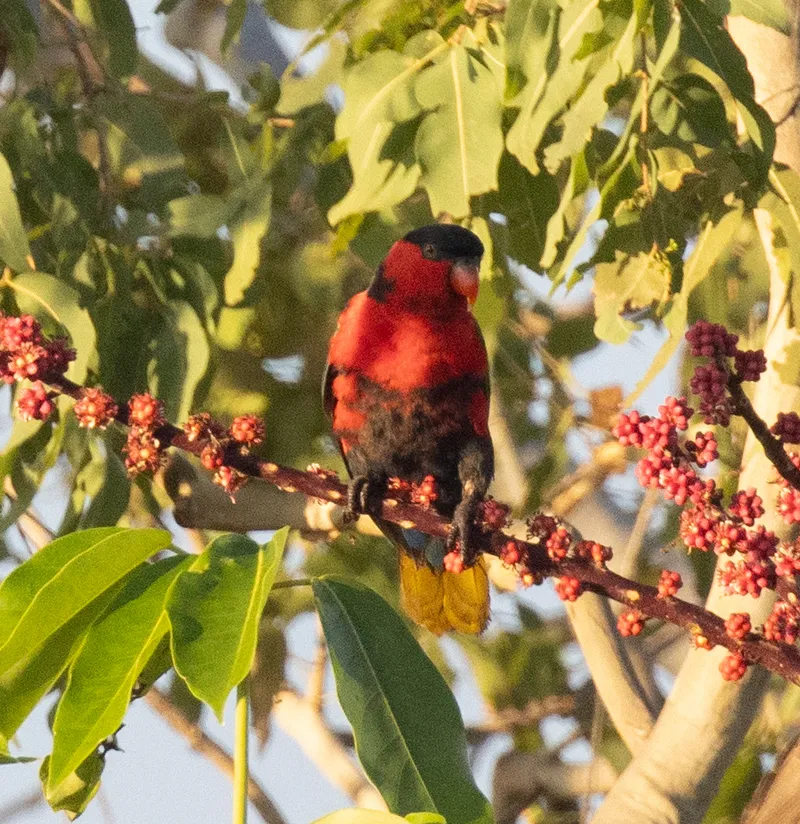
The black-capped lory (Lorius lory) is a parrot of the lory group with mainly red plumage and a black cap. The World Parrot Trust describes the nominate form as having a dark blue band on the nape, bronze-green wings, a dark blue lower breast, and a red tail with a broad blue-black tip. The bill is yellow-orange and the bird weighs 200–260 g.
Indonesia's protected-species regulation P.106/2018 lists it as kasturi kepala hitam. The World Parrot Trust recognises seven subspecies, which differ in how much blue and black they show on the breast, nape and wings. Males and females look alike.
Evidence: World Parrot Trust — Black-capped Lory (Lorius lory) ↗ · JDIH Kemenko Infrastruktur — Permen LHK P.106/MENLHK/SETJEN/KUM.1/12/2018 tentang Jenis Tumbuhan dan Satwa yang Dilindungi (PDF) ↗
Where does the black-capped lory live?
The black-capped lory lives on New Guinea, in both Indonesian Papua and Papua New Guinea. According to the World Parrot Trust, in Indonesia it occurs on the Raja Ampat islands (Waigeo, Batanta, Salawati and Misool), the Bird's Head (Vogelkop) Peninsula, the Bomberai Peninsula and the island's south, the north coast from the Mamberamo River to Yos Sudarso Bay, and Yapen, Mios Num and Biak.
It lives in primary forest, forest edges and well-grown secondary forest up to 1,000 m, and also in partly cleared areas, dryland forest and swamp forest. BirdLife rates it as highly dependent on forest.
Evidence: World Parrot Trust — Black-capped Lory (Lorius lory) ↗ · BirdLife International (DataZone) — Black-capped Lory Lorius lory species factsheet ↗
What does the black-capped lory eat?
The black-capped lory feeds mainly on flower nectar and pollen, plus fruit and small insects. The World Parrot Trust lists the flowers of Syzygium, Freycinetia and Schefflera among its food plants. It forages in the middle storey and the canopy of the forest.
It is usually seen in pairs or small groups, but ten or more may gather to feed in a flowering tree. It is quiet and inconspicuous for much of the day but very active at dawn and dusk.
Evidence: World Parrot Trust — Black-capped Lory (Lorius lory) ↗
How does the black-capped lory breed?
The black-capped lory nests in tree cavities and lays two elliptical eggs, according to the World Parrot Trust, with breeding recorded in May–July. Young birds resemble adults but have a brown bill, brown eyes and pale grey skin around the eye.
In flight it gives raucous two- or three-note whistles, and it whistles and squeaks when perched. It is also a good mimic: one captive pair learned to copy chickens, gulls, steam whistles and dogs. A study of trade in Papua found that parrot prices depend on plumage and the ability to mimic sounds.
Evidence: World Parrot Trust — Black-capped Lory (Lorius lory) ↗ · Rare Bird Alert — Wildlife Under Pressure: New Study Exposes Illegal Trade in Papua (2025) ↗
Why is the black-capped lory so heavily traded?
The black-capped lory is hunted because it is in demand as a pet, and hunting brings cash to people with few other economic options. The head of technical affairs at BBKSDA Papua named it among the most-hunted species in Papua. A 2025 study likewise found it was the most heavily traded of 82 species recorded in Papua's wildlife trade.
Most animals taken from Papua are sent to Java and Maluku. Birds are often stuffed into plastic bottles or boxes to get past airport and seaport checks. In 2024 Mongabay found two black-capped lories chained to perches in a shop in Morowali, Central Sulawesi, each priced at 1.8 million rupiah.
Evidence: Betahita — Jawa dan Maluku, Tujuan Perdagangan Satwa Ilegal dari Tanah Papua (2024) ↗ · Rare Bird Alert — Wildlife Under Pressure: New Study Exposes Illegal Trade in Papua (2025) ↗ · Mongabay — In eastern Indonesia, forest bird trade flies quietly under social media radar (2024) ↗
How can the black-capped lory be protected?
The black-capped lory is protected under ministerial regulation P.106/2018, and Indonesia's conservation law (Law No. 5 of 1990) prohibits catching, keeping, transporting or trading protected animals. Do not buy lories from markets, shops or social media, and report sales to the local BKSDA.
BBKSDA Papua regularly returns and releases lories that were seized or handed over by the public: 59 were released in 2021 and 72 in 2023. In March 2026 BKSDA Maluku also secured an ownerless black-capped lory on a passenger ship at Yos Sudarso port, Ambon, for rehabilitation before release.
Evidence: JDIH Kemenko Infrastruktur — Permen LHK P.106/MENLHK/SETJEN/KUM.1/12/2018 tentang Jenis Tumbuhan dan Satwa yang Dilindungi (PDF) ↗ · Kompas.com (Lestari) — Nuri Kepala Hitam Papua Ditemukan di Kapal, BKSDA Maluku Langsung Bertindak (2026) ↗ · Betahita — Jawa dan Maluku, Tujuan Perdagangan Satwa Ilegal dari Tanah Papua (2024) ↗
Explore related habitats
These habitat relationships are supported by species sources in this guide. This is not a complete range map.
Common questions about the Black-capped lory
What is the scientific name of the Black-capped lory?
The scientific name of the Black-capped lory is Lorius lory, in the family Psittacidae. In Indonesian it is called Nuri kepala hitam.
Where can the Black-capped lory be found in Indonesia?
In Indonesia, this guide records the Black-capped lory in: Indonesian New Guinea (Papua), including Raja Ampat, Biak and Yapen.
Source-supported habitats: Tropical Rainforests, Freshwater Wetlands.
What does the Black-capped lory eat?
Diet of the Black-capped lory: flower nectar and pollen, fruit, small insects.
What is the conservation status of the Black-capped lory?
On the IUCN Red List, the Black-capped lory is listed as Least Concern: it does not currently qualify for a threatened category in the global assessment. Source: IUCN Red List (via GBIF), checked 25 September 2026.
This global category is separate from legal protection in Indonesia. To check whether the Black-capped lory is a protected species, consult the current national list of protected species or contact the local BKSDA (natural resources conservation office).
Sources & references
- BirdLife International (DataZone) — Black-capped Lory Lorius lory species factsheet ↗
- World Parrot Trust — Black-capped Lory (Lorius lory) ↗
- JDIH Kemenko Infrastruktur — Permen LHK P.106/MENLHK/SETJEN/KUM.1/12/2018 tentang Jenis Tumbuhan dan Satwa yang Dilindungi (PDF) ↗
- Betahita — Jawa dan Maluku, Tujuan Perdagangan Satwa Ilegal dari Tanah Papua (2024) ↗
- Rare Bird Alert — Wildlife Under Pressure: New Study Exposes Illegal Trade in Papua (2025) ↗
- Mongabay — In eastern Indonesia, forest bird trade flies quietly under social media radar (2024) ↗
- Kompas.com (Lestari) — Nuri Kepala Hitam Papua Ditemukan di Kapal, BKSDA Maluku Langsung Bertindak (2026) ↗
- IUCN Red List of Threatened Species, version 2026-1, via GBIF (CC BY 4.0) ↗
References can change. Check dates and context in the original source.
Cite this page
PanduanHewan. (2026, 25 September). Black-capped lory (Lorius lory). PanduanHewan.org. https://panduanhewan.org/en/species/black-capped-lory/