North Sulawesi and North Maluku · Published · PanduanHewan editorial team
Summary
What you need to know
Thirty-five chattering lory parrots and 23 other wild animals seized or found at a ferry port have been sent back to North Maluku, where most of them come from, by the North Sulawesi conservation agency (BKSDA Sulut), whose head described the operation on Monday 28 September 2026. Most are protected parrots that had been treated at a wildlife rescue centre and tested negative for avian influenza.
- Number of animals
- 58 seized or found animals source ↗
- Breakdown
- 35 chattering lories, 18 Moluccan eclectus, 2 violet-necked lories, 1 white cockatoo, 1 snake, 1 mangrove monitor source ↗
- Chattering lory status
- Protected (P.106/2018 no. 556); Vulnerable (IUCN) source ↗
- Health check
- Negative for avian influenza (North Sulawesi quarantine) source ↗
- White cockatoo status
- Protected (P.106/2018 no. 255); Endangered (IUCN) source ↗
- Maximum penalty
- Up to 15 years in prison and/or a category VII fine (Rp5 billion) source ↗
Which animals were sent back to North Maluku?
Danny Pattipellohy, head of the North Sulawesi BKSDA, said the 58 animals had been seized or found at a ferry port. They were 35 chattering lories (Lorius garrulus), 18 Moluccan eclectus parrots (Eclectus roratus), two violet-necked lories (Eos squamata), one white cockatoo (Cacatua alba), one snake recorded as ular manuk tana and one mangrove monitor (biawak maluku).
A North Sulawesi quarantine vet said some came from smuggling cases out of North Maluku on the port route, gathered over a period of time. After quarantine stopped the shipments, the animals went to the BKSDA and were cared for at a wildlife rescue centre in North Sulawesi.
Health and laboratory checks came back negative for avian influenza. The BKSDA said the animals' wild behaviour had returned, and cited P.106/2018, the regulation listing protected species.
Sources: BKSDA Sulut translokasi 58 satwa liar hasil sitaan ke Maluku Utara, mayoritas burung paruh bengkok ↗
Is the chattering lory protected, and is it threatened?
Yes, the chattering lory is protected: it is entry 556 in the P.106/2018 annex. The same annex lists the white cockatoo (255), Moluccan eclectus (537), violet-necked lory (543) and mangrove monitor (723).
The IUCN Red List rates the chattering lory Vulnerable and the white cockatoo Endangered. The eclectus, violet-necked lory and mangrove monitor are Least Concern but remain protected under Indonesian law.
Trapping pressure has long been documented. Surveys on Obi, Bacan and Halmahera in 1991–1992 put the minimum populations at 50,000 white cockatoos and 46,000 chattering lories, against minimum catches in 1991 of 5,120 and 9,600 birds, levels judged to be overexploitation.
Sources: Permen LHK P.106/MENLHK/SETJEN/KUM.1/12/2018 tentang Jenis Tumbuhan dan Satwa yang Dilindungi (lampiran) ↗ · Kategori Daftar Merah IUCN untuk Lorius garrulus (checklist IUCN yang diterbitkan ulang GBIF) ↗ · Kategori Daftar Merah IUCN untuk Cacatua alba (checklist IUCN yang diterbitkan ulang GBIF) ↗ · Kategori Daftar Merah IUCN untuk Eclectus roratus (checklist IUCN yang diterbitkan ulang GBIF) ↗ · Kategori Daftar Merah IUCN untuk Eos squamata (checklist IUCN yang diterbitkan ulang GBIF) ↗ · Kategori Daftar Merah IUCN untuk Varanus indicus (checklist IUCN yang diterbitkan ulang GBIF) ↗ · Lambert (1993) Trade, status and management of three parrots in the North Moluccas, Indonesia: White Cockatoo Cacatua alba, Chattering Lory Lorius garrulus and Violet-eared Lory Eos squamata. Bird Conservation International 3(2) ↗
How are parrots smuggled out of North Maluku?
An investigation published in June 2024 described Manado port as the entry point for parrots from North Maluku, because of regular sailings to Ternate, and Bitung port as an entry point for wildlife from Maluku, North Maluku and Papua. From there, some cargo goes on to Tahuna in Sangihe and across to the Philippines.
Another report that month said a single collector in Halmahera could ship 100–200 birds every three months, mostly white cockatoos, chattering lories and eclectus parrots. When checks are tight, birds are hidden in water bottles or plastic pipes.
Sources: Yang terjerat di tangan penyelundup: rantai pasok gelap paruh bengkok dari Sulut ke Filipina (Bagian 1) ↗ · Jalur Gelap Penyelundup Paruh Bengkok dari Halmahera ke Filipina ↗
What else was seized at Maluku ports in September 2026?
In a report dated 5 September 2026, Maluku quarantine said it had stopped a ship passenger at Namlea port on Buru island carrying 40 red lories and lorikeets without quarantine documents or transport permits.
At Yos Sudarso port in Ambon, the Maluku BKSDA found a red lory (Eos bornea) and a coconut lorikeet (Trichoglossus haematodus) on ship passengers on 11 September 2026, and a sulphur-crested cockatoo (Cacatua galerita) on 12 September 2026. All three went to a wildlife centre for quarantine and rehabilitation.
In a report dated 25 September 2026, the Maluku BKSDA also seized a dusky lory (Pseudeos fuscata) hidden in a five-litre jerrycan in a cabin on a Jayapura–Jakarta ship docked at Ambon.
Sources: BKHIT Maluku gagalkan penyelundupan 40 nuri paruh bengkok ↗ · BKSDA Maluku amankan tiga burung dilindungi dari penumpang kapal ↗ · BKSDA Maluku amankan Nuri Kelam disembunyikan dalam jeriken ↗
What happens to seized animals once they are sent home?
Environment and Forestry Ministerial Regulation 17/2024 on wildlife rescue says animals that are medically healthy and behave naturally may be released, while those not yet able to adapt must be rehabilitated. It also covers animals handed over voluntarily by people who kept them.
This is not the first such return from North Sulawesi. On 21 June 2024, 68 animals, including 11 white cockatoos and 29 chattering lories, were moved to Ternate and Ambon. Animals were chosen on physical condition, such as complete wings and the ability to fly, and on laboratory tests for avian influenza and psittacine beak and feather disease (PBFD).
Sources: JDIH BPK: Permen LHK No. 17 Tahun 2024 tentang Penyelamatan Jenis Satwa ↗ · 68 ekor satwa kembali ke habitat asal melalui translokasi dari Sulut ke Ternate dan Ambon ↗
What penalties do smugglers of protected wildlife face?
Law 5/1990 as amended by Law 32/2024 bans hunting, keeping, transporting and trading live protected animals, and moving them from one place to another within Indonesia. Since the Law 1/2026 penalty adjustment, hunting through to trading live protected animals carries up to 15 years in prison and/or a category VII fine (Rp5 billion), while moving them between places in Indonesia carries up to 10 years and/or a category VI fine.
Shipping animals without documents can also be prosecuted under Law 21/2019 on animal, fish and plant quarantine, which Maluku quarantine cited in the Namlea case.
Sources: UU No. 32 Tahun 2024 tentang Perubahan atas UU No. 5 Tahun 1990 tentang Konservasi Sumber Daya Alam Hayati dan Ekosistemnya ↗ · JDIH BPK: UU No. 1 Tahun 2026 tentang Penyesuaian Pidana (Lampiran, no. 183, Pasal 40A ayat (2)) ↗ · JDIH BPK: UU No. 1 Tahun 2023 tentang KUHP ↗ · BKHIT Maluku gagalkan penyelundupan 40 nuri paruh bengkok ↗
What happens next
- The animals are being returned to their home range in North Maluku; the reports we reviewed did not give release sites.
- Birds seized in Ambon are in quarantine and rehabilitation before release.
- Maluku quarantine says it will tighten checks at ports and airports.
How to help
- Do not buy wild-caught chattering lories, white cockatoos, eclectus or other parrots.
- If you see animals carried without documents on a ship or at a port, tell BKSDA or quarantine officers; do not try to seize or handle them yourself.
- If you keep a protected animal, hand it over voluntarily to the BKSDA.
- If a bird or monitor lizard bites or scratches you, go to a health facility promptly.
Common questions
Is the chattering lory protected?
Yes. The chattering lory (Lorius garrulus) is entry 556 in the P.106/2018 annex and is rated Vulnerable by the IUCN. Catching, keeping or selling one without a permit is a criminal offence.
Source: Permen LHK P.106/MENLHK/SETJEN/KUM.1/12/2018 tentang Jenis Tumbuhan dan Satwa yang Dilindungi (lampiran) ↗ · Kategori Daftar Merah IUCN untuk Lorius garrulus (checklist IUCN yang diterbitkan ulang GBIF) ↗ · UU No. 32 Tahun 2024 tentang Perubahan atas UU No. 5 Tahun 1990 tentang Konservasi Sumber Daya Alam Hayati dan Ekosistemnya ↗
What is the chattering lory's scientific name?
Its scientific name is Lorius garrulus. Its relatives, the purple-naped lory (Lorius domicella) and black-capped lory (Lorius lory), are also listed in the P.106/2018 annex.
Is the eclectus parrot protected in Indonesia?
Yes. The Moluccan eclectus (Eclectus roratus) is entry 537 in the P.106/2018 annex. The IUCN rates it Least Concern, but that global rating does not change its legal protection in Indonesia.
Source: Permen LHK P.106/MENLHK/SETJEN/KUM.1/12/2018 tentang Jenis Tumbuhan dan Satwa yang Dilindungi (lampiran) ↗ · Kategori Daftar Merah IUCN untuk Eclectus roratus (checklist IUCN yang diterbitkan ulang GBIF) ↗
Is the white cockatoo protected?
Yes. The white cockatoo (Cacatua alba) is entry 255 in the P.106/2018 annex and is rated Endangered by the IUCN. The yellow-crested cockatoo (Cacatua sulphurea, 260) and sulphur-crested cockatoo (Cacatua galerita, 256) are also protected.
Source: Permen LHK P.106/MENLHK/SETJEN/KUM.1/12/2018 tentang Jenis Tumbuhan dan Satwa yang Dilindungi (lampiran) ↗ · Permen LHK P.106/MENLHK/SETJEN/KUM.1/12/2018 tentang Jenis Tumbuhan dan Satwa yang Dilindungi (lampiran) ↗ · Kategori Daftar Merah IUCN untuk Cacatua alba (checklist IUCN yang diterbitkan ulang GBIF) ↗
Is the mangrove monitor (biawak maluku) protected?
Yes. The mangrove monitor (Varanus indicus), known as biawak maluku, is entry 723 in the P.106/2018 annex, although the IUCN rates it Least Concern. Do not approach or handle wild monitors; report them to the BKSDA.
Source: Permen LHK P.106/MENLHK/SETJEN/KUM.1/12/2018 tentang Jenis Tumbuhan dan Satwa yang Dilindungi (lampiran) ↗ · Kategori Daftar Merah IUCN untuk Varanus indicus (checklist IUCN yang diterbitkan ulang GBIF) ↗
Animals in this story
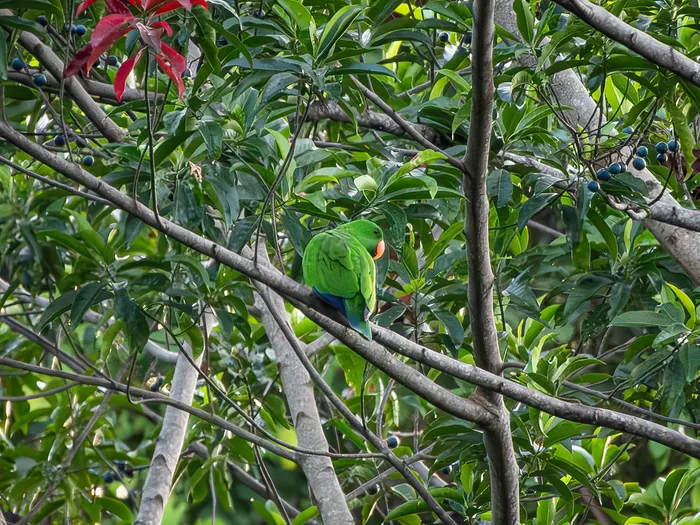
Moluccan Eclectus (Eclectus roratus). Eclectus parrots show striking male-female colour differences; island origin also matters because species limits in the eclectus complex have changed.
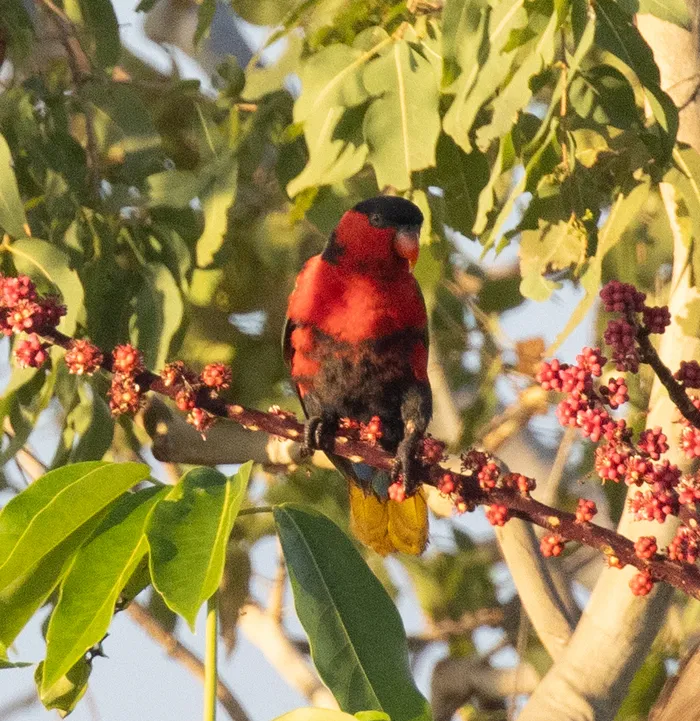
The black-capped lory (Lorius lory) is a red, black-capped parrot of Papua's forests. It is protected in Indonesia yet is among Papua's most-traded birds.
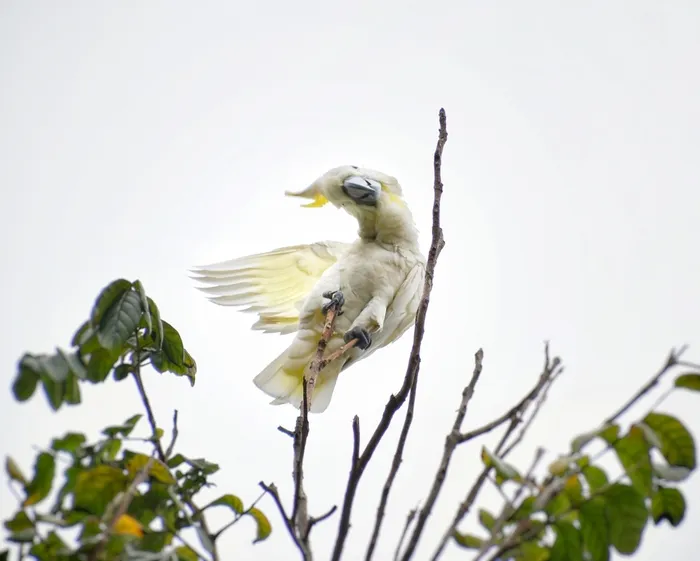
A white, yellow-crested cockatoo whose island populations need careful distinction. Feeding, nesting, and roosting trees complement efforts to prevent harmful trade.
Sources and references
- BKSDA Sulut translokasi 58 satwa liar hasil sitaan ke Maluku Utara, mayoritas burung paruh bengkok ↗ — Zonautara, 2026-09-29
- Permen LHK P.106/MENLHK/SETJEN/KUM.1/12/2018 tentang Jenis Tumbuhan dan Satwa yang Dilindungi (lampiran) ↗ — Kementerian Lingkungan Hidup dan Kehutanan (JDIH Kementerian Kehutanan), 2018-12-28
- Kategori Daftar Merah IUCN untuk Cacatua alba (checklist IUCN yang diterbitkan ulang GBIF) ↗ — GBIF / IUCN Red List
- JDIH BPK: UU No. 1 Tahun 2026 tentang Penyesuaian Pidana (Lampiran, no. 183, Pasal 40A ayat (2)) ↗ — JDIH BPK, 2026-01-02
- Kategori Daftar Merah IUCN untuk Lorius garrulus (checklist IUCN yang diterbitkan ulang GBIF) ↗ — GBIF / IUCN Red List
- Kategori Daftar Merah IUCN untuk Eclectus roratus (checklist IUCN yang diterbitkan ulang GBIF) ↗ — GBIF / IUCN Red List
- Kategori Daftar Merah IUCN untuk Eos squamata (checklist IUCN yang diterbitkan ulang GBIF) ↗ — GBIF / IUCN Red List
- Kategori Daftar Merah IUCN untuk Varanus indicus (checklist IUCN yang diterbitkan ulang GBIF) ↗ — GBIF / IUCN Red List
- Lambert (1993) Trade, status and management of three parrots in the North Moluccas, Indonesia: White Cockatoo Cacatua alba, Chattering Lory Lorius garrulus and Violet-eared Lory Eos squamata. Bird Conservation International 3(2) ↗ — Cambridge University Press, 1993
- Yang terjerat di tangan penyelundup: rantai pasok gelap paruh bengkok dari Sulut ke Filipina (Bagian 1) ↗ — Zonautara, 2024-06-07
- Jalur Gelap Penyelundup Paruh Bengkok dari Halmahera ke Filipina ↗ — Mongabay Indonesia, 2024-06-07
- BKHIT Maluku gagalkan penyelundupan 40 nuri paruh bengkok ↗ — ANTARA, 2026-09-05
- BKSDA Maluku amankan tiga burung dilindungi dari penumpang kapal ↗ — ANTARA Ambon, 2026-09-21
- BKSDA Maluku amankan Nuri Kelam disembunyikan dalam jeriken ↗ — ANTARA Ambon, 2026-09-25
- JDIH BPK: Permen LHK No. 17 Tahun 2024 tentang Penyelamatan Jenis Satwa ↗ — JDIH BPK, 2024-10-15
- 68 ekor satwa kembali ke habitat asal melalui translokasi dari Sulut ke Ternate dan Ambon ↗ — Zonautara, 2024-06-24
- UU No. 32 Tahun 2024 tentang Perubahan atas UU No. 5 Tahun 1990 tentang Konservasi Sumber Daya Alam Hayati dan Ekosistemnya ↗ — JDIH BPK, 2024-08-07
- JDIH BPK: UU No. 1 Tahun 2023 tentang KUHP ↗ — JDIH BPK, 2023-01-02
This story was written by the PanduanHewan editorial team from the reports and official sources listed; we do not copy other outlets. Facts may change as the story develops; the update date is shown at the top. Send a correction