Quick answer
IUCN status: EndangeredSalmon-crested cockatoo at a glance
The salmon-crested cockatoo (Cacatua moluccensis) is a bird in the family Cacatuidae. Range in Indonesia: Seram and Ambon, Maluku. It is endemic to Indonesia, living naturally only in South Moluccas: Seram and Ambon (formerly also Saparua and Haruku). Diet: berries, nuts, seeds, coconut, insects and their larvae. IUCN Red List status: Endangered. It is a legally protected species in Indonesia (Regulation P.106/2018).
| Scientific name | Cacatua moluccensis |
|---|---|
| Indonesian name | Kakatua Maluku |
| Group | Birds |
| Family | Cacatuidae |
| Range in Indonesia | Seram and Ambon, Maluku |
| Linked habitats | Tropical Rainforests |
| Diet | Berries, nuts, seeds, coconut, insects and their larvae |
| Range in Indonesia | Seram and Ambon; lost from Saparua and Haruku |
| Key feature | Pink-tinged white plumage, backward-curving salmon crest |
| Other names | Moluccan cockatoo, Seram cockatoo, kakatua Maluku |
| IUCN status | Endangered (2024 assessment) |
| IUCN status | Endangered · IUCN Red List (via GBIF) · checked 1 October 2026 |
| Legal protection in Indonesia | Protected · Regulation P.106/2018 · annex no. 258 |
| Body weight | 775–935 g · World Parrot Trust — Salmon-crested Cockatoo (Cacatua moluccensis) |
| Fledging age | About 15 weeks · World Parrot Trust — Salmon-crested Cockatoo (Cacatua moluccensis) |
| Reproduction | Laying eggs (oviparous) · Vigie-Nature École (MNHN) |
| Active | Diurnal (active by day) · EltonTraits 1.0 (Wilman et al. 2014, Ecology 95:2027), BirdFuncDat.txt |
| Endemic to Indonesia | Yes — South Moluccas: Seram and Ambon (formerly also Saparua and Haruku) · BirdLife DataZone |
In this guide (12)
What is the salmon-crested cockatoo?
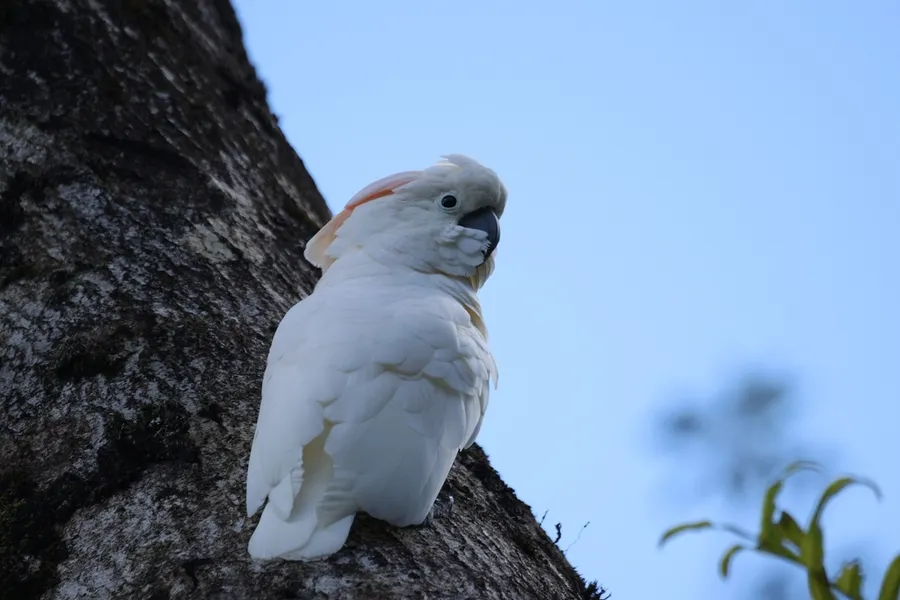
The salmon-crested cockatoo (Cacatua moluccensis) is a large cockatoo with pink-tinged white plumage and a long, backward-curving salmon crest. Mongabay Indonesia and Burung Indonesia give its length as about 46–52 cm. The underwings and undertail are yellowish-orange, the bill is grey-black, and the eye-ring is bluish-white.
BirdLife International notes that it is closely related to the white cockatoo (Cacatua alba) and has no subspecies. According to the World Parrot Trust, males have black eyes and females dark brown eyes.
Evidence: Mongabay Indonesia — Si Burung Cantik yang Terus Diburu (2015) ↗ · BirdLife International (DataZone) — Salmon-crested Cockatoo Cacatua moluccensis species factsheet ↗ · World Parrot Trust — Salmon-crested Cockatoo (Cacatua moluccensis) ↗
Where does the salmon-crested cockatoo live?
The salmon-crested cockatoo lives only in southern Maluku: on Seram and Ambon, and formerly on Saparua and Haruku. BirdLife reports no recent records from Saparua or Haruku and only a small population on Ambon, so almost all remaining birds are on Seram, including Manusela National Park.
It lives in lowland rainforest up to 1,400 m. The highest densities have been found in unlogged primary forest below 180 m, and its numbers are linked to strangler figs and large nesting trees. In the buffer zone of Manusela National Park, cockatoos also feed in villagers' fruit gardens.
Evidence: BirdLife International (DataZone) — Salmon-crested Cockatoo Cacatua moluccensis species factsheet ↗ · IPB University Repository — Pengelolaan Daerah Penyangga Taman Nasional Manusela untuk Konservasi Kakatua Maluku (Cacatua moluccensis) ↗
What does the salmon-crested cockatoo eat?
The salmon-crested cockatoo eats berries, nuts, seeds, coconuts, and insects and their larvae, according to BirdLife International. The World Parrot Trust specifically mentions young coconut (Cocos nucifera) in its diet.
Most of its food comes from lowland forest, but it also visits villagers' fruit gardens right next to Manusela National Park. An IPB University study found that this habit leaves cockatoos in the buffer zone exposed to hunting, because the area outside the park is not well monitored.
Evidence: BirdLife International (DataZone) — Salmon-crested Cockatoo Cacatua moluccensis species factsheet ↗ · World Parrot Trust — Salmon-crested Cockatoo (Cacatua moluccensis) ↗ · IPB University Repository — Pengelolaan Daerah Penyangga Taman Nasional Manusela untuk Konservasi Kakatua Maluku (Cacatua moluccensis) ↗
How does the salmon-crested cockatoo breed?
The salmon-crested cockatoo nests high in tree hollows and lays two eggs, with breeding starting around July–August, according to the World Parrot Trust. In the buffer zone of Manusela National Park, IPB University researchers found nests in four large tree species, including Pometia pinnata and Octomeles sumatrana, all over 50 cm in diameter and 15 m tall.
Outside the breeding season it can gather in groups of up to 16 birds; when breeding it is usually seen alone or in pairs. Like other cockatoos it is long-lived and slow to breed. BirdLife puts its generation length at 21.4 years, so recovery could take many decades.
Evidence: World Parrot Trust — Salmon-crested Cockatoo (Cacatua moluccensis) ↗ · IPB University Repository — Pengelolaan Daerah Penyangga Taman Nasional Manusela untuk Konservasi Kakatua Maluku (Cacatua moluccensis) ↗ · BirdLife International (DataZone) — Salmon-crested Cockatoo Cacatua moluccensis species factsheet ↗
Why is the salmon-crested cockatoo endangered?
The salmon-crested cockatoo is endangered mainly because of heavy trapping for the pet trade, made worse by logging and clearing of lowland forest. BirdLife estimates a 50–79% decline since 1959. An estimated 74,509 birds were exported from Indonesia in 1981–1990, and at least 10,000 a year were taken from Seram in the 1980s.
Reported international trade fell to zero in the 1990s and the species is now on CITES Appendix I, but trapping for the domestic market, mainly supplying Java, continues. BirdLife estimates 20,000–62,000 mature birds (2023). In parts of Manusela National Park density has collapsed to 1.6 birds per km², against 15.28 at a strictly protected site.
Evidence: BirdLife International (DataZone) — Salmon-crested Cockatoo Cacatua moluccensis species factsheet ↗ · World Parrot Trust — Salmon-crested Cockatoo (Cacatua moluccensis) ↗ · Mongabay — On an Indonesian island, an ancient ritual evolves to protect an endangered cockatoo (2026) ↗
How can the salmon-crested cockatoo be protected?
The salmon-crested cockatoo is protected under ministerial regulation P.106/2018, and Indonesian conservation law prohibits capturing or killing it. People can help by not buying cockatoos or their feathers, which were even found for sale online in 2024, and by reporting trade to the BKSDA. BKSDA Maluku releases seized birds, for example seven at Tanjung Sial, West Seram, in 2021.
Community action matters too. The Indigenous Huaulu people of Seram now use naturally shed feathers from rehabilitation centres and zoos for their Cidaku initiation ritual instead of hunting cockatoos. Burung Indonesia warns that wildlife trafficking and habitat loss must be tackled at the same time.
Evidence: JDIH Kementerian Kehutanan — Permen LHK P.106/MENLHK/SETJEN/KUM.1/12/2018 tentang Jenis Tumbuhan dan Satwa yang Dilindungi (PDF, dengan lampiran) ↗ · Mongabay — On an Indonesian island, an ancient ritual evolves to protect an endangered cockatoo (2026) ↗ · Mongabay Indonesia — Satwa-satwa Ini Kembali Hidup Bebas di Pulau Seram (2021) ↗
Explore related habitats
These habitat relationships are supported by species sources in this guide. This is not a complete range map.
Scientific classification of the Salmon-crested cockatoo
| Kingdom | Animalia |
|---|---|
| Phylum | Chordata |
| Class | Aves |
| Order | Psittaciformes |
| Family | Cacatuidae |
| Genus | Cacatua |
| Species | Cacatua moluccensis |
Source: GBIF Backbone Taxonomy, adjusted to the ranks commonly used in school biology (for example class Reptilia).
Common questions about the salmon-crested cockatoo
What is the scientific name of the salmon-crested cockatoo?
The scientific name of the salmon-crested cockatoo is Cacatua moluccensis, in the family Cacatuidae. In Indonesian it is called Kakatua Maluku.
What kind of animal is the salmon-crested cockatoo?
The salmon-crested cockatoo is a bird in the family Cacatuidae. It is also endemic to Indonesia.
Where does the salmon-crested cockatoo live in Indonesia?
In Indonesia, this guide records the salmon-crested cockatoo in: Seram and Ambon, Maluku.
The salmon-crested cockatoo is endemic to Indonesia and lives naturally only in South Moluccas: Seram and Ambon (formerly also Saparua and Haruku). Source: BirdLife DataZone.
Source-supported habitats: Tropical Rainforests.
What does the salmon-crested cockatoo eat?
Diet of the salmon-crested cockatoo: berries, nuts, seeds, coconut, insects and their larvae.
How does the salmon-crested cockatoo reproduce?
The salmon-crested cockatoo reproduces by laying eggs (oviparous). Source: Vigie-Nature École (MNHN).
Is the salmon-crested cockatoo nocturnal?
The cited source records the salmon-crested cockatoo as diurnal (active by day). Source: EltonTraits 1.0 (Wilman et al. 2014, Ecology 95:2027), BirdFuncDat.txt.
See also the list of nocturnal and diurnal animals in Indonesia.
What are the main features of the salmon-crested cockatoo?
Key features of the salmon-crested cockatoo, from this guide’s sources: Key feature: pink-tinged white plumage, backward-curving salmon crest; Body weight: 775–935 g.
How big is the salmon-crested cockatoo?
Body weight: 775–935 g. Source: World Parrot Trust — Salmon-crested Cockatoo (Cacatua moluccensis).
What is the scientific classification of the salmon-crested cockatoo?
Scientific classification of the salmon-crested cockatoo: kingdom Animalia, phylum Chordata, class Aves, order Psittaciformes, family Cacatuidae, genus Cacatua, species Cacatua moluccensis.
Source: GBIF Backbone Taxonomy, adjusted to the ranks commonly used in school biology.
Is the salmon-crested cockatoo endangered?
Yes. On the IUCN Red List, the salmon-crested cockatoo is listed as Endangered: it is considered to face a very high risk of extinction in the wild. Source: IUCN Red List (via GBIF), checked 1 October 2026.
This global category is separate from national legal protection. Is the salmon-crested cockatoo protected in Indonesia?
Is the salmon-crested cockatoo protected in Indonesia?
Yes. The salmon-crested cockatoo (Cacatua moluccensis) is a protected species in Indonesia under Environment and Forestry Ministerial Regulation No. P.106/MENLHK/SETJEN/KUM.1/12/2018 on protected plant and animal species (annex, entry 258).
Article 21(2) of Law No. 5 of 1990, as amended by Law No. 32 of 2024, prohibits anyone from hunting, catching, injuring, killing, storing, owning, keeping, transporting or trading a protected animal, alive or dead, including its body parts, eggs and nests.
If you see this animal being traded, kept or injured, contact the local BKSDA office.
Can the salmon-crested cockatoo be kept as a pet?
No. Because the salmon-crested cockatoo is a protected species, catching, owning, keeping, transporting or trading it without a permit is prohibited by law. Trading without a permit through electronic media is also prohibited.
If you see this animal for sale or being kept, report it to the local BKSDA office.
Compare with similar animals
Sources & references
- BirdLife International (DataZone) — Salmon-crested Cockatoo Cacatua moluccensis species factsheet ↗
- Mongabay Indonesia — Si Burung Cantik yang Terus Diburu (2015) ↗
- World Parrot Trust — Salmon-crested Cockatoo (Cacatua moluccensis) ↗
- IPB University Repository — Pengelolaan Daerah Penyangga Taman Nasional Manusela untuk Konservasi Kakatua Maluku (Cacatua moluccensis) ↗
- Mongabay — On an Indonesian island, an ancient ritual evolves to protect an endangered cockatoo (2026) ↗
- Mongabay Indonesia — Satwa-satwa Ini Kembali Hidup Bebas di Pulau Seram (2021) ↗
- JDIH Kementerian Kehutanan — Permen LHK P.106/MENLHK/SETJEN/KUM.1/12/2018 tentang Jenis Tumbuhan dan Satwa yang Dilindungi (PDF, dengan lampiran) ↗
- Vigie-Nature École (MNHN) ↗
- EltonTraits 1.0 (Wilman et al. 2014, Ecology 95:2027), BirdFuncDat.txt ↗
- GBIF Backbone Taxonomy (GBIF) ↗
- IUCN Red List of Threatened Species, version 2026-1, via GBIF (CC BY 4.0) ↗
References can change. Check dates and context in the original source. How we use sources and data →
National parks where it is recorded
According to the official national park profiles from the KSDAE directorate. The animal may also live elsewhere.
Further reading
Cockatoo: facts, threats and conservation ↗ — World Animal Rescue Network. A broader overview that covers this animal.
Related site: PanduanHewan’s founder is also a director of World Animal Rescue Network.
Cite this page
Credit PanduanHewan when referring to this page. Check the original evidence sources before reusing a claim.
PanduanHewan. Salmon-crested cockatoo (Cacatua moluccensis). Last substantive update: 1 October 2026. https://panduanhewan.org/en/species/salmon-crested-cockatoo/