Quick answer
Crown-of-thorns starfish at a glance
The Crown-of-thorns starfish (Acanthaster planci) is a marine animal in the family Acanthasteridae.
| Scientific name | Acanthaster planci |
|---|---|
| Indonesian name | Bintang laut mahkota duri |
| Group | Marine |
| Family | Acanthasteridae |
| Range in Indonesia | Sulawesi, Kalimantan and Tunda Island (Banten) |
| Linked habitats | Coral Reefs |
| Diet | Living hard corals, especially Acropora |
| Range in Indonesia | Coral reefs; recorded in Sulawesi, Kalimantan and Banten |
| Key feature | Large, many-armed body covered in long, sharp venomous spines |
| Other names | COTS; lipan laut, tayomo (local Indonesian names) |
| Risk to people | Venomous spine wounds: pain, swelling, nausea and vomiting |
In this guide (10)
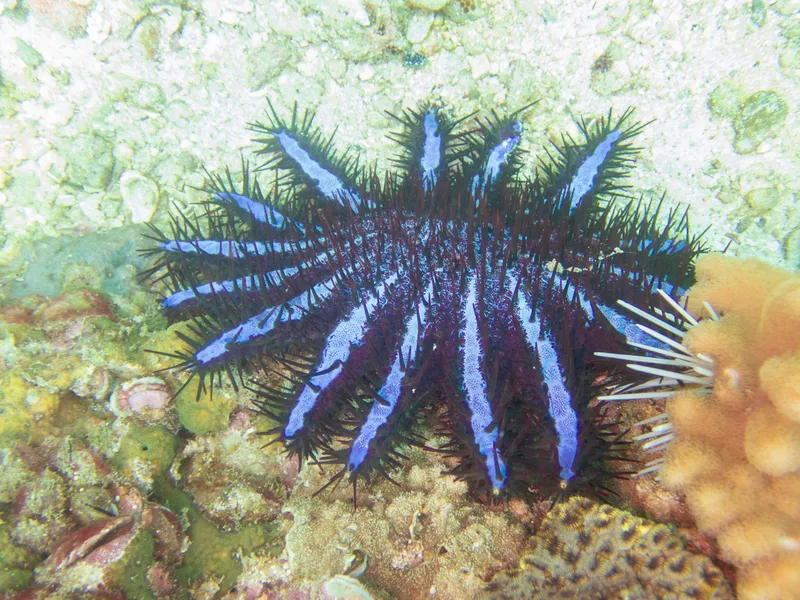
What is the crown-of-thorns starfish?
The crown-of-thorns starfish is a large, coral-eating starfish covered in long, sharp, venomous spines. All Indo-Pacific populations were once treated as one species, Acanthaster planci. Genetic and morphological studies have since revealed at least four species: A. planci in the northern Indian Ocean, A. mauritiensis in the southern Indian Ocean, A. benziei in the Red Sea and A. cf. solaris in the western and central Pacific. Uthicke and colleagues (2024) treat populations in Sulawesi and Kalimantan as A. cf. solaris, while in western Indonesia A. planci and A. cf. solaris occur together. WoRMS still lists A. solaris as a synonym of A. planci, so the older name remains common.
Evidence: Marine Biology (Uthicke et al. 2024, via VLIZ) — The crown-of-thorns seastar species complex: knowledge on the biology and ecology of five corallivorous Acanthaster species ↗ · WoRMS — Acanthaster solaris (Schreber, 1793) ↗ · PeerJ (2023, via PMC) — Crown-of-thorns starfish spines secrete defence proteins ↗
Where does the crown-of-thorns starfish live?
Crown-of-thorns starfish live on coral reefs throughout the Indo-Pacific, including Indonesia. They are usually scarce, but their numbers sometimes explode. The 2024 review by Uthicke and colleagues lists outbreaks in Sulawesi and Kalimantan. In the Togean Islands National Park, Central Sulawesi, residents call the starfish lipan laut and regard it as a reef pest. A 2024 study found 36–117 individuals in the Sombori Islands off Sulawesi, but none at its survey stations in Wakatobi. At Tunda Island in Serang Regency, Banten, one study judged their numbers to be natural and not yet a threat to the reef.
Evidence: Marine Biology (Uthicke et al. 2024, via VLIZ) — The crown-of-thorns seastar species complex: knowledge on the biology and ecology of five corallivorous Acanthaster species ↗ · Mongabay Indonesia (2022) — Bintang Laut Berduri Ini Jadi Musuh Terumbu Karang ↗ · Biodiversitas (2024) — Analysis of environmental parameters supporting the abundance of Acanthaster planci in the Wakatobi and Sombori Marine Protected Areas, Sulawesi, Indonesia ↗
What does the crown-of-thorns starfish eat?
Adult crown-of-thorns starfish feed on the living tissue of hard corals. Acropora corals, including branching and table corals, are usually the preferred prey, but once these are gone other corals are eaten too. According to the 2024 review by Uthicke and colleagues, one adult can consume 161–678 cm² of coral a day and feeds mostly at night. Densities above 10 starfish per hectare are thought to be enough to deplete the coral. Juveniles first graze biofilms and crustose coralline algae, then switch to coral after about 140 days.
Evidence: Marine Biology (Uthicke et al. 2024, via VLIZ) — The crown-of-thorns seastar species complex: knowledge on the biology and ecology of five corallivorous Acanthaster species ↗ · Mongabay Indonesia (2022) — Bintang Laut Berduri Ini Jadi Musuh Terumbu Karang ↗
Why do crown-of-thorns starfish populations explode?
Crown-of-thorns populations can explode because the animals are extremely fertile and their larvae can survive a long time at sea. The 2024 review by Uthicke and colleagues says a single A. cf. solaris female can produce more than 100 million eggs. The larvae drift as plankton for 9–11 days, or more than 40 days when food is scarce, and then settle on crustose coralline algae. Individuals can spawn for the first time at about two years old. The two main suspected causes of outbreaks are fewer predators due to overfishing and nutrient runoff from land that feeds the phytoplankton the larvae eat.
Evidence: Marine Biology (Uthicke et al. 2024, via VLIZ) — The crown-of-thorns seastar species complex: knowledge on the biology and ecology of five corallivorous Acanthaster species ↗ · Mongabay Indonesia (2022) — Bintang Laut Berduri Ini Jadi Musuh Terumbu Karang ↗
Is the crown-of-thorns starfish venomous?
Yes, the spines of the crown-of-thorns starfish are sharp and venomous. A 2023 study in PeerJ says the venom contains saponins and plancitoxin proteins. A spine wound can cause nausea, numbness, vomiting, joint aches and sometimes paralysis. Mongabay Indonesia reports that spine wounds are very painful, can swell for hours or days and may bring on fever. The PeerJ study also notes one documented human death: a woman who died of anaphylactic shock 13 hours after being stung. If you are pricked by its spines, seek medical care at a health facility immediately.
Evidence: PeerJ (2023, via PMC) — Crown-of-thorns starfish spines secrete defence proteins ↗ · Mongabay Indonesia (2022) — Bintang Laut Berduri Ini Jadi Musuh Terumbu Karang ↗
What should you do if you find a crown-of-thorns starfish?
Do not touch, hold or step on a crown-of-thorns starfish, and keep your distance when swimming or diving. Do not try to kill them yourself. Report large numbers to the local protected-area authority, such as the national park office. In the Togean Islands, clean-ups have been run with the Togean Islands National Park office, resort operators and visitors. In 2019, about 8,000 starfish measuring 8–48 cm across were removed from the park with bamboo tongs and collected on boats to avoid direct contact. In the long term, fisheries management and less nutrient runoff from land help prevent outbreaks.
Evidence: Mongabay Indonesia (2022) — Catatan Akhir Tahun: Bintang Laut Berduri Bisa Jadi Ancaman Terumbu Karang Indonesia ↗ · Mongabay Indonesia (2022) — Bintang Laut Berduri Ini Jadi Musuh Terumbu Karang ↗ · Marine Biology (Uthicke et al. 2024, via VLIZ) — The crown-of-thorns seastar species complex: knowledge on the biology and ecology of five corallivorous Acanthaster species ↗
Explore related habitats
These habitat relationships are supported by species sources in this guide. This is not a complete range map.
Common questions about the Crown-of-thorns starfish
What is the scientific name of the Crown-of-thorns starfish?
The scientific name of the Crown-of-thorns starfish is Acanthaster planci, in the family Acanthasteridae. In Indonesian it is called Bintang laut mahkota duri.
Where can the Crown-of-thorns starfish be found in Indonesia?
In Indonesia, this guide records the Crown-of-thorns starfish in: Sulawesi, Kalimantan and Tunda Island (Banten).
Source-supported habitats: Coral Reefs.
What does the Crown-of-thorns starfish eat?
Diet of the Crown-of-thorns starfish: living hard corals, especially Acropora.
Sources & references
- Marine Biology (Uthicke et al. 2024, via VLIZ) — The crown-of-thorns seastar species complex: knowledge on the biology and ecology of five corallivorous Acanthaster species ↗
- WoRMS — Acanthaster solaris (Schreber, 1793) ↗
- PeerJ (2023, via PMC) — Crown-of-thorns starfish spines secrete defence proteins ↗
- Mongabay Indonesia (2022) — Bintang Laut Berduri Ini Jadi Musuh Terumbu Karang ↗
- Mongabay Indonesia (2022) — Catatan Akhir Tahun: Bintang Laut Berduri Bisa Jadi Ancaman Terumbu Karang Indonesia ↗
- Biodiversitas (2024) — Analysis of environmental parameters supporting the abundance of Acanthaster planci in the Wakatobi and Sombori Marine Protected Areas, Sulawesi, Indonesia ↗
References can change. Check dates and context in the original source.
Cite this page
PanduanHewan. (2026, 25 September). Crown-of-thorns starfish (Acanthaster planci). PanduanHewan.org. https://panduanhewan.org/en/species/crown-of-thorns-starfish/