Quick answer
IUCN status: Least ConcernGreater blue-ringed octopus at a glance
The Greater blue-ringed octopus (Hapalochlaena lunulata) is a marine animal in the family Octopodidae. Its IUCN Red List category is Least Concern.
| Scientific name | Hapalochlaena lunulata |
|---|---|
| Indonesian name | Gurita cincin biru |
| Group | Marine |
| Family | Octopodidae |
| Range in Indonesia | Shallow Indonesian waters |
| Linked habitats | Coral Reefs |
| Diet | Crabs, small fish and molluscs |
| Range in Indonesia | Shallow coral reefs and rock pools at low tide |
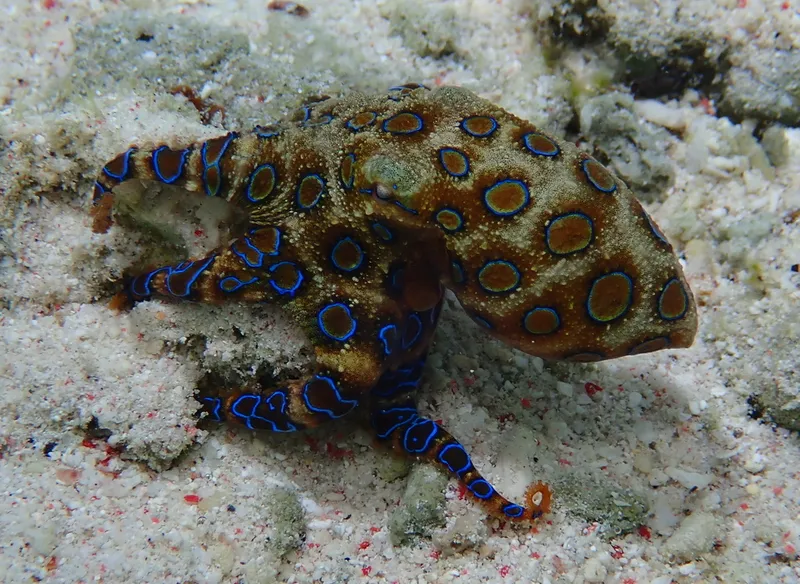
| Key feature | Small yellowish-brown body with large, shimmering blue rings |
| Other names | Gurita cincin biru (Indonesian) |
| Risk to people | Bite carries tetrodotoxin and can kill; no antivenom exists |
| IUCN status | Least Concern · IUCN Red List (via GBIF) · checked 25 September 2026 |
In this guide (10)
What is the greater blue-ringed octopus?
The greater blue-ringed octopus (Hapalochlaena lunulata) is a small octopus known for its bright blue rings and extremely potent venom. SeaLifeBase gives a total length of only about 12 cm, with a mantle of about 5 cm. The body is yellow to dark brown. The blue rings are most striking when the animal is disturbed, hunting or mating; at rest they may not be visible at all. Its larger rings set it apart from its relatives, the southern blue-ringed octopus (H. maculosa) and the blue-lined octopus (H. fasciata).
Evidence: SeaLifeBase — Hapalochlaena lunulata ↗ · Divers Alert Network — Blue-Ringed Octopus ↗ · Animal Diversity Web — Hapalochlaena lunulata (greater blue-ringed octopus) ↗
Where does the greater blue-ringed octopus live?
The greater blue-ringed octopus lives in shallow tropical waters of the western Indo-Pacific, including Indonesia. A 2019 study in Marine Drugs gives its range as Indonesia, the Philippines, Papua New Guinea, Vanuatu, the Solomon Islands and Japan. A researcher at LIPI, Indonesia's former science institute, also named H. lunulata as a blue-ringed octopus that is easy to find in Indonesia, in shallow water less than 30 m deep. It lives on the seabed, on coral reefs and in rock pools at low tide. It hides in rock crevices, inside seashells and even in discarded bottles and cans.
Evidence: Marine Drugs (2019, via PMC) — Toxicity and Toxin Composition of the Greater Blue-Ringed Octopus Hapalochlaena lunulata from Ishigaki Island, Okinawa Prefecture, Japan ↗ · CNN Indonesia (2021) — LIPI Jelaskan 3 Jenis Gurita Cincin Mematikan di Indonesia ↗ · Animal Diversity Web — Hapalochlaena lunulata (greater blue-ringed octopus) ↗
What does the greater blue-ringed octopus eat?
The greater blue-ringed octopus is a predator that feeds mainly on crabs, small fish, molluscs and other small sea animals. Animal Diversity Web says it often ambushes prey from cover or lures it by wriggling an arm tip like a worm. It wraps a captured crab in its arms and pulls it towards its beak. Venom in its saliva subdues the prey. The Marine Drugs study found that the main toxin, tetrodotoxin, is most concentrated in the posterior salivary glands. The entrance to an octopus den is often littered with the shells and legs of crustaceans it has eaten.
Evidence: Animal Diversity Web — Hapalochlaena lunulata (greater blue-ringed octopus) ↗ · Marine Drugs (2019, via PMC) — Toxicity and Toxin Composition of the Greater Blue-Ringed Octopus Hapalochlaena lunulata from Ishigaki Island, Okinawa Prefecture, Japan ↗
How does the greater blue-ringed octopus behave and breed?
The greater blue-ringed octopus lives alone and spends most of its time hiding. According to Divers Alert Network (DAN), it is more active at night and spends the day hidden in its den. It is not aggressive and tends to hide or flee when disturbed. When agitated, its blue rings flash brightly as a warning. After mating, the female lays 60–100 eggs, carries them under her arms and guards them for about 50 days without eating. She dies soon after they hatch. The young hatch as plankton before settling on the seabed.
Evidence: Divers Alert Network — Blue-Ringed Octopus ↗ · Animal Diversity Web — Hapalochlaena lunulata (greater blue-ringed octopus) ↗ · SeaLifeBase — Hapalochlaena lunulata ↗
How dangerous is the greater blue-ringed octopus's venom?
A bite from the greater blue-ringed octopus can kill a person because it carries tetrodotoxin (TTX), a nerve toxin also found in pufferfish. TTX blocks sodium channels in nerve cells, which paralyses muscles. The Marine Drugs study says symptoms include facial numbness and worsening muscle weakness; in the most severe cases, victims die of respiratory failure. The toxin is found in all of the octopus's soft tissues, so it is also dangerous to eat. DAN notes that bites are often painless and that no antivenom exists. If you are bitten, get emergency medical care at a health facility immediately, even if the bite does not hurt.
Evidence: Marine Drugs (2019, via PMC) — Toxicity and Toxin Composition of the Greater Blue-Ringed Octopus Hapalochlaena lunulata from Ishigaki Island, Okinawa Prefecture, Japan ↗ · Divers Alert Network — Blue-Ringed Octopus ↗
What should you do if you find a greater blue-ringed octopus?
Do not touch, hold or pick up a blue-ringed octopus, however small or pretty it looks. Watch it from a safe distance. Animal Diversity Web says it has a reputation for biting only when provoked. DAN notes that bites outside its natural range usually happen when people deliberately handle aquarium specimens. Because the octopus can hide in tiny spaces, do not pick up bottles, cans or shells where it is known to live. In 2021, a video of a tourist in Bali unknowingly holding a blue-ringed octopus caused alarm in Indonesia. If you are bitten, get emergency medical care immediately.
Evidence: Divers Alert Network — Blue-Ringed Octopus ↗ · Animal Diversity Web — Hapalochlaena lunulata (greater blue-ringed octopus) ↗ · CNN Indonesia (2021) — LIPI Jelaskan 3 Jenis Gurita Cincin Mematikan di Indonesia ↗
Explore related habitats
These habitat relationships are supported by species sources in this guide. This is not a complete range map.
Common questions about the Greater blue-ringed octopus
What is the scientific name of the Greater blue-ringed octopus?
The scientific name of the Greater blue-ringed octopus is Hapalochlaena lunulata, in the family Octopodidae. In Indonesian it is called Gurita cincin biru.
Where can the Greater blue-ringed octopus be found in Indonesia?
In Indonesia, this guide records the Greater blue-ringed octopus in: Shallow Indonesian waters.
Source-supported habitats: Coral Reefs.
What does the Greater blue-ringed octopus eat?
Diet of the Greater blue-ringed octopus: crabs, small fish and molluscs.
What is the conservation status of the Greater blue-ringed octopus?
On the IUCN Red List, the Greater blue-ringed octopus is listed as Least Concern: it does not currently qualify for a threatened category in the global assessment. Source: IUCN Red List (via GBIF), checked 25 September 2026.
This global category is separate from legal protection in Indonesia. To check whether the Greater blue-ringed octopus is a protected species, consult the current national list of protected species or contact the local BKSDA (natural resources conservation office).
Sources & references
- SeaLifeBase — Hapalochlaena lunulata ↗
- Animal Diversity Web — Hapalochlaena lunulata (greater blue-ringed octopus) ↗
- Marine Drugs (2019, via PMC) — Toxicity and Toxin Composition of the Greater Blue-Ringed Octopus Hapalochlaena lunulata from Ishigaki Island, Okinawa Prefecture, Japan ↗
- Divers Alert Network — Blue-Ringed Octopus ↗
- CNN Indonesia (2021) — LIPI Jelaskan 3 Jenis Gurita Cincin Mematikan di Indonesia ↗
- IUCN Red List of Threatened Species, version 2026-1, via GBIF (CC BY 4.0) ↗
References can change. Check dates and context in the original source.
Cite this page
PanduanHewan. (2026, 25 September). Greater blue-ringed octopus (Hapalochlaena lunulata). PanduanHewan.org. https://panduanhewan.org/en/species/greater-blue-ringed-octopus/