Quick answer
IUCN status: VulnerableLoggerhead turtle at a glance
The loggerhead turtle (Caretta caretta) is a marine animal in the family Cheloniidae. Range in Indonesia: Komodo Island, the Thousand Islands, the Java Sea and eastern Indonesian waters. Diet: shellfish, snails, crabs, sea urchins and jellyfish; a carnivore. IUCN Red List status: Vulnerable. It is a legally protected species in Indonesia (Regulation P.106/2018).
| Scientific name | Caretta caretta |
|---|---|
| Indonesian name | Penyu tempayan |
| Group | Marine |
| Family | Cheloniidae |
| Range in Indonesia | Komodo Island, the Thousand Islands, the Java Sea and eastern Indonesian waters |
| Linked habitats | Coral Reefs |
| Diet | Shellfish, snails, crabs, sea urchins and jellyfish |
| Range in Indonesia | Very rare; recorded at Komodo Island and the Thousand Islands |
| Key feature | Large head; reddish-brown shell with five pairs of costal scutes |
| Other names | Loggerhead sea turtle; penyu tempayan, penyu bromo (Indonesian) |
| IUCN status | Vulnerable · IUCN Red List (via GBIF) · checked 1 October 2026 |
| Legal protection in Indonesia | Protected · Regulation P.106/2018 · annex no. 700 |
| Diet type | Carnivore (meat-eater) — eats hard-shelled prey (clams, snails, crabs) and other invertebrates · Animal Diversity Web |
| Reproduction | Laying eggs (oviparous) · Reptile Database |
| Venom or poison | Not venomous, but can cause poisoning if eaten · Pavlin et al. 2015, Mass poisoning after consumption of a hawksbill turtle, Federated States of Micronesia, 2010 (Western Pac Surveill Response J) |
| Observance days | World Turtle Day (23 May) |
| Active | Cathemeral (active irregularly by day and night) · ReptTraits v1-2 (Oskyrko et al. 2024, Scientific Data 11:243), column 'Active time' |
In this guide (12)
What is the loggerhead turtle?
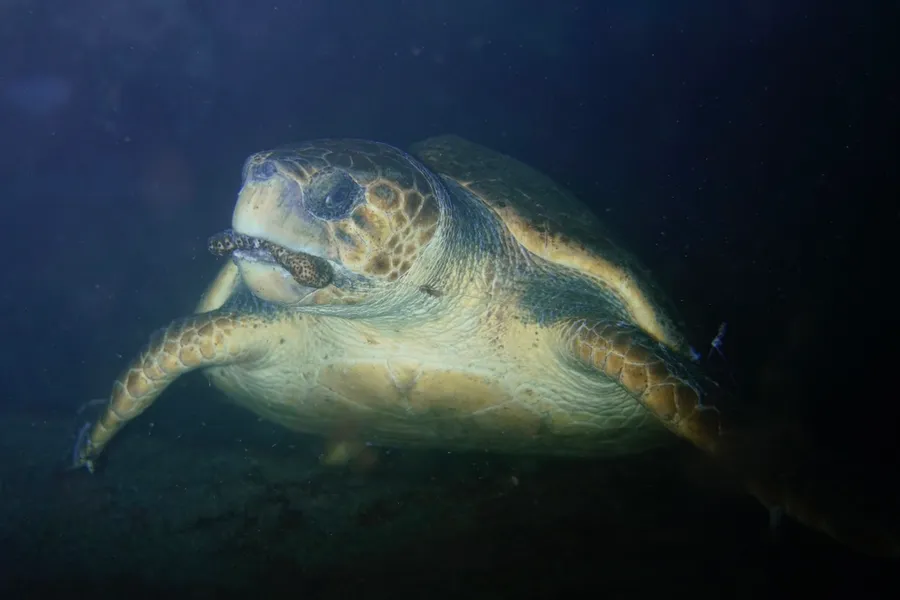
The loggerhead turtle (Caretta caretta) is a hard-shelled sea turtle known for its large head and powerful jaws. Its slightly heart-shaped carapace is reddish brown, and its skin is yellow to brown. NOAA Fisheries gives adult sizes of 2.5–3.5 feet (about 76–107 cm) and 200–350 pounds (about 90–160 kg). In Indonesian it is also called penyu bromo. It can be confused with other sea turtles, so check the scutes. The loggerhead has five pairs of costal scutes, while green and hawksbill turtles have four. It has three pairs of inframarginal scutes on the plastron, while ridley turtles have four.
Evidence: NOAA Fisheries — Loggerhead Turtle ↗ · Kementerian Kelautan dan Perikanan (JDIH KKP) — Keputusan Menteri Kelautan dan Perikanan Nomor 66 Tahun 2025 tentang Jenis Ikan yang Dilindungi ↗ · Animal Diversity Web — Caretta caretta (loggerhead sea turtle) ↗
Where does the loggerhead turtle live?
Loggerheads live in subtropical and temperate waters of the Atlantic, Pacific and Indian oceans, but they are very rare in Indonesian waters. The annex to KKP Decree 66/2025 says the species has been reported at Komodo Island and that no loggerhead nesting beach is known in Indonesia. On 10 July 2025, a female was found in the waters of the Thousand Islands National Park. Loggerheads seen in Indonesia are thought to come from populations that nest in Australia. Females tagged on Queensland nesting beaches have been recovered in Indonesia, and turtles from Western Australia forage as far as the Java Sea.
Evidence: Kementerian Kelautan dan Perikanan (JDIH KKP) — Keputusan Menteri Kelautan dan Perikanan Nomor 66 Tahun 2025 tentang Jenis Ikan yang Dilindungi ↗ · Fakultas Perikanan dan Kelautan Universitas Airlangga (2025) — Loggerhead Turtle Found in the Thousand Islands National Park Waters ↗ · Queensland Environmental Protection Agency (Limpus 2008; copy hosted by George H. Balazs) — A Biological Review of Australian Marine Turtles. 1. Loggerhead Turtle, Caretta caretta ↗
What does the loggerhead turtle eat?
Loggerheads feed mainly on hard-shelled animals such as shellfish, snails, crabs and sea urchins. Their powerful jaws crush the shells of their prey. The Queensland Government says they also eat jellyfish and forage on the seabed, from intertidal shallows down to about 80 m. Animal Diversity Web describes them as dietary generalists that also take sponges, squid, shrimp, fish and small amounts of algae. Young loggerheads in the open ocean feed on floating items. There, NOAA Fisheries notes, small pieces of plastic are often mistaken for food and swallowed.
Evidence: Queensland Government — Loggerhead turtle ↗ · Animal Diversity Web — Caretta caretta (loggerhead sea turtle) ↗ · NOAA Fisheries — Loggerhead Turtle ↗
How do loggerhead turtles breed and migrate?
Loggerheads grow slowly and migrate long distances between feeding grounds and nesting beaches. NOAA Fisheries says females mature at about 35 years of age and then nest every 2–3 years. In one season a female lays 3–5 nests about two weeks apart, each with about 100 eggs. The eggs hatch after about two months, and sand temperature decides the sex of the hatchlings. Hatchlings and juveniles spend their first 7–15 years in the open ocean. According to the Queensland Government, hatchlings from Queensland disperse as far as South America before returning to the south-west Pacific.
Evidence: NOAA Fisheries — Loggerhead Turtle ↗ · Queensland Government — Loggerhead turtle ↗
Why is the loggerhead turtle threatened?
The biggest threat to loggerheads worldwide is bycatch, their accidental capture in fishing gear. NOAA Fisheries names trawls, longlines, gillnets and hook-and-line gear as the main problems. A 2008 review by Colin Limpus recorded large juvenile loggerheads being killed by Japanese tuna longliners off Western Australia and further north in Indonesian waters. Other threats include hunting for meat and eggs, swallowed plastic, boat strikes and the loss of nesting beaches. Beachfront lights can also lead hatchlings inland instead of out to sea.
Evidence: NOAA Fisheries — Loggerhead Turtle ↗ · Queensland Environmental Protection Agency (Limpus 2008; copy hosted by George H. Balazs) — A Biological Review of Australian Marine Turtles. 1. Loggerhead Turtle, Caretta caretta ↗
What should you do if you see a loggerhead turtle?
If you see a loggerhead, watch it from a safe distance and do not touch, feed or catch it. The species is fully protected under KKP Decree 66/2025 and is listed in the annex to Environment Regulation P.106/2018. This protection covers every life stage, including body parts and products made from them, so do not buy turtle eggs, meat or crafts. Slow down when boating in waters where turtles live. If you find a stranded, injured or entangled turtle, report it to local conservation officers so that trained responders can help.
Evidence: Kementerian Kelautan dan Perikanan (JDIH KKP) — Keputusan Menteri Kelautan dan Perikanan Nomor 66 Tahun 2025 tentang Jenis Ikan yang Dilindungi ↗ · JDIH Kementerian Kehutanan — Permen LHK P.106/MENLHK/SETJEN/KUM.1/12/2018 tentang Jenis Tumbuhan dan Satwa yang Dilindungi (PDF, dengan lampiran) ↗ · NOAA Fisheries — Loggerhead Turtle ↗
Explore related habitats
These habitat relationships are supported by species sources in this guide. This is not a complete range map.
Scientific classification of the Loggerhead turtle
| Kingdom | Animalia |
|---|---|
| Phylum | Chordata |
| Class | Reptilia |
| Order | Testudines |
| Family | Cheloniidae |
| Genus | Caretta |
| Species | Caretta caretta |
Source: GBIF Backbone Taxonomy, adjusted to the ranks commonly used in school biology (for example class Reptilia).
Common questions about the loggerhead turtle
What is the scientific name of the loggerhead turtle?
The scientific name of the loggerhead turtle is Caretta caretta, in the family Cheloniidae. In Indonesian it is called Penyu tempayan.
What kind of animal is the loggerhead turtle?
The loggerhead turtle is a marine animal in the family Cheloniidae. By diet it is a carnivore (meat-eater): a eats hard-shelled prey (clams, snails, crabs) and other invertebrates.
Where does the loggerhead turtle live in Indonesia?
In Indonesia, this guide records the loggerhead turtle in: Komodo Island, the Thousand Islands, the Java Sea and eastern Indonesian waters.
Source-supported habitats: Coral Reefs.
What does the loggerhead turtle eat?
Diet of the loggerhead turtle: shellfish, snails, crabs, sea urchins and jellyfish. That makes it a carnivore (meat-eater). Source: Animal Diversity Web.
How does the loggerhead turtle reproduce?
The loggerhead turtle reproduces by laying eggs (oviparous). Source: Reptile Database.
Is the loggerhead turtle poisonous?
Only if eaten. Sea turtles are not venomous, but eating turtle meat has caused fatal mass poisonings (chelonitoxism). Source: Pavlin et al. 2015, Mass poisoning after consumption of a hawksbill turtle, Federated States of Micronesia, 2010 (Western Pac Surveill Response J).
Do not catch, handle or disturb wild animals. If bitten, stung or exposed to its toxins, go to the nearest health facility straight away.
Is the loggerhead turtle nocturnal?
The cited source records the loggerhead turtle as cathemeral (active irregularly by day and night). Source: ReptTraits v1-2 (Oskyrko et al. 2024, Scientific Data 11:243), column 'Active time'.
See also the list of nocturnal and diurnal animals in Indonesia.
What are the main features of the loggerhead turtle?
Key features of the loggerhead turtle, from this guide’s sources: Key feature: large head; reddish-brown shell with five pairs of costal scutes.
What is the scientific classification of the loggerhead turtle?
Scientific classification of the loggerhead turtle: kingdom Animalia, phylum Chordata, class Reptilia, order Testudines, family Cheloniidae, genus Caretta, species Caretta caretta.
Source: GBIF Backbone Taxonomy, adjusted to the ranks commonly used in school biology.
Is the loggerhead turtle endangered?
Yes. On the IUCN Red List, the loggerhead turtle is listed as Vulnerable: it is considered to face a high risk of extinction in the wild. Source: IUCN Red List (via GBIF), checked 1 October 2026.
This global category is separate from national legal protection. Is the loggerhead turtle protected in Indonesia?
Is the loggerhead turtle protected in Indonesia?
Yes. The loggerhead turtle (Caretta caretta) is a protected species in Indonesia under Environment and Forestry Ministerial Regulation No. P.106/MENLHK/SETJEN/KUM.1/12/2018 on protected plant and animal species (annex, entry 700).
It is also fully protected under Marine Affairs and Fisheries Ministerial Decree No. 66 of 2025 on protected fish species (first provision, entry 38).
Article 21(2) of Law No. 5 of 1990, as amended by Law No. 32 of 2024, prohibits anyone from hunting, catching, injuring, killing, storing, owning, keeping, transporting or trading a protected animal, alive or dead, including its body parts, eggs and nests.
If you see this animal being traded, kept or injured, contact the local BKSDA office.
Can the loggerhead turtle be kept as a pet?
No. Because the loggerhead turtle is a protected species, catching, owning, keeping, transporting or trading it without a permit is prohibited by law. Trading without a permit through electronic media is also prohibited.
If you see this animal for sale or being kept, report it to the local BKSDA office.
Sources & references
- Kementerian Kelautan dan Perikanan (JDIH KKP) — Keputusan Menteri Kelautan dan Perikanan Nomor 66 Tahun 2025 tentang Jenis Ikan yang Dilindungi ↗
- JDIH Kementerian Kehutanan — Permen LHK P.106/MENLHK/SETJEN/KUM.1/12/2018 tentang Jenis Tumbuhan dan Satwa yang Dilindungi (PDF, dengan lampiran) ↗
- NOAA Fisheries — Loggerhead Turtle ↗
- Animal Diversity Web — Caretta caretta (loggerhead sea turtle) ↗
- Queensland Environmental Protection Agency (Limpus 2008; copy hosted by George H. Balazs) — A Biological Review of Australian Marine Turtles. 1. Loggerhead Turtle, Caretta caretta ↗
- Queensland Government — Loggerhead turtle ↗
- Fakultas Perikanan dan Kelautan Universitas Airlangga (2025) — Loggerhead Turtle Found in the Thousand Islands National Park Waters ↗
- Reptile Database ↗
- ReptTraits v1-2 (Oskyrko et al. 2024, Scientific Data 11:243), column 'Active time' ↗
- Pavlin et al. 2015, Mass poisoning after consumption of a hawksbill turtle, Federated States of Micronesia, 2010 (Western Pac Surveill Response J) ↗
- GBIF Backbone Taxonomy (GBIF) ↗
- IUCN Red List of Threatened Species, version 2026-1, via GBIF (CC BY 4.0) ↗
References can change. Check dates and context in the original source. How we use sources and data →
Related causes and news
Help from outside Indonesia
If you live outside Indonesia, you can help sea turtles with rescue and beach protection with World Animal Rescue Network.
Related site: PanduanHewan’s founder is also a director of World Animal Rescue Network. PanduanHewan itself does not accept donations, and this invitation is not directed at people in Indonesia.
Further reading
Sea turtle: facts, threats and conservation ↗ — World Animal Rescue Network. A broader overview that covers this animal.
Related site: PanduanHewan’s founder is also a director of World Animal Rescue Network.
Cite this page
Credit PanduanHewan when referring to this page. Check the original evidence sources before reusing a claim.
PanduanHewan. Loggerhead turtle (Caretta caretta). Last substantive update: 1 October 2026. https://panduanhewan.org/en/species/loggerhead-turtle/