Quick answer
IUCN status: Critically EndangeredGiant clam at a glance
The Giant clam (Tridacna gigas) is a marine animal in the family Cardiidae. Its IUCN Red List category is Critically Endangered.
| Scientific name | Tridacna gigas |
|---|---|
| Indonesian name | Kima raksasa |
| Group | Marine |
| Family | Cardiidae |
| Range in Indonesia | Raja Ampat, Cenderawasih Bay, North Sulawesi (Manado) and the Kei Islands; now very rare |
| Linked habitats | Coral Reefs |
| Diet | Products of symbiotic algae, plus filtered plankton |
| Range in Indonesia | Shallow reefs; remaining populations mainly in Raja Ampat |
| Key feature | Shell up to 137 cm with four to six deep folds |
| Other names | True giant clam, kima raksasa |
| IUCN status | Critically Endangered · IUCN Red List (via GBIF) · checked 25 September 2026 |
In this guide (10)
What is the giant clam?
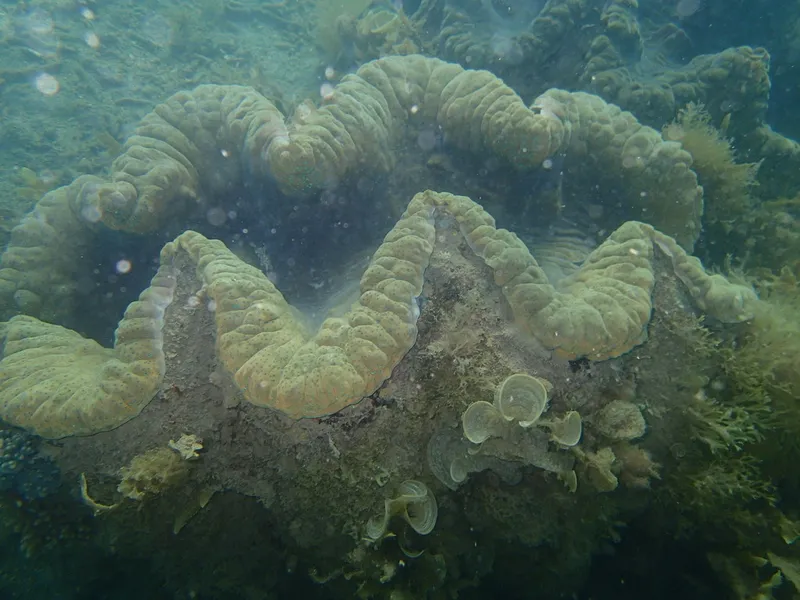
The giant clam (Tridacna gigas) is the world's largest bivalve, with a shell up to 137 cm long and a weight of more than 225 kg. Most individuals are about 80 cm long. The shell is thick, heavy and off-white, with four to six deep radial folds that form triangular points along its upper edge. The mantle is yellowish brown to olive green and dotted with many small, brilliant blue-green rings. Adults are free-living and not attached by byssal threads. According to Indonesia's fisheries ministry (KKP), Indonesia has seven giant clam species, including this one.
Evidence: NOAA Fisheries (2024) — Status Review Report of Seven Giant Clam Species Petitioned Under the U.S. Endangered Species Act ↗ · NOAA Fisheries — True Giant Clam ↗ · Kementerian Kelautan dan Perikanan (PPID KKP) — Poster Jenis-jenis Kima di Indonesia ↗
Where does the giant clam live?
Giant clams live on shallow Indo-Pacific coral reefs, from Myanmar to Kiribati and from Japan's Ryukyu Islands to Queensland, Australia. They are usually found at 2–20 metres, among hard corals such as Acropora, on reef rock or on sand. According to NOAA's 2024 status review, the species is now extremely rare across most of Indonesia and has been reported as gone from eastern Sumatra, Java and western Indonesia. Surveys around Manado and Kei Kecil each found only one clam. Raja Ampat is seen as one of the last strongholds for giant clams in Indonesia, and a few were also recorded in Cenderawasih Bay.
Evidence: NOAA Fisheries — True Giant Clam ↗ · NOAA Fisheries (2024) — Status Review Report of Seven Giant Clam Species Petitioned Under the U.S. Endangered Species Act ↗
What does the giant clam eat?
Giant clams get most of their food from microscopic algae (zooxanthellae) that live in their mantle tissue and photosynthesise. This is why they need clear water and sunlight. They also filter phytoplankton and zooplankton from seawater with their gills. According to NOAA's review, small clams of about 4 cm can get up to 65 per cent of their carbon from filter feeding, while large adults can probably meet all their respiratory carbon and nitrogen needs from their algal partners. ADW notes that the partnership is essential: a giant clam dies without its zooxanthellae or if kept in the dark.
Evidence: NOAA Fisheries (2024) — Status Review Report of Seven Giant Clam Species Petitioned Under the U.S. Endangered Species Act ↗ · Animal Diversity Web — Tridacna gigas ↗ · SeaLifeBase — Tridacna gigas, Giant clam ↗
How does the giant clam reproduce?
Giant clams breed by releasing sperm and eggs into the sea, where fertilisation takes place. They are hermaphrodites: according to NOAA, they mature as males at about six years old and start producing eggs at 9–10 years. One clam can release about 500 million eggs in a single spawning. Yet fewer than 1 per cent of fertilised eggs survive the larval stage. The larvae swim in open water before settling on sand or coral rubble. Giant clams grow 8–12 cm a year, and the oldest reliably aged individual was 63 years old.
Evidence: NOAA Fisheries (2024) — Status Review Report of Seven Giant Clam Species Petitioned Under the U.S. Endangered Species Act ↗ · Animal Diversity Web — Tridacna gigas ↗ · SeaLifeBase — Tridacna gigas, Giant clam ↗
Why is the giant clam becoming so rare?
Giant clams have become rare mainly because of decades of overharvesting for their meat and shells. The IUCN assessed the species as Critically Endangered in 2024, and it is listed on CITES Appendix II. NOAA's review notes that in 2018 Indonesia exported 59,000 wild-caught giant clam shells to China, even though Indonesian populations were already very low. In 2024 NOAA also proposed listing the species as endangered under the US Endangered Species Act. Because so few larvae survive, very few young clams are added to wild populations naturally.
Evidence: NOAA Fisheries (2024) — Status Review Report of Seven Giant Clam Species Petitioned Under the U.S. Endangered Species Act ↗ · SeaLifeBase — Tridacna gigas, Giant clam ↗ · NOAA Fisheries — True Giant Clam ↗
What should you do if you see a giant clam?
If you see a giant clam while diving or snorkelling, enjoy it without touching it, standing on it or trying to lift it. Giant clams are not dangerous: ADW says there are no authentic cases of people being trapped and drowned by one, because they close their shells slowly. Injuries happen instead when people try to lift large, very heavy clams out of the water. Do not take live clams from the wild, and do not buy clam meat, shells or shell crafts. Aquaculture trials to restock reefs are under way, but the clams still living on reefs need protecting too.
Evidence: Animal Diversity Web — Tridacna gigas ↗ · SeaLifeBase — Tridacna gigas, Giant clam ↗
Explore related habitats
These habitat relationships are supported by species sources in this guide. This is not a complete range map.
Common questions about the Giant clam
What is the scientific name of the Giant clam?
The scientific name of the Giant clam is Tridacna gigas, in the family Cardiidae. In Indonesian it is called Kima raksasa.
Where can the Giant clam be found in Indonesia?
In Indonesia, this guide records the Giant clam in: Raja Ampat, Cenderawasih Bay, North Sulawesi (Manado) and the Kei Islands; now very rare.
Source-supported habitats: Coral Reefs.
What does the Giant clam eat?
Diet of the Giant clam: products of symbiotic algae, plus filtered plankton.
What is the conservation status of the Giant clam?
On the IUCN Red List, the Giant clam is listed as Critically Endangered: it is considered to face an extremely high risk of extinction in the wild. Source: IUCN Red List (via GBIF), checked 25 September 2026.
This global category is separate from legal protection in Indonesia. To check whether the Giant clam is a protected species, consult the current national list of protected species or contact the local BKSDA (natural resources conservation office).
Sources & references
- SeaLifeBase — Tridacna gigas, Giant clam ↗
- NOAA Fisheries — True Giant Clam ↗
- NOAA Fisheries (2024) — Status Review Report of Seven Giant Clam Species Petitioned Under the U.S. Endangered Species Act ↗
- Animal Diversity Web — Tridacna gigas ↗
- Kementerian Kelautan dan Perikanan (PPID KKP) — Poster Jenis-jenis Kima di Indonesia ↗
- IUCN Red List of Threatened Species, version 2026-1, via GBIF (CC BY 4.0) ↗
References can change. Check dates and context in the original source.
Further reading
Giant clam: facts, threats and conservation ↗ — World Animal Rescue Network.
Cite this page
PanduanHewan. (2026, 25 September). Giant clam (Tridacna gigas). PanduanHewan.org. https://panduanhewan.org/en/species/giant-clam/