Quick answer
IUCN status: EndangeredHumphead wrasse at a glance
The humphead wrasse (Cheilinus undulatus) is a marine animal in the family Labridae. Range in Indonesia: Riau Islands (Natuna, Anambas), Thousand Islands, Karimunjawa, Bangka Belitung, Derawan, Nunukan, Sulawesi and Wakatobi. Diet: molluscs, sea urchins, crustaceans, fish and crown-of-thorns starfish; a carnivore. IUCN Red List status: Endangered. It is under limited legal protection in Indonesia (Fisheries Decree 37/2013).
| Scientific name | Cheilinus undulatus |
|---|---|
| Indonesian name | Ikan napoleon |
| Group | Marine |
| Family | Labridae |
| Range in Indonesia | Riau Islands (Natuna, Anambas), Thousand Islands, Karimunjawa, Bangka Belitung, Derawan, Nunukan, Sulawesi and Wakatobi |
| Linked habitats | Coral Reefs |
| Diet | Molluscs, sea urchins, crustaceans, fish and crown-of-thorns starfish |
| Range in Indonesia | Coral reefs from Natuna and Anambas to Wakatobi |
| Key feature | Large forehead hump and thick lips in adults |
| Other names | Napoleon wrasse, Maori wrasse, ikan napoleon |
| IUCN status | Endangered · IUCN Red List (via GBIF) · checked 1 October 2026 |
| Legal protection in Indonesia | Limited protection · Fisheries Decree 37/2013 |
| Diet type | Carnivore (meat-eater) — predator of molluscs, fish, sea urchins and crustaceans, including crown-of-thorns starfish · FishBase |
| Reproduction | Laying eggs (oviparous) · FishBase |
| Venom or poison | Not venomous, but can cause poisoning if eaten · FishBase: Cheilinus undulatus species summary |
| Active | Diurnal (active by day) · Cheilinus undulatus, Humphead wrasse, species summary, FishBase |
In this guide (12)
What is the humphead wrasse?
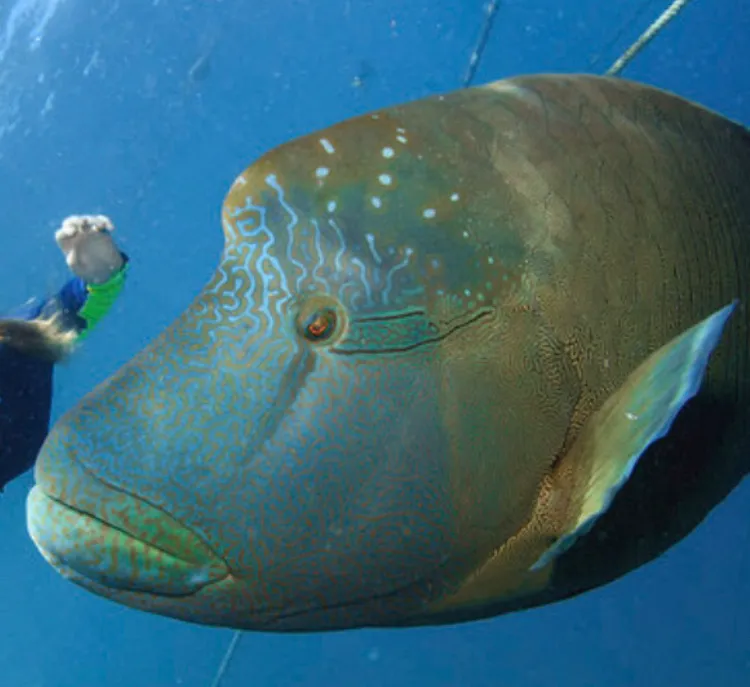
The humphead wrasse (Cheilinus undulatus) is the largest member of the wrasse family (Labridae), reaching 2 metres and 190 kg according to Indonesia's fisheries ministry (KKP). Adults have a large hump on the forehead, thick lips and two black lines behind each eye. Males are bright green to bluish with wavy lines on the head, while females are greyish, reddish or dull brown. Juveniles are pale green with dark lines on their scales. Local names vary, including maming in the Thousand Islands and Sulawesi, mengkait in Natuna and ketipas in Anambas. FishBase gives a maximum recorded age of 32 years.
Evidence: Kementerian Kelautan dan Perikanan (via JDIH BPK) — Keputusan Menteri Kelautan dan Perikanan Nomor 37/KEPMEN-KP/2013 tentang Penetapan Status Perlindungan Ikan Napoleon (Cheilinus undulatus) ↗ · FishBase — Cheilinus undulatus, Humphead wrasse ↗
Where does the humphead wrasse live?
The humphead wrasse lives on Indo-Pacific coral reefs, from the Red Sea and South Africa to the Tuamotu Islands. Adults prefer steep outer reef slopes, channels and lagoon reefs at about 2–60 metres, and KKP records them down to 100 metres. Juveniles live in coral-rich lagoons, especially among branching Acropora corals, and in seagrass beds and mangroves next to reefs. In Indonesia, its local names are recorded from Natuna, Anambas, the Thousand Islands, Bangka Belitung, Karimunjawa, Derawan, Sulawesi and Nunukan. It also occurs in Wakatobi National Park, Southeast Sulawesi, although fishers say it is becoming rarer.
Evidence: FishBase — Cheilinus undulatus, Humphead wrasse ↗ · Kementerian Kelautan dan Perikanan (via JDIH BPK) — Keputusan Menteri Kelautan dan Perikanan Nomor 37/KEPMEN-KP/2013 tentang Penetapan Status Perlindungan Ikan Napoleon (Cheilinus undulatus) ↗ · Mongabay Indonesia (2022) — Perburuan Ikan Napoleon: Ditangkap di Wakatobi, Transit di Bali, Jadi Sup di Hongkong (1) ↗
What does the humphead wrasse eat?
The humphead wrasse eats mainly molluscs, fish, sea urchins, crustaceans and other invertebrates. According to FishBase, it is one of the few predators of toxic animals such as sea hares, boxfishes and crown-of-thorns starfish. Its jaws and lips are prominent, with two strong canine teeth at the front of each jaw. KKP also notes that it favours reefs rich in sea urchins, molluscs and crustaceans. By day it roams across the reef to feed, and at night it rests in reef caves or under coral ledges.
Evidence: FishBase — Cheilinus undulatus, Humphead wrasse ↗ · Kementerian Kelautan dan Perikanan (via JDIH BPK) — Keputusan Menteri Kelautan dan Perikanan Nomor 37/KEPMEN-KP/2013 tentang Penetapan Status Perlindungan Ikan Napoleon (Cheilinus undulatus) ↗
How does the humphead wrasse reproduce?
The humphead wrasse is a protogynous hermaphrodite: fish start life as females, and some later change into males. According to KKP, the sex change happens at around 55–75 cm. The species lays eggs and forms distinct pairs when spawning. Day to day, humphead wrasse live alone, in pairs or in small groups of three to seven. KKP also links size and weight: a 1 kg fish is about 38 cm long, while a 3 kg fish is about 55 cm. These figures matter because Indonesia's protection rules are set by the weight of the fish.
Evidence: Kementerian Kelautan dan Perikanan (via JDIH BPK) — Keputusan Menteri Kelautan dan Perikanan Nomor 37/KEPMEN-KP/2013 tentang Penetapan Status Perlindungan Ikan Napoleon (Cheilinus undulatus) ↗ · FishBase — Cheilinus undulatus, Humphead wrasse ↗
Why is the humphead wrasse threatened?
The humphead wrasse is threatened mainly by overfishing for the live reef fish trade, with Hong Kong as the main market. The IUCN lists it as Endangered, and since 2004 it has been on CITES Appendix II, so exports need quotas and permits. In Natuna and Anambas, wrasse are grown in floating net cages and exported alive to Hong Kong. A 2022 Mongabay investigation found fishers in Wakatobi spearing sleeping wrasse at night. The fish were then smuggled through Baubau, Kendari, Makassar or Bali. FishBase also records reports of ciguatera poisoning from eating this fish.
Evidence: FishBase — Cheilinus undulatus, Humphead wrasse ↗ · Mongabay Indonesia (2018) — Kenapa Natuna dan Anambas Ekspor Napoleon Kembali lewat Laut? ↗ · Mongabay Indonesia (2022) — Perburuan Ikan Napoleon: Ditangkap di Wakatobi, Transit di Bali, Jadi Sup di Hongkong (1) ↗
How can we protect the humphead wrasse?
The humphead wrasse has limited protection in Indonesia under Decree No. 37/KEPMEN-KP/2013 of the Minister of Marine Affairs and Fisheries. Fish of 100 grams to 1 kg and fish over 3 kg are protected, so only fish of 1–3 kg may be used, except for research and development. The managers of Wakatobi National Park go further and ban catching or selling the species at any size. You can help by not buying or ordering humphead wrasse in restaurants and markets, not spearing it while diving, and reporting illegal trade to fisheries officers. Divers should enjoy it from a safe distance without chasing it.
Evidence: Kementerian Kelautan dan Perikanan (via JDIH BPK) — Keputusan Menteri Kelautan dan Perikanan Nomor 37/KEPMEN-KP/2013 tentang Penetapan Status Perlindungan Ikan Napoleon (Cheilinus undulatus) ↗ · Mongabay Indonesia (2022) — Perburuan Ikan Napoleon: Ditangkap di Wakatobi, Transit di Bali, Jadi Sup di Hongkong (1) ↗
Explore related habitats
These habitat relationships are supported by species sources in this guide. This is not a complete range map.
Scientific classification of the Humphead wrasse
| Kingdom | Animalia |
|---|---|
| Phylum | Chordata |
| Class | Actinopterygii |
| Order | Perciformes |
| Family | Labridae |
| Genus | Cheilinus |
| Species | Cheilinus undulatus |
Source: GBIF Backbone Taxonomy, adjusted to the ranks commonly used in school biology (for example class Reptilia).
Common questions about the humphead wrasse
What is the scientific name of the humphead wrasse?
The scientific name of the humphead wrasse is Cheilinus undulatus, in the family Labridae. In Indonesian it is called Ikan napoleon.
What kind of animal is the humphead wrasse?
The humphead wrasse is a marine animal in the family Labridae. By diet it is a carnivore (meat-eater): a predator of molluscs, fish, sea urchins and crustaceans, including crown-of-thorns starfish.
Where does the humphead wrasse live in Indonesia?
In Indonesia, this guide records the humphead wrasse in: Riau Islands (Natuna, Anambas), Thousand Islands, Karimunjawa, Bangka Belitung, Derawan, Nunukan, Sulawesi and Wakatobi.
Source-supported habitats: Coral Reefs.
What does the humphead wrasse eat?
Diet of the humphead wrasse: molluscs, sea urchins, crustaceans, fish and crown-of-thorns starfish. That makes it a carnivore (meat-eater). Source: FishBase.
How does the humphead wrasse reproduce?
The humphead wrasse reproduces by laying eggs (oviparous). Source: FishBase.
Is the humphead wrasse poisonous?
Only if eaten. Not venomous, but its flesh has been linked to ciguatera poisoning. Source: FishBase: Cheilinus undulatus species summary.
Do not catch, handle or disturb wild animals. If bitten, stung or exposed to its toxins, go to the nearest health facility straight away.
Is the humphead wrasse nocturnal?
The cited source records the humphead wrasse as diurnal (active by day). Source: Cheilinus undulatus, Humphead wrasse, species summary, FishBase.
See also the list of nocturnal and diurnal animals in Indonesia.
What are the main features of the humphead wrasse?
Key features of the humphead wrasse, from this guide’s sources: Key feature: large forehead hump and thick lips in adults.
What is the scientific classification of the humphead wrasse?
Scientific classification of the humphead wrasse: kingdom Animalia, phylum Chordata, class Actinopterygii, order Perciformes, family Labridae, genus Cheilinus, species Cheilinus undulatus.
Source: GBIF Backbone Taxonomy, adjusted to the ranks commonly used in school biology.
Is the humphead wrasse endangered?
Yes. On the IUCN Red List, the humphead wrasse is listed as Endangered: it is considered to face a very high risk of extinction in the wild. Source: IUCN Red List (via GBIF), checked 1 October 2026.
This global category is separate from national legal protection. Is the humphead wrasse protected in Indonesia?
Is the humphead wrasse protected in Indonesia?
Yes. The humphead wrasse (Cheilinus undulatus) is under limited protection in Indonesia under Marine Affairs and Fisheries Ministerial Decree No. 37/KEPMEN-KP/2013 on the protection status of the humphead wrasse (Cheilinus undulatus).
Protection is limited by size: humphead wrasse weighing 100–1,000 g or more than 3 kg are protected; fish of 1–3 kg may be used under quota.
If you see this animal being traded, kept or injured, contact the local BKSDA office or the local marine and fisheries office.
Sources & references
- FishBase — Cheilinus undulatus, Humphead wrasse ↗
- Kementerian Kelautan dan Perikanan (via JDIH BPK) — Keputusan Menteri Kelautan dan Perikanan Nomor 37/KEPMEN-KP/2013 tentang Penetapan Status Perlindungan Ikan Napoleon (Cheilinus undulatus) ↗
- Mongabay Indonesia (2018) — Kenapa Natuna dan Anambas Ekspor Napoleon Kembali lewat Laut? ↗
- Mongabay Indonesia (2022) — Perburuan Ikan Napoleon: Ditangkap di Wakatobi, Transit di Bali, Jadi Sup di Hongkong (1) ↗
- Keputusan Menteri Kelautan dan Perikanan Nomor 37/KEPMEN-KP/2013 tentang Penetapan Status Perlindungan Ikan Napoleon (Cheilinus undulatus) ↗
- GBIF Backbone Taxonomy (GBIF) ↗
- IUCN Red List of Threatened Species, version 2026-1, via GBIF (CC BY 4.0) ↗
References can change. Check dates and context in the original source. How we use sources and data →
National parks where it is recorded
According to the official national park profiles from the KSDAE directorate. The animal may also live elsewhere.
Cite this page
Credit PanduanHewan when referring to this page. Check the original evidence sources before reusing a claim.
PanduanHewan. Humphead wrasse (Cheilinus undulatus). Last substantive update: 1 October 2026. https://panduanhewan.org/en/species/humphead-wrasse/